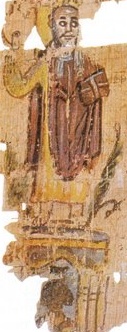
Saint
Theophilus of Alexandria
Patriarch of Alexandria
Patriarch of Alexandria from 385 to 412, known for his struggle against paganism and Origenism.
- Reposed
- 4125th century
- Place
- Egypt
- Order
- Hierarchs
Life
Theophilus of Alexandria was the twenty-third pope and patriarch of Alexandria, from 385 to 412, successor of the Holy Apostle and Evangelist Mark. He is remembered as a significant figure of Christianity in the late Empire, known for the firmness with which he opposed paganism and the teaching of Origen, and for his part in the downfall of Saint John Chrysostom. He is regarded as a saint in the Coptic Church and the Syriac Orthodox Church, where he is commemorated on 18 Paopi (28 October in the Gregorian calendar). His image is controversial, and the sources of his time often describe him harshly.
Beginnings
Little is known of his youth. He was probably born in Egypt in the middle of the fourth century and came to the throne of Alexandria in 385, after Timothy I. His nephew Cyril, whom he mentored, later succeeded him. He became patriarch in a time of great change: Christianity had recently gained the support of the emperors Constantine and Theodosius, and the city, home to many philosophical traditions, became the stage of great religious tensions. According to some sources he demanded full obedience from bishops, and put the disobedient in prison or exile; he had informers and tried to extend his power over the whole East, on the model of the pope in Rome. Fourteen canons composed by him are among the canons of the Orthodox Church.
The struggle with paganism
In 391, after several edicts of Theodosius I forbidding pagan worship and closing temples, Theophilus led at Alexandria the repurposing or demolition of pagan sanctuaries. According to Rufinus and Sozomen, he and his followers uncovered a pagan temple and publicly showed its cult objects in mockery; this provoked clashes between pagans and Christians, and the pagans withdrew into the temple of Serapis. Theodosius asked Theophilus to pardon the pagans but to demolish their temple. The destruction of the Serapeum, one of the most prominent temples of the city, was seen by Christian sources as a victory over idolatry, and modern scholars see it as part of the political and social tensions of Alexandria at that time.
The Origenist dispute and the Synod of the Oak
Theophilus at first supported Origen’s allegorical teaching, but in 399 he changed his view, joining the “Anthropomorphite” monks, who read the image of God literally. A synod at Alexandria condemned Origen’s writings and expelled the Origenist monks, among them the Four Tall Brothers, who sought shelter with John Chrysostom at Constantinople. In 403 Theophilus presided at Chalcedon over the “Synod of the Oak”, which deposed John Chrysostom, accusing him of insubordination and heresy, in part because he had sheltered the expelled Origenists. Gibbon called him an eternal enemy of peace and virtue.
Writings and death
Theophilus wrote much, but nearly all his writings survive only in fragments or translations; some of his prayers were translated into Ge’ez, the liturgical language of the Ethiopian Church, a sign of his influence. He died on 15 October 412 and was buried at Alexandria. His contemporaries also gave him the nickname “the Christian Pharaoh”, for his rule in two domains at once, the worldly and the spiritual.