Apostle
Thomas
The Apostle
One of the Twelve, who came to believe in Christ's Resurrection and preached in India.
Life
The holy Apostle Thomas, also called the Twin, was one of the twelve disciples of the Lord. The Church honours him for the confession he made before the risen Christ, "My Lord and my God", and for carrying the Gospel to the lands of the East as far as India, where, according to tradition, he received the crown of martyrdom.
Disciple of the Lord
The name Thomas comes from Aramaic and means "twin"; the Greek word Didymus, used in the Gospel of John, has the same sense. The Greek synaxarion says he came from a family of fishermen. The Gospel of John records him speaking three times. When the Lord resolved to go to Judea, to the tomb of Lazarus, although the Jews sought to kill Him, Thomas said to the others: "Let us also go, that we may die with Him." At the Last Supper he asked how they could know the way, and Christ answered that He is the Way, the Truth and the Life.
Doubt and confession
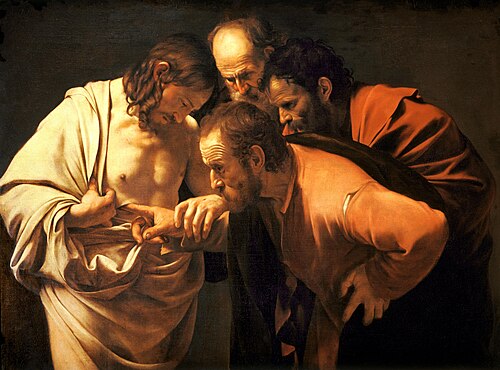
Thomas was not with the other disciples when the risen Christ first appeared to them. When they told him they had seen the Lord, he answered that he would not believe until he put his finger in the mark of the nails and his hand in His side. After eight days the Lord came again, the doors being shut, and bade him touch His wounds. Thomas worshipped and said, "My Lord and my God." Christ replied that he had believed because he had seen, but blessed are those who have not seen and yet believe.
The Greek synaxarion stresses that this answer teaches everyone who is tempted to doubt the truth of the Gospel. In the preaching of the Church, Thomas's hesitation confirmed faith in the Resurrection, for it drew from him the fullest confession of the divinity of Christ.
Preaching of the Gospel
After the descent of the Holy Spirit, according to tradition, Thomas preached among the Persians, Medes and Indians. Eusebius of Caesarea assigns him, with Bartholomew, to Parthia and north-western India, and the Syriac Didascalia, of the end of the third century, says that India received the apostolic ordinances from Judas Thomas. The Saint Thomas Christians of Kerala preserve the memory of his landing on the Malabar coast around the year 52 and of the communities he founded there. Historians disagree about these dates, and the Church keeps to what tradition hands down.
The Greek synaxarion relates that in India Thomas was seized by King Misdaeus because he had instructed and baptized the king's son Azanes, his wife Tertia, and her daughters Mygdonia and Narca.
Martyrdom
The king imprisoned him and then gave him to five soldiers, who led him up a mountain and killed him with spears. The Indian tradition places the place of death at Saint Thomas Mount near today's Chennai, in the year 72, and says that his body was laid in the ground at Mylapore. The oldest witness is Saint Ephrem the Syrian, who writes that the apostle was put to death in India and that his remains were carried to Edessa by a merchant. According to tradition, the greater part of the relics reached Edessa in 232. In 1258 a part was brought to Ortona in Italy.
The Greek synaxarion records that the head of the saint is kept at the monastery of Saint John the Theologian on Patmos, with portions of the relics at the Pantaleon monastery on Mount Athos, with the Coptic Patriarchate of Egypt, and in a Syro-Jacobite church at Mosul.
Veneration
The Church celebrates him on 6 October. On 30 June he is remembered in the Synaxis of the Twelve Apostles, and on 20 June at the deposition of the relics of the Apostles Andrew, Thomas and Luke, the Prophet Elisha and the Martyr Lazarus. The first Sunday after Pascha, a week after the Resurrection, is called the Sunday of Thomas and recalls the appearance of the Lord to him. Church tradition also links his name with the Cincture of the Mother of God, kept on 31 August, and with the icon of the Mother of God called the Arabian. In Iași there is a church dedicated to him.
Commemorated the same day October 6
- Sagaris of LaodiceaHieromartyr · Bishop of LaodiceaOct 6
 Michael SoyuzovHieromartyr · PriestOct 6
- AedhSaintOct 6
- Aurea of BovesVenerableOct 6
- Baoithin of Cluain da anSaintOct 6
- CalantiusVenerableOct 6
- CassianVenerableOct 6
- CeollachSaintOct 6
- ColmanVenerableOct 6
- DiurenSaintOct 6
 EnimiaRight-Believing · Devout ruler of Sainte-ÉnimieOct 6
- Epiphania of PaviaVenerableOct 6