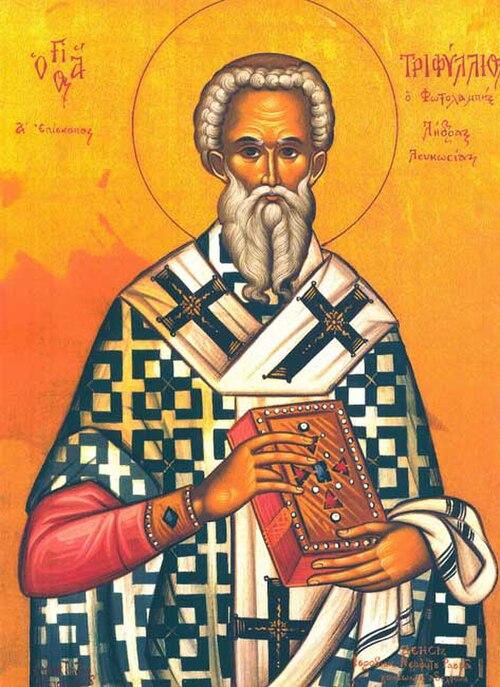
Saint
Triphyllius of Ledra
Bishop of Ledra in Cyprus
Born in Constantinople, he studied law at Beirut, converted to Christianity and became a bishop in Cyprus.
Life
Saint Triphyllius, bishop of Ledra (Lefkousia, today Nicosia) in Cyprus, lived in the fourth century, was a disciple of Saint Spyridon of Trimythous and a defender of the right faith. Saint Jerome counted him among the most eloquent men of the Church of his day. He fell asleep in the Lord around 370.
Youth and studies
His birthplace is not known for certain. Some say he was born in Constantinople, others think him a Cypriot. His parents, people of means, gave him a good education first at Salamis and Soloi in Cyprus, then sent him to the law school of Beirut. There he became a jurist and rhetor, stayed for a time to practise as an advocate, and became known in educated society for his gift of speech and his wisdom.
Disciple of Saint Spyridon
After the Edict of Milan in 313, which gave Christians religious freedom, Spyridon was released and resumed his ministry in Cyprus. Triphyllius then moved to the island and became his disciple, devoting himself to works of mercy. Spyridon ordained him first deacon, then priest, then bishop of Lefkousia, that is, of Ledra.
According to the life of Saint Spyridon, the two were summoned to Antioch by the emperor Constantius II, who was ill with a sickness the physicians could not cure. By tradition, the emperor saw in a dream an angel who showed him a gathering of hierarchs and pointed out two of them, saying that only through them would he find healing. Spyridon and Triphyllius came and healed him. With Spyridon he took part in 343 in the Council of Serdica. He was an ardent supporter of Saint Athanasius the Great of Alexandria against the Arians, by whom he was persecuted.
Ministry in Cyprus
In Cyprus he preached the word of God and built two monasteries, one for monks and one for nuns. Beside the monks' monastery he laid out a cemetery, where he was buried. Tradition describes him as merciful, pure in thought and a great ascetic, who governed the Church well. He died a natural death around 370.
Relics and veneration
When the Saracens invaded Cyprus around 640, his relics were partly burned, but the saint's head was preserved and is kept today in the Greek church in Nicosia. The saint is commemorated on 13 June.
Commemorated the same day June 13
 Aquilina of ByblosMartyr · Child martyr of ByblosJun 13
 Alexandra MelgunovaVenerable · Founder of the Diveevo communityJun 13
 Andronicus of MoscowVenerable · First abbot of Andronikov MonasteryJun 13
- Sava of MoscowVenerable · Abbot of Andronikov MonasteryJun 13
- Antipater of BostraSaint · Metropolitan of BostraJun 13
- Alexis ArkhangelskyHieromartyr · PriestJun 13
- Andronicus of RadonezhVenerableJun 13
- Anna of BithyniaVenerableJun 13
- AventinMartyrJun 13
- Branko BilanovićNew Martyr · Martyr of Žitomislić MonasteryJun 13
- Cairell of Tir RoisSaintJun 13
 Cetteus of AmiternumHieromartyr · Bishop of AmiternumJun 13