Venerable
Andronicus of Moscow
First abbot of Andronikov Monastery
Disciple of Saint Sergius of Radonezh and first abbot of the Spaso-Andronikov Monastery in Moscow, who died in 1373.
- Feast
- June 13old style June 26
- Reposed
- 137314th century
- Order
- Venerables
Life
Saint Andronicus of Moscow (Spassky, 1320s - 13 June 1373) was the first abbot of the Spaso-Andronikov monastery in Moscow and a disciple of Saint Sergius of Radonezh. The Russian Orthodox Church venerates him as a venerable saint. He was canonized toward the end of the fifteenth century, and in 1981 his name was entered in the Synaxis of the Saints of Radonezh. He is commemorated on 13 June, on 6 July (the saints of Radonezh) and on the second Sunday after Pentecost.
Life
Andronicus came from the Rostov region. The basic sources are the Life of Saint Sergius of Radonezh and the Life of Saint Metropolitan Alexis, written by Pachomius the Logothete. It says there that a boy came to Sergius and received from him, around 1353, monastic tonsure. For many years he was under the guidance of this great teacher of Orthodoxy, distinguished by the labors of fasting, prayer, humility and obedience (the Serbian source).
The date of death is usually given only approximately in the biography of Andronicus, but according to the Menologion of Simon (Azarin), he died on 13 June 1373. Once Metropolitan Alexis visited Sergius, and the thoughtful monk pleased him and he took him to Moscow, assigning him to establish the community of the All-Merciful Savior, seven versts from the Kremlin, on the river Yauza. In 1361 a church was built, consecrated by the metropolitan in honor of the Image of the Savior Not Made by Hands, around which the monastery then grew. According to the Russian Biographical Dictionary of A. A. Polovtsov, in this monastery, under the shelter of Andronicus, were his successor as head of it, Saint Sabbas the abbot, and the icon painters Andrei Rublev and Daniel Chorny, known later.
Canonization and relics
Andronicus of Moscow was canonized toward the end of the fifteenth century, although Saint Joseph of Volokolamsk, in his "Answer to the inquisitive and brief narrative of the holy fathers who were in the monasteries of the Russian land" (1507), gives Andronicus as one of the most venerated Russian saints. He was buried in the cathedral of the Savior of the monastery. In 1812 the French plundered the monastery, but the relics remained untouched; the head, however, disappeared. After 1917 the relics too disappeared. As a result of archaeological research in 1993, under the ancient altar of the Savior cathedral the oldest burials were found, attributed by the scientific leader of the excavations, Professor Oleg Ulyanov, to the founders of the monastery, Andronicus and Sabbas of Moscow. In 1981 his name was entered in the Synaxis of the Saints of Radonezh.
Iconography
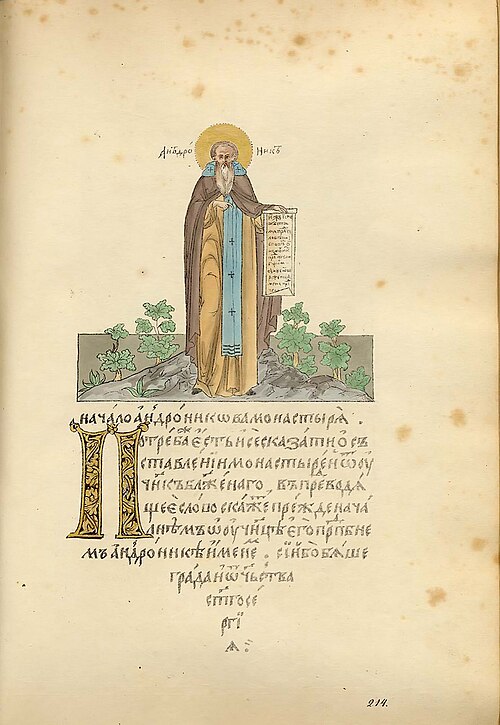
The earliest depiction is, by all signs, on the icon "Saint Alexis, Metropolitan of Moscow, with nineteen scenes from his life" by the icon painter Dionysius, of the late fifteenth century, in two scenes: Saint Alexis asks Saint Sergius for Andronicus for the abbacy of the Savior monastery, and Saint Alexis blesses Andronicus for the abbacy. Andronicus is shown here in monastic dress, but bareheaded, with a short fair beard. There are miniatures with Andronicus in the illustrated Life of Saint Sergius. Andronicus of Moscow is shown on the medallion-icon "The Tree of the Muscovite State" by Simon Ushakov (1668), with a scroll in hand, and on the icon "Synaxis of the Saints of Radonezh" in the Dormition cathedral. From the Andronikov monastery an icon of the venerable Andronicus and Sabbas of Moscow of the second half of the nineteenth century has survived, in which Andronicus is an old man in a mantle, with a long beard and the left hand with a prayer rope pressed to the chest. In the 1980s-1990s several icons of him appeared, painted by Moscow icon painters; in 1995, for example, the abbot, Archpriest Vyacheslav Savinykh, painted for the Savior cathedral the temple icon of the venerable Andronicus and Sabbas of Moscow.
Commemorated the same day June 13
 Aquilina of ByblosMartyr · Child martyr of ByblosJun 13
 Triphyllius of LedraSaint · Bishop of Ledra in CyprusJun 13
 Alexandra MelgunovaVenerable · Founder of the Diveevo communityJun 13
- Sava of MoscowVenerable · Abbot of Andronikov MonasteryJun 13
- Antipater of BostraSaint · Metropolitan of BostraJun 13
- Alexis ArkhangelskyHieromartyr · PriestJun 13
- Andronicus of RadonezhVenerableJun 13
- Anna of BithyniaVenerableJun 13
- AventinMartyrJun 13
- Branko BilanovićNew Martyr · Martyr of Žitomislić MonasteryJun 13
- Cairell of Tir RoisSaintJun 13
 Cetteus of AmiternumHieromartyr · Bishop of AmiternumJun 13