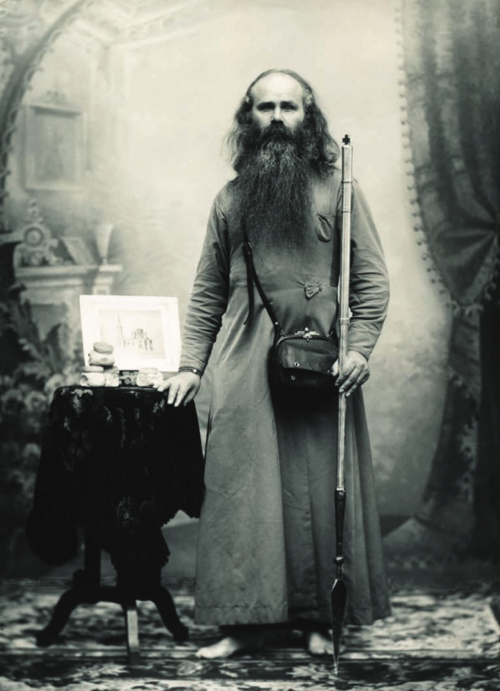
Saint
Vasily the Barefoot
Wanderer
Russian wanderer of the late 19th century, loved for his charitable deeds, who died in 1933.
- Reposed
- 193320th century
- Place
- Nadeschda
Life
Vasily the Barefoot, whose real name was Vasily Filippovich Tkachenko, was a Russian wanderer of the late nineteenth and early twentieth centuries, known among the people as Vasya the Barefoot. He crossed the Russian Empire barefoot, gave alms, fought against drunkenness and foul language, and collected money for a church in his native village. He was received by the imperial family and corresponded with its members for years about the building of this church. He reposed in 1933 in the village of Nadezhda in the North Caucasus.
Childhood and healing
He was born between 1856 and 1858 in Chernihiv province into a prosperous Cossack family, though he himself claimed peasant status, and a certificate of the Holy Synod of 1903 also calls him a peasant. He is said to have been the youngest of the sons.
At the age of nine he fell gravely ill: sores that would not heal appeared on his hands and feet, according to other accounts all over his body. When he was eighteen his parents vowed to go and venerate the relics of the saints, and the young man was healed, but they never fulfilled their vow. Soon afterwards the family moved to the village of Nadezhda in Stavropol province.
There Vasily worked as peasants work: he herded pigs, ploughed the land and drove for the post station. In 1877 he married, but after a time, for reasons unknown, he separated from his wife and left his only child, aged six, in the care of relatives. The separation was legally completed only in 1890. He then worked as a cab driver and coachman, and later as a drover for a merchant, driving a herd to Moscow. A local historian believed that his miraculous healing had marked him deeply, and that he made the journey to Moscow barefoot and almost unclothed, to harden body and soul.
Soldier and disciple
From Moscow he went to Saint Petersburg, where on 17 June 1884 he was enlisted as a private in the Life Guards Jäger Regiment. After only three months he fell seriously ill and was taken to hospital, and in October of that year he was declared unfit and discharged.
He then set off on foot for the Kyiv Caves Lavra, seeking his way in life. In Kyiv he met Archimandrite Jonah, superior of the Holy Trinity Monastery, whom the Russian Church later numbered among the saints. All the sources agree that Saint Jonah blessed him to take up the life of a pilgrim. Vasily first wished to become a monk and for a time carried out obediences in the monastery as cell attendant, tailor and coachman, but illness and the desire to raise money for a church in his village led him to give up the idea. A biography printed in 1903 places the meeting with Saint Jonah before his army years and says he became a wanderer only after working for a while in private service.
The years of wandering
At first his way of life aroused the unease and incomprehension of church authorities. In 1894-1895 he was sent out of Saint Petersburg under escort for begging, and a Synod certificate of 1903 attributed his wanderings to "religious mania". Beggars saw him as a dangerous rival, tried to drive him from church porches and beat him several times. In 1896 the Kyiv police confiscated his staff, which was later returned to him at Peterhof.
On his journeys he prayed for the faithful, gave out lives of saints, books and edifying pamphlets, and urged people to give up drink and foul language and turn their thoughts to God. In the fourth year of his wanderings he badly frostbit his feet, was taken to hospital and even received holy unction, as death was expected. He carried a heavy iron staff with a silver cross at the top.
A biographer of the time wrote that Vasily stood out among the Russian wanderers at the turn of the century for his moral strength, which amazed everyone who met him even once. Present-day scholars note that wandering was for him a vow: a man left family and property and sought the salvation of his soul through the hardship of the road and the veneration of holy places.
The church at Nadezhda
In 1897 Vasily announced that he was collecting money for a new stone church in his village. At first he wished to dedicate it to the coronation of the emperor, to the Sign icon of the Mother of God and to Saint Alexandra the Empress. It is said that he had been personally invited to the coronation. Later it was decided to dedicate the church to Saint Nicholas in honour of the birth of the heir to the throne. He gathered the money on his travels. In 1906 the foundation was laid, the design approved, the materials gathered and the bells cast.
The church was completed in 1910 and consecrated on 5 December of that year. It stood on a rise at a crossroads, with five domes and two side chapels dedicated to Saint Seraphim of Sarov and Saint Alexis of Moscow. It had a fountain for the blessing of water and for baptism, and the square before it was paved with cast-iron slabs. It held 1,500 worshippers in a village of some 7,500 souls, and was considered one of the most beautiful churches of the Stavropol region. Vasily also built a hostel for pilgrims in the village.
Ties with the imperial family
His correspondence with the imperial family about the building of the church has survived. He wrote most often to the Dowager Empress Maria Feodorovna, who helped him obtain the necessary permits and documents, but he also wrote to Nicholas II and Empress Alexandra. He sent them gifts as well. At his initiative an icon of the saints of the Russian Church who shone forth from every rank of society was painted for the assembly hall of the State Duma, and he presented the heir to the throne with an icon of Saint Alexis, Metropolitan of Kyiv and All Russia.
In 1903 he attended the canonisation of Saint Seraphim of Sarov. He reached Sarov with the train of the court stables, entered the town in a court carriage along with the imperial procession, and had the honour of greeting and kissing the hands of the two empresses, the wife and mother of the emperor. He gave the monastery a silver-gilt lamp made to an original design at a cost of 1,200 roubles. In 1913 he was in Moscow for the canonisation of Saint Patriarch Hermogenes.
In Saint Petersburg he usually stayed at the city dependencies of the Kyiv and New Athos monasteries. Together with Matrona the Barefoot he collected money for the church of the "Joy of All Who Sorrow" icon with the coins, destroyed in Soviet times. He knew Saint John of Kronstadt and Matrona of Petersburg, and in 1911 he attended her funeral and was one of the founders of the society dedicated to her memory. Among his friends was also the hieromonk Iliodor, a man of turbulent career.
Two biographical pamphlets about him were printed in his lifetime. He was photographed by the great photographers of the day, among them Karl Bulla and the studio that worked for the imperial family, and his unusual appearance, with silver locks, soft beard and bare feet, drew the attention of writers and high society. Some Soviet historians wrote that after the murder of Rasputin he was sought out again in the salons of Petrograd, relying on newspaper reports of January 1917.
The Revolution
In March 1917 a Petrograd newspaper reported that the staff of Vasya the Barefoot, weighing about 16 kilograms and bearing an inscription, had been handed over to the Extraordinary Investigative Commission, which had decided to take it from him so that he could not use it for "agitation among the dark masses". He was last seen in Petrograd in 1918. He was arrested for a time for wearing on his chest the badge of the Union of the Russian People, which he did not remove even after the revolution.
The writer Alexei Demidov related in his recollections of Maxim Gorky that he had seen Vasily under arrest in the Tauride Palace, standing barefoot, with his white beard and his staff with the silver cross, among the other prisoners lying on the floor, like the Apostle Peter among the first Christians. Gorky then reportedly showed him a photograph said to show Vasily at a carousal with Rasputin, as the reason for his arrest. Demidov portrayed him again, arrested and silent, in his novel about the year 1917.
Repose
The documents about Vasily stop in 1917, and of his last years we know only from recollections written much later. According to one, he died of old age while working as a watchman at the storehouse into which the church built with his money had been turned. According to another, he died of hunger.
A relative of his, then a child of six, remembered that the church had already been completely looted and laid waste. Grandfather Vasily came to their house, washed, put on clean clothes and towards evening went to pray in the Church of the Sign. He was joyful and seemed to shine. The next morning some nuns living in the village came and said they had found him in the church, on his knees, dead.
The death certificate states that he died at home on 6 February 1933 of the frailty of old age. Soon after his death the church was blown up. He was buried in the cemetery of the village of Nadezhda, where his gravestone survives with an almost illegible inscription. His life was studied anew at the beginning of the twenty-first century, when a book and several studies were devoted to him.