Saint
Vera the Silent
Of Syrkov Convent
An ascetic of silence, who reposed in 1861 at Syrkov Convent near Novgorod; venerated by the faithful, not formally canonized.
- Reposed
- 186119th century
- Place
- Syrkov Convent, Novgorod
Life
Vera the Silent (died 1861) was an ascetic recluse at the Syrkov Convent in the Novgorod region, who kept silence for twenty-three years. She is venerated by the faithful and by some Orthodox groups, without official canonization; she died on 18 May (30 May) 1861.
An unknown woman who called herself Vera Alexandrovna appeared at Tikhvin in 1834. She never spoke of her past and gave no surname, but her piety and scrupulous keeping of the commandments earned respect. She was often seen praying at the Tikhvin Monastery of the Mother of God before the Tikhvin icon, and made pilgrimages to the surrounding monasteries. After three years she left to nurse a sick woman in the Olonets province, then returned and left again, weary of the attention people paid her. She settled in the village of Berezovsky Ryadok near Valdai, in a small cottage, where she received only children, drew for them images of Christ and the Mother of God and taught them prayers and reading. The police grew suspicious and in 1838 she was arrested for lack of a passport. At Valdai, asked about her name and origin, she replied, according to legend: if judged by heaven, I am dust, if by earth, I am above you. After that, for twenty-three years, until her death, she never opened her mouth, answering rarely by notes or fragments of phrases.
Thought mad, she was held a year and a half in the prison at Novgorod and then a year and a half in the asylum at Kolomovo, where she wrote "The Lament of the Mother of God at the Passion of Her Son." Countess Anna Orlova-Chesmenskaya found her there and offered her a home at Syrkov Convent. By a decree of the Novgorod consistory of 10 April 1841 she was received into the convent at the countess's expense. She was received at first with hostility; the abbess asked Metropolitan Seraphim of Petersburg to expel her, but did not obtain it.
She lived in a cell-cottage with a single room, with a small bookcase, a lectern with Scripture, a samovar, two chairs, a bed and a cuckoo clock. Her cell icon was Christ in bonds, before which she kept an unquenched lamp. She slept on a bed covered with thin felt, with logs along the sides, like a kind of coffin. She confined her life to the cell and the church; she confessed by notes which her confessor, Father John Lebedev, burned in a candle flame. She gave most of her food to the poor and to the birds and made small paper boxes, decorated with crosses and texts from Scripture, which she gave to visitors. The faithful regarded her as having foresight, especially about the death or recovery of sick children.
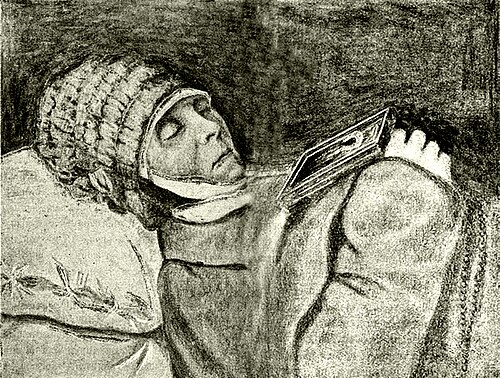
She died on 18 May (30 May) 1861. Healings and signs are told of her grave; she is said to help above all parents who pray for their children. She became famous through the legend that identified her with Empress Elizabeth Alexeievna, the wife of Alexander I, supposed to have lived on as the elder Fyodor Kuzmich; this identification is not supported by sure evidence. A troparion and a prayer have been composed for her as "the righteous Vera of Novgorod," not adopted officially by the Church.