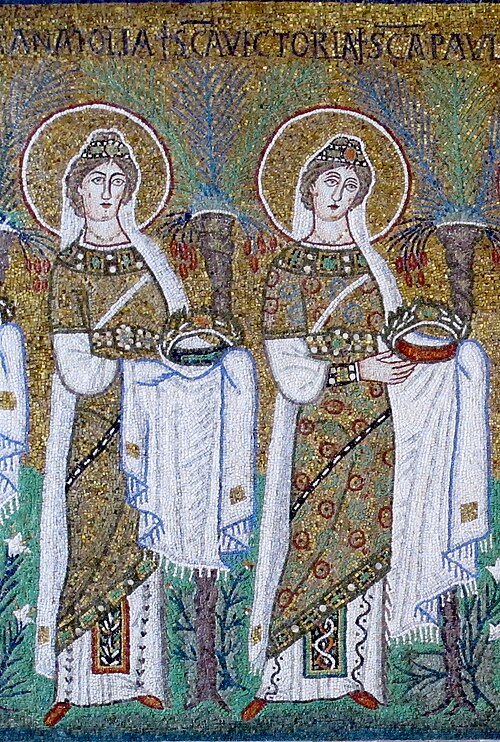
Holy Martyrs
Victoria, Anatolia and Audax
Martyrs venerated by both the Orthodox and the Catholic Church.
- Era
- unknown
- Order
- Martyrs
Life
Holy Martyrs Victoria, Anatolia and Audax were Roman martyrs, put to death in the time of the emperor Decius, around 250. They are venerated as martyrs and saints by the Catholic Church and the Orthodox Church. The sources give the commemoration on 9 July, 10 July, 19 December and 23 December. The record gives no day.
Saints Victoria and Anatolia (without Audax) are commemorated in the Roman Martyrology on 10 July. Saint Anatolia is first mentioned in De Laude Sanctorum, composed in 396 by Saint Victricius, bishop of Rouen (330 to 409). In the Hieronymian Martyrology, Anatolia and Victoria are commemorated together on 10 July, and Saint Victoria is also commemorated on 19 December, in the city of Trebula in the Sabine country. The two saints are depicted in the mosaic of the church of Sant'Apollinare Nuovo in Ravenna, between Saints Paulina and Christina. The Passion of Saints Anatolia and Audax and of Saint Victoria, of the sixth or seventh century, in which the name of Audax was added, is mentioned by Aldhelm (died 709) and by Saint Bede (died 735), who listed saints in their martyrologies. Caesar Baronius mentions Saints Anatolia and Audax on 9 July, and Saint Victoria on 23 December.
According to tradition, in the time of the emperor Decius, the sisters Anatolia and Victoria were to marry noble Romans who were not Christians. The holy virgins opposed the marriage, and their prospective bridegrooms denounced them for the Christian confession. The bridegrooms received from the authorities permission to confine the girls in their estates and to persuade them to renounce faith in Christ. Saint Anatolia's betrothed, Titus Aurelius, gave way and handed her back to the authorities. Saint Victoria's betrothed, Eugenius, proved more persistent, but in the end he too returned his bride to the authorities.
According to Holy Tradition, Saint Victoria was pierced with a spear in the heart in the year 250 at Trebula Mutuesca (today Monteleone Sabino). Tradition says that her murderer was struck at once with leprosy and died in six days. Saint Anatolia was killed also in the year 250 at Thora (identified with today's Castel di Tora). Tradition says that she was first shut in with a venomous snake. Since the snake did not bite her, the soldier Audax was sent into the cell where the saint was, to kill her. The snake attacked Audax, but Anatolia saved him. Impressed by her example, the soldier Audax believed in Christ and was, together with Saint Anatolia, put to the sword.
Through the translation of relics, the veneration of the saints spread throughout Italy. The body of Saint Victoria was moved in 827 by the abbot of the monastery of Farfa, Peter, to Mount Matenano, in Piceno, because of the invasion of the Moors. In her honour the town of Santa Vittoria in Matenano is named. Ratfred, later abbot of Farfa, moved the body to his monastery on 20 June 931. The bodies of Anatolia and Audax were moved by the abbot Leo to Subiaco around 950; at an unknown date the shoulder of Saint Anatolia was taken to present-day Anatoli, and her hand to Esanatoglia. The bodies of Saints Anatolia and Audax still remain at Subiaco, not far from the basilica of Saint Scholastica (under the altar of the Blessed Sacrament, with the feast on 9 July). The surviving relics of Saint Victoria are now displayed in the church of Santa Maria della Vittoria in Rome.