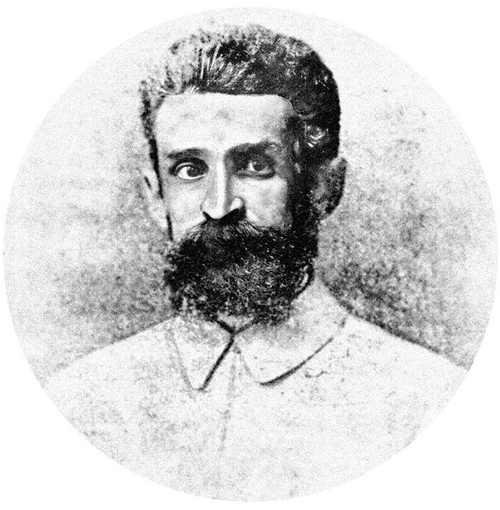
Martyr
Vladimir Klevezal
Physician and religious thinker
Russian physician and religious thinker, born in Kasimov in 1864 and died in 1927 at Tuma; a new martyr.
- Reposed
- 192720th century
- Place
- Russian Socialist Federative Soviet Republic
- Order
- Martyrs
Life
Vladimir Pavlovich Klevezal was a zemstvo doctor, religious thinker, spiritual writer and churchman, a nobleman of monarchist convictions, a lay member of the Local Council of 1917 to 1918 and counted among the New Martyrs of the Russian Church for what he endured in Soviet times. Born on 9 (21) July 1864 at Kasimov, he died on 30 May 1927 at Tuma, in the Ryazan region. A rumour spread about his end that he was shot, but he seems to have died of cancer of the oesophagus.
Family and medicine
He was the son of Colonel Pavel Nikolaevich Klevezal and Glafira Dmitrievna, née Rykachova. He attended the Third Moscow Classical Gymnasium and in 1888 the medical faculty of Moscow University. Still a student, under the influence of F. F. Erisman, he decided to serve in the countryside and worked in vacations in the Moscow district beside the well-known zemstvo doctors N. D. Kuznetsov and I. I. Orlov. After graduating he was for a year and a half assistant in the Solnechnogorsk clinic of the surgeon I. I. Orlov, where he received good preparation for working alone. At the end of 1889 he was engaged as zemstvo doctor in his native district, Kasimov.
From 1890 to 1902 he was zemstvo doctor in the Kasimov district, at Tuma. In 1893 the zemstvo assembly adopted, on his report, a resolution to set up a medical-sanitary bureau. Through his labour the hospital at Snokhino (the Tuma hospital) was built after a fire, where the doctor developed a lively surgical work and organized the matter by the principles of Moscow zemstvo medicine. His duties included not only running the hospital and receiving the sick, but urgent calls, preventive checks on the population and much else. From 1914 to 1916 he also ran the infirmary of the Tuma fire brigade. He was a member of the Ryazan Medical Society in 1908 to 1910. Taking only twenty kopecks for a visit, his affairs went well; though the zemstvo hospital was near his home, he had daily twenty-five to thirty patients. After twelve years, from disagreements of principle with the administration, he left the service, but stayed at Tuma as a free-practising doctor among the peasants and railway workers, and gave this work the last twenty-five years of his life, with the people's love and support. Beside his clinic a society for the blind made a small infirmary, where he performed the main operations. His work is shown by the half a million patients received in thirty-nine years. He also opened at Tuma a meteorological station, which still works, though moved, since he thought there was a link between climate and disease.
Service in the Church
He was known for his work in zemstvo circles and received several offers to move to large centres, but would not leave the people he had grown used to. Between medical work he found time also for public work: he held popular readings, medical talks, took part in doctors' congresses, and at the Sixth Pirogov Congress gave a paper "On Specialization in Zemstvo Medicine". He wrote notes and articles in the press and was a well-known public figure and religious thinker. As an active member of the Brotherhood of Saint Nicholas, he took part in organizing a book depot, gave courses on medicine and hygiene, helped at feasts and at useful gatherings for the people of the parish, gave special attention to children and helped the poor. He was himself a great benefactor, and the Ryazan Diocesan Gazette often wrote of him. As a publicist, he described in detail concrete events, the thinking and the contradictions among the strata of the population, and his writings help in studying the history of the Holy Trinity church at the end of the nineteenth and beginning of the twentieth century.
As a lay member of the Local Council, elected from the Ryazan diocese, he took part in the election of the patriarch and in discussing possible changes in the liturgy after the killing of the tsar. He took part in the first and second sessions, was secretary of the eleventh section and member of other sections. In spring 1919 the Missionary Council decided to widen the circle of authors who were to refute the most popular arguments of anti-religious agitators; Mikhail Novoselov, Professor Leonid Pisarev and Vladimir Klevezal were to write of the merits of the Church and clergy toward the people.
Arrest and end
A message was sent to the Council from the rector of the Holy Trinity church at Nikolaevskaya Tuma: on the evening of 2 (15) September 1918 Vladimir Pavlovich Klevezal was hurriedly taken to Kasimov, probably into prison; the reason was not known. Two searches had preceded the arrest, in the second of which his correspondence with his wife from when she was his fiancée was found, with silver spoons and coins. Asked about his party, he answered that he was a monarchist. Perhaps he was arrested in connection with the parish meeting of 29 April, at which he had been chairman and at which the parishioners had resolved to defend church property; the parish council presented to the volost assembly a statement with his signature and for this he, with other members, was under investigation. The accusation that he had been chairman of the Brotherhood of the Archangel Michael was not true.
In Soviet times his religious and educational work aroused the authorities' fears, and he was left practically without the possibility of working in his profession. Information on that period is scant; it is known that in May 1925 he was elected honorary member of the Ryazan Medical Society and gave a speech, "Medicine as a Ministry of Love". This was his swan song: in July 1926 a narrowing of the oesophagus was found, and in October an X-ray examination showed it to be cancerous. His fate long remained unknown and it was said that he was shot, but he died, it seems, on 30 May 1927, at Tuma, of cancer of the oesophagus, and was buried on 2 June in the local cemetery. His obituary says that his life and person "can serve as an example of selfless fulfilment of medical and human duty and of unchanging fidelity to the ideals of youth". His wife was named Vera Antonovna; they had no children, but they had many godchildren at Tuma. In 2024 a monument to Archpriest Stefan Ostroumov and to his friend and companion, Vladimir Pavlovich Klevezal, was unveiled at Tuma.