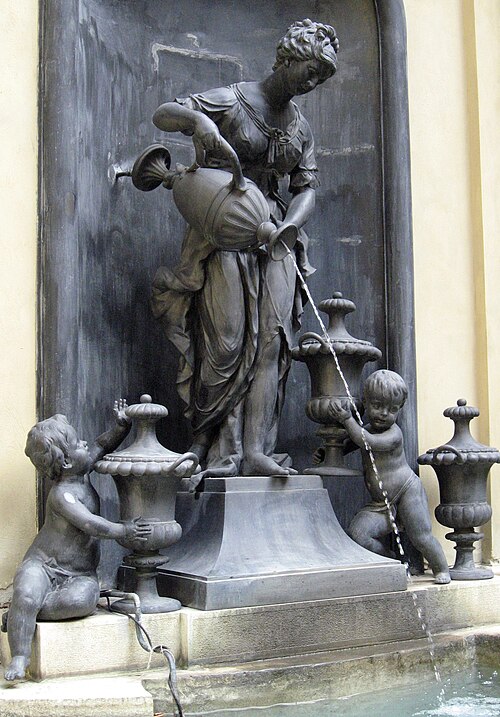
Righteous
Widow of Zarephath
Hostess of the prophet Elijah
Woman of Zarephath who sheltered the prophet Elijah; her son was raised through his prayer.
- Era
- unknown
- Order
- The Righteous
Life
The Righteous Widow of Zarephath (also called Sarepta or Sarafthia, in some Russian texts Saraffia) is a woman of the Old Testament, not named in Scripture, to whom the prophet Elijah was sent in the time of famine. She received him into her house, and by the prophet's word the flour in the jar and the oil in the cruse did not fail; later, at Elijah's prayer, her dead son was raised. The Orthodox Church honors her among the forefathers of Christ and the righteous of the Old Testament, on the Sunday of the Forefathers before the Nativity.
In Scripture
Her story is in the Third Book of Kings, chapter 17. She was a widow and lived in the city of Zarephath (modern Sarafand, in the region of Sidon) with her son. The prophet Elijah was at the brook Cherith (Chorrath) and from there received the command of God to go to Zarephath of Sidon, where a widow would feed him. Elijah went and found the woman gathering sticks. He asked her for water and, before she went away, asked her also for a piece of bread. She answered that she had nothing baked, only a handful of flour in the jar and a little oil in the cruse, that she was gathering two sticks to prepare it for herself and her son, and that they would eat and die; in such want they were. Elijah told her not to fear, to do as she had said, but first to make him a small cake and bring it to him, and afterward to prepare for herself and her son, for thus says the Lord God of Israel: the flour in the jar shall not be spent and the oil in the cruse shall not fail, until the day the Lord gives rain on the earth. The widow did as Elijah said, and she, he and her house ate for some time; the flour was not spent and the oil did not fail, according to the word of the Lord spoken through Elijah.
The raising of her son
Later the son of the woman, mistress of the house, fell sick, and his illness was so severe that no breath was left in him, which is usually understood as death (some have also proposed a severe coma). She said to Elijah: "What have I to do with you, O man of God? Have you come to me to bring my sins to remembrance and to kill my son?" Victor H. Matthews supposes that the woman uses sarcasm meant to make the prophet feel shame, being the cause of her son's death; by raising him Elijah regains his honor and authority. In Orthodox tradition and commentary these words are understood rather as an urging of the prophet than as irony.
Elijah said to her: "Give me your son". He took him from her arms, carried him up to the upper room where he lived and laid him on his own bed. He cried to the Lord: "O Lord my God, have you brought evil even on the widow with whom I stay, by killing her son?" Stretching himself three times over the child (according to the Russian text), or, in the Greek translation of the Septuagint, breathing three times on the child, he called on the Lord: "O Lord my God, let this child's soul come into him again". The Lord heard the voice of Elijah and the soul of the child returned into him, and he revived. Elijah took the child, brought him down from the room into the house and gave him to his mother, saying: "See, your son lives". The woman said to Elijah: "Now I know that you are a man of God and that the word of the Lord in your mouth is truth". Commentators note parallels between this account and the raising of the son of the widow of Nain in the Gospel of Luke.
The mother of the prophet Jonah?
Blessed Jerome, in his commentary on the prophet Jonah, mentions the Hebrew tradition that Jonah was the son of the widow of Zarephath raised by Elijah. The explanation is that the name of Jonah's father, Amittai, resembles the Hebrew word for truth, and the widow, after the raising of her son, says: "the word of the Lord in your mouth is truth". The tradition is found in Midrash Tehillim 26, 220, in the Jerusalem Talmud (Sukkah 5) and in Midrash Rabbah on Genesis 98. Judaism has another tradition as well, by which Jonah was the disciple of the prophet Elisha. The Russian source says that both traditions, which link Jonah to the great prophets of Israel, Elijah and Elisha, are accepted by the Orthodox Church and included in the service of the prophet. Luther also mentions the tradition, but adds that he does not believe it, since Jesus says that the widow was a Gentile, while Jonah says he is a Hebrew.
Jewish tradition
Apart from the identification as mother of Jonah, Jewish tradition keeps other details. Elijah was sent to the widow so that he might know the hunger that tormented the people (Sanhedrin 113a); the hospitality shown to Elijah merited the raising of her son (Song of Songs Rabbah 2:5:3). The rabbis attribute to this woman the verse from the "Woman of Valor" (Proverbs 31:20): "She opens her hand to the poor and reaches out her hands to the needy", because she fed Elijah. The miracle of the flour and oil, which suffice and do not run out, is connected with Proverbs 10:22. When her son fell ill, the widow is said to have told him, according to Pesikta Rabbati, chapter 3: "Until you came to me, God weighed my deeds against those of the local people and I was found worthy. Now that you, the righteous one, have come to me, God weighs my deeds against yours, so you have recalled my sins to me, and [therefore] my son died".
In the Church
The Greek source says that the Orthodox Church honors her as a saint (the Righteous Sarafthia) and keeps her memory on the Sunday before the Nativity, the Sunday of the Forefathers. In the New Testament Jesus mentions her in Luke 4:26: after three years and six months of drought and famine, Elijah was sent, among so many widows, only to the one at Zarephath; the verse is read on the Monday of the third week of Great Lent. In the Epistle to the Hebrews 11:35, the words "women received their dead by resurrection" are interpreted as referring to the son of the Shunammite and the son of the widow of Zarephath.
Saint John Chrysostom, in his "Homily on the Apostle Peter and the Prophet Elijah" (Migne, P.G. 50, 728-735), praises the widow of Zarephath and exalts her hospitality, endurance and virtue; he too mentions that Elijah was sent to her because in his seclusion at Cherith he did not know that the world was suffering from famine. Saint Gregory Palamas mentions Sarafthia in his homily for the third Sunday of Luke. The Great Canon of Saint Andrew of Crete (Wednesday of the first week of Great Lent, at Great Compline, ode seven) says: "Heaven has been shut to you, O soul, and God's famine has overtaken you, when you did not obey the words of Elijah the Tishbite, like Ahab, but, becoming like the woman of Zarephath, feed the prophetic soul". In the Hermeneia of Dionysius of Fourna she is called "the righteous Sarafthia, to whom the prophet Elijah was sent, an aged widow". In art the subject is seen in the paintings of the synagogue of Dura-Europos.