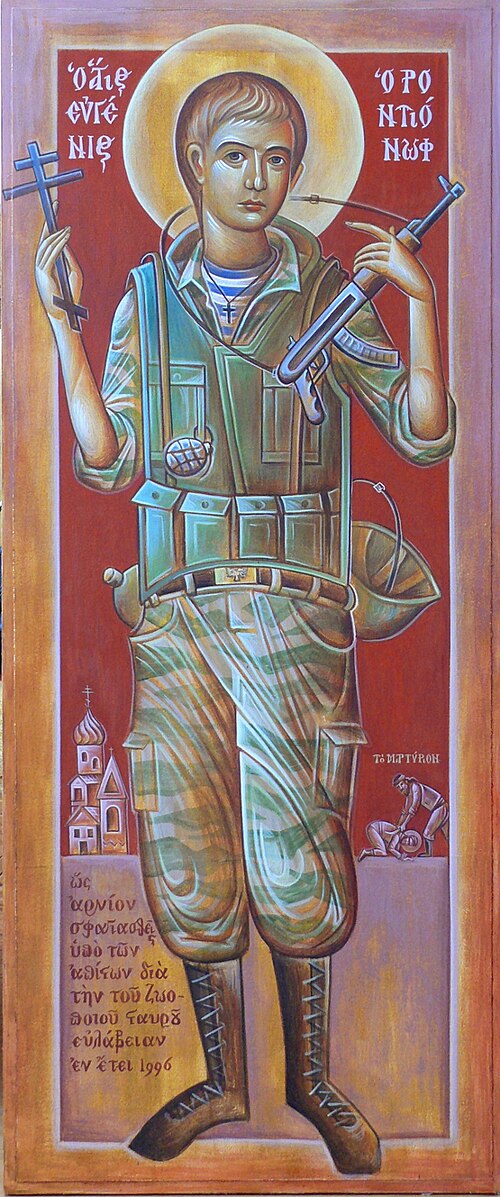
New Martyr
Yevgeny Rodionov
Russian soldier
Russian soldier captured in the First Chechen War and executed in captivity in 1996, aged nineteen.
- Reposed
- 199620th century
- Place
- Chechen Republic of Ichkeria
- Order
- Martyrs
Life
Yevgeny Rodionov was a nineteen-year-old Russian soldier, taken prisoner in the First Chechen War and killed in captivity on 23 May 1996. He is honoured by many Orthodox believers as a martyr, although the Russian Orthodox Church has not officially canonised him.
He was born on 23 May 1977 in the village of Chibirley, Penza region, to Aleksandr Konstantinovich, a carpenter and furniture maker, and Lyubov Vasilievna, a specialist in furniture technology. He was baptised at the age of one. He wore no cross until 1988 or 1989, when his grandmother took him to church and he was given one; his mother disapproved, but Yevgeny never took it off, only replacing the chain with a cord. His parents separated when he was about six or seven, and the boy grew up with his mother at Kurilovo in the Moscow region. After nine years of school he worked at a furniture factory and trained as a driver.
He was called up on 25 June 1995 into the border troops and took the oath on 10 July. He served as a grenade launcher operator and in January 1996 was sent to the border unit at Nazran, on the border with Chechnya. In February 1996, while on guard on a road with privates Andrey Trusov, Igor Yakovlev and Alexander Zheleznov, he stopped an ambulance carrying weapons, driven by the Chechen general Ruslan Khaikhoroev. The four soldiers were overpowered by a dozen fighters and taken prisoner. At first they were thought to be deserters. His mother, Lyubov, went to Chechnya to look for him. According to her, Khaikhoroev later admitted, before an OSCE representative, that Yevgeny could have lived had he changed his faith, but he refused to take off his cross. On 23 May 1996, the day he turned nineteen, he was beheaded near the village of Bamut. His mother found the body after paying a large sum, and the account of his end is not confirmed by other independent sources. He was buried near Moscow, at the church of the Ascension near the village of Satino-Russkoye; his father died a few days after the burial.
He was posthumously awarded the Order of Courage. Veneration of him spread widely among the people: icons of him are placed in many churches in Russia, in Chișinău, Frankfurt and Tacoma, and many believers tell of myrrh streaming from them. In 2003 the priest Alexander Shargunov proposed his canonisation, but the synodal commission rejected it in 2004, for lack of data on a martyr's death in the church sense. Local veneration continues, especially in Serbia; in 2010 a monument to him was raised at Kuznetsk, in the Penza region.