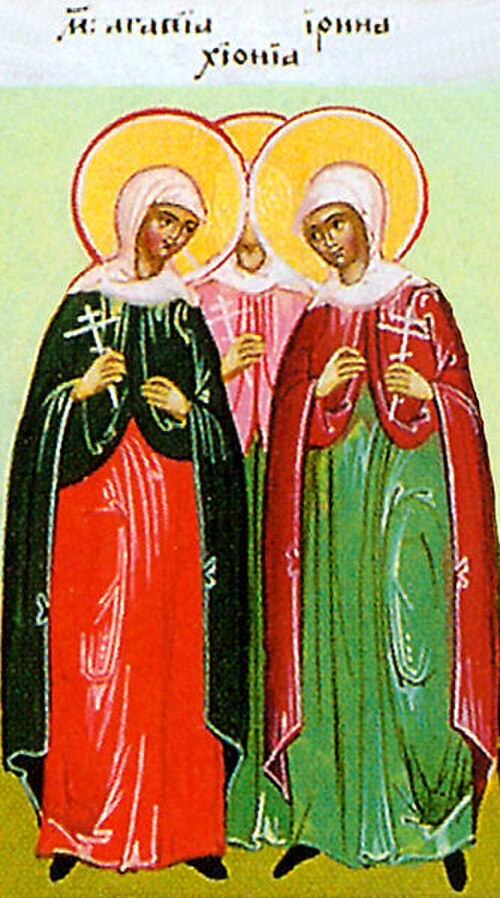
Holy Martyrs
Agape, Irene and Chione
Martyrs of Thessalonica
Three sisters from Aquileia, martyred at Thessalonica in 304.
Life
The Holy Martyrs Agape, Irene and Chione ("Love", "Peace" and "Snowy" in Greek) were three sisters, Christian martyrs of the fourth century. They suffered at Thessalonica, according to one source in the year 304, and are remembered on 16 April. Tradition calls them sometimes of Aquileia, sometimes of Thessalonica or of Illyria.
The oldest life
The commemoration of the martyrs Agape and Chione of Thessalonica is found in the oldest Eastern calendar, the Syriac one of the years 411 and 412. The oldest version of their life, which goes back to the records of their interrogations, survives only in Codex Vaticanus Graecus 1660, of the year 916. The three sisters, together with three other pious women, among them the widow Eutychia, and with a man named Agathon, were from Thessalonica. They were taken in the mountains near the city, where they were hiding from Diocletian's persecution, and brought to trial before the Roman governor. A search of their house turned up Christian books, which it was forbidden to keep.
They refused to eat food sacrificed to idols, first before the official Cassander, then before the head of the Roman administration, Dulcitius, and were subjected to various punishments. Agape and Chione were burned on the very first day, and the others were imprisoned, to give them time to change their minds. After a new interrogation, Dulcitius ordered Irene taken to a brothel, but no one touched her. Then she was burned or beheaded. The life does not say what happened to the other prisoners.
The longer version
Later, the story of their martyrdom, like that of Saints Theodota and Evodius, was incorporated into the life of Saint Anastasia the Deliverer from Potions, and for that reason the setting was moved to the Italian city of Aquileia. Orphaned early, the sisters were pious Christians, refused marriage and followed the spiritual guidance of the priest Zeno (Zoilus), to whom it was revealed in a dream that he would soon die, and that the maidens were destined for martyrdom. The same revelation came to the Great Martyr Anastasia, who was at Aquileia, and she went to the sisters and strengthened them to accept the crown of martyrdom with courage.
Zeno soon died, and the girls were arrested and sent to be tried by the emperor Diocletian. Despite exhortations, they did not renounce Christ. Diocletian set out for Macedonia and took them with him, giving them to the judgement of the governor Dulcitius. He was taken with their beauty and promised them deliverance if they would satisfy his desire. The girls refused, and he went to them at night, but an unseen power struck him, he lost his mind, ended up in the kitchen, was smeared with soot and was hardly recognised by the guards. He thought the girls had bewitched him and wished to take revenge. At the trial he ordered them stripped, but the soldiers could not, for the garments seemed stuck to the girls' bodies. Dulcitius suddenly fell into a deep sleep, which lasted until he was carried back home. Diocletian, informed, grew angry with the judge and gave the case to another, Sisinnius. He questioned the maidens and none renounced. He ordered Agape and Chione burned alive, and left the younger sister, Irene, for last. When the fire died, it was seen that the bodies and clothes of the martyrs were untouched by fire, and their faces were full of calm.
The next day Sisinnius tried Irene, frightening her with the fate of her sisters and threatening to hand her over to disgrace in a brothel. Irene answered calmly that even then her soul would not be defiled by renouncing Christ. As the soldiers were leading her there, two shining soldiers came up and told them that their lord Sisinnius commanded them to take the maiden to a high mountain and leave her there, then return to him and report. So it was done. They were angels, who saved her from disgrace. Sisinnius went to the mountain with a company and saw the girl on the peak. They could not climb up, and a soldier killed her with an arrow. The bodies of the maidens were buried by Saint Anastasia.
Because the two traditions have lived side by side, Agape, Chione and Irene were honoured now as martyrs of Thessalonica, now as martyrs of Illyria. In the tenth century Hrotsvitha of Gandersheim wrote the play Dulcitius on this story.
Commemorated the same day April 16
 Fructuosus of BragaSaint · Bishop of BragaApr 16
- Leonidas of CorinthMartyrApr 16
 Theodora of Nizhny NovgorodVenerable · Abbess in Nizhny NovgorodApr 16
- Michael of BourlaNew MartyrApr 16
- John of VerkhoturyeFool-for-ChristApr 16
- Amphilochios of PatmosVenerable · Hieromonk and elderApr 16
- Konstantin ZhdanovHieromartyr · PriestApr 16
- AgathonConfessorApr 16
- Apodemius of ZaragozaMartyrApr 16
- Caecilian of ZaragozaMartyrApr 16
- Calisa of CorinthMartyrApr 16
- Callis of CorinthMartyrApr 16