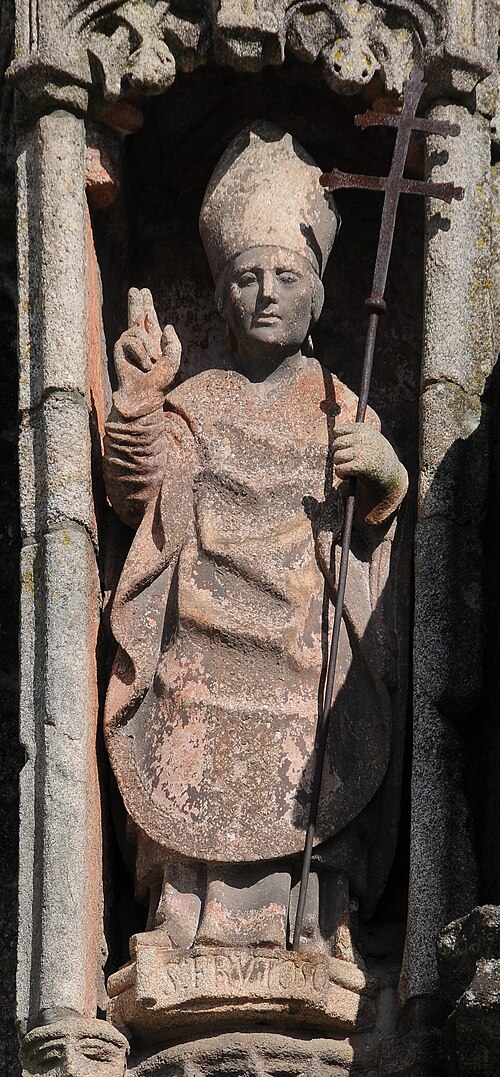
Saint
Fructuosus of Braga
Bishop of Braga
Bishop of Dumio and then of Braga, a great founder of monasteries in Visigothic Spain, who died in 665.
Life
Saint Fructuosus was bishop of Dumio and then of Braga in Visigothic Spain, and one of the great founders of monasteries in the Iberian Peninsula. He fell asleep on 16 April 665. The Church remembers him as a poor bishop, strict with himself, who cared for those in prison.
He was born around 600, the son of a Gothic commander in the Bierzo region, and as a young man accompanied his father on journeys through the estates. After the death of his parents he first went to Bishop Conantius of Palencia to learn, and then withdrew as a hermit into a desert place in Galicia. So many disciples gathered around him that he founded the monastery of Compludo, in Bierzo, over which he first presided himself, then appointed another abbot and returned to the wilderness. In time he founded nine more monasteries, among them one for women under the abbess Benedicta. Some were in Gallaecia, others farther south in Baetica, including one on the island of Cádiz and the nunnery of Nono. The monastery of Compludo was known for an unusually severe rule: monks had to tell their superiors all their thoughts, visions and dreams, and punishments included beating and imprisonment on scanty bread.
His relations with kings were not always easy: in 652 he wrote to King Recceswinth asking for the release of political prisoners held from the reign of King Chintila. In 653 he attended the Eighth Council of Toledo in place of Bishop Riccimer of Dumio, and raised the question of the prisoners again. After Riccimer's death he became bishop of Dumio in 654. In 656 he planned a journey to the East, but under the laws of King Chindasuinth no one could leave the kingdom without the king's leave; one of the disciples who knew the plan gave him away, and Fructuosus was arrested. He took part in the Tenth Council of Toledo (December 656), where he was given the task of repairing the damage left by Riccimer, and on 1 December 656 he was given the see of Braga, after Archbishop Potamius was sent to a monastery for improper conduct.
He dressed so poorly that he was taken for a slave and beaten by a peasant, from whom, say the monastic chroniclers, he was saved by a miracle. His life, an important source for the history of the age, was wrongly attributed to Valerius of Bierzo until the twentieth century; today it is held to have been written by an anonymous disciple. His relics, kept for a time at Braga, were taken in 1102 to Santiago de Compostela and returned to Braga in 1966. In icons he is shown with a stag that he is said to have saved from hunters. His feast is on 16 April.
Commemorated the same day April 16
 Agape, Irene and ChioneHoly Martyrs · Martyrs of ThessalonicaApr 16
- Leonidas of CorinthMartyrApr 16
 Theodora of Nizhny NovgorodVenerable · Abbess in Nizhny NovgorodApr 16
- Michael of BourlaNew MartyrApr 16
- John of VerkhoturyeFool-for-ChristApr 16
- Amphilochios of PatmosVenerable · Hieromonk and elderApr 16
- Konstantin ZhdanovHieromartyr · PriestApr 16
- AgathonConfessorApr 16
- Apodemius of ZaragozaMartyrApr 16
- Caecilian of ZaragozaMartyrApr 16
- Calisa of CorinthMartyrApr 16
- Callis of CorinthMartyrApr 16