Righteous
Alexander of Chagra
Priest
Born Alexander Yungerov in 1821, a priest venerated as a local saint of the Samara diocese, who died in 1900.
- Feast
- January 4old style January 17
- Reposed
- 190019th century
- Order
- The Righteous
Life
The Righteous Alexander of Chagra, born Alexander Stefanovich Yungerov, was a nineteenth-century parish priest who served for decades in the village of Balakovo on the Volga and spent his last years at the Chagra convent in Samara province. Known among the people as a clairvoyant elder and healer, he reposed in 1900 and is venerated as a local saint of the Samara diocese.
Childhood and schooling
He was born in 1821 in the village of Ablyazovo in Penza province (today Radishchevo), to the church reader Stefan Ignatyevich and his wife Praskovia Kuzminichna. He was one of five children, and the exact date of his birth has not survived. His father soon became a priest and was sent to the village of Yungerovka, from which the family took its surname.
Stefan Yungerov died in 1831, and in September of that year Alexander entered the Saratov theological school. The school was housed in a cold, damp building with unheated classrooms, and the already frail boy developed a disease of the legs that stayed with him all his life.
After five years he moved on to the Saratov seminary. Study came hard to him; he had no special gifts, was timid, and relied mostly on memorizing. His mother even advised him to leave the seminary and work his way to the priesthood through the diaconate, but he answered that he would leave only if he were expelled. Nevertheless, in 1842 he completed the full course and on 20 October was ordained priest. Shortly before, he had married Elizaveta Ivanovna, a poor orphan five years younger than himself.
First years of priesthood
The young priest's first posting was to the Church of Saint Nicholas in the village of Tretyaki in the Serdobsk district. It was a temporary appointment, with the task of obtaining the agreement of the village community and the landowners to build a new church in place of one that had burned. Father Alexander quickly won the people's affection and settled the matter in a month, even though the parish was so poor that the four clergy together earned only thirty kopecks in that month.
He was then appointed to the village of Neverkino in the Kuznetsk district, but the harsh climate did not suit his ailing wife, and his service there lasted only a little over six months.
Forty years in Balakovo
In July 1843 he was appointed to the Trinity Church in the village of Balakovo. The parish was very poor, and most of the inhabitants were Old Believers. By keeping the church rule strictly and serving with care and reverence, Father Alexander gradually began to draw people to the church.
His sermons attracted attention, and on great feasts he visited his parishioners' homes, urging them to live as Orthodox Christians. His reports of conversations with Old Believers have survived, after which some of them joined the Church through the Edinoverie.
One of his chief concerns was the old church, built more than a century earlier, cold and dilapidated. The bells even had to be taken down from the belfry because they rang by themselves when it swayed in the wind. It took him two years just to persuade the parishioners to build a heated church, since they feared a church with a stove would burn down.
Only after eighteen years, in 1861, was the new Trinity Church built on Khlebnaya Square in Balakovo, a brick church in Byzantine style with six tent-shaped domes of different sizes. In 1875, with the help of benefactors he had found, the church was doubled in size, and in 1881 a side chapel dedicated to Saint Alexander Nevsky was added.
Teacher, missionary and dean
In the parish house, built beside the church to replace one that had burned in 1861, lived Father Alexander, his wife, their three sons and his mother. Besides his priestly duties, from 1846 to 1867 he taught at the Balakovo girls' school, instructing the girls in prayers and reading from church books, with lessons held in his own home.
He served as confessor of the deanery, missionary in the villages of Balakovo and Natalino, and dean. For his labours he was awarded the violet velvet skufia and kamilavka.
At the Chagra convent
On 1 October 1880, at the age of sixty, Father Alexander told his parish that he had asked to retire and for his place at the Trinity Church to be given to his son, the priest Vasily Yungerov. Bishop Seraphim granted the request concerning his son but did not retire Father Alexander; instead he sent him to the women's community at Chagra.
Service there was lighter than in a parish. Making use of his leisure, as he put it, he taught religion in the convent school, accompanied the services with sermons and continued his Balakovo practice of speaking with peasants in their homes. Gradually the convent became known and sought out.
The church grew too small for the crowds, and through the efforts of Abbess Seraphima and Father Alexander, with the help of benefactors, a new heated church was built and completed in 1890. That same year both his wife and Abbess Seraphima died. The cares of building and the loss of those close to him undermined his health, and in April 1893 he was retired.
The elder of Chagra
From then began his widest ministry, which made him and the convent known far beyond the district and the province. People spoke of his gifts of clairvoyance, discernment and wonderworking. In 1896 the Samara diocesan gazette placed him beside Saint John of Kronstadt, Saint Theophan the Recluse and Saint Ambrose of Optina as one of the men of special spiritual gifts of the age.
The priest Gregory Razumovsky, who then served at the convent, left a description of how he received the people. The gathering began with the usual prayers and passed into a free address in which those present were shown to be great sinners who nonetheless boldly approach God, trusting in His mercy. This first part ended with everyone weeping.
The elder then spoke of the people's daily lives: their careless prayer, their hard-heartedness, their recourse to fortune-tellers and folk healers, their family relations, the harm of drink and tobacco, and their forgetfulness of God. He called them to repent and, with God's help, to begin a new life. At the end he asked whether they repented sincerely and, on hearing their answer, asked all to bow their heads and read the prayer of absolution.
Among the people he was held to be a wonderworker, and the memoirs of a peasant from the nearby village of Alexandrovka, published in 1913, describe several healings of the sick through his prayers. Many pilgrims came to the convent seeking relief from doubt and healing of soul and body; by some accounts their number reached a thousand a day. From their gifts a guesthouse for pilgrims was opened in 1895.
Repose
By the beginning of 1900 Father Alexander had grown weak and could no longer receive visitors. In February he learned of the death of his son Vasily, and his health declined sharply. At Pascha he received Holy Unction, then rallied somewhat, though he suffered from severe headaches and lapses of memory.
In December he took to his bed for good. He received Communion several times, was anointed again, and reposed on 22 December 1900 (4 January 1901 New Style). Two hours before his death his son Paul arrived from Kazan. He was buried on 26 December in the convent cemetery beside his wife and Abbess Seraphima, and a wooden chapel with an ever-burning lamp was built over his grave.
His family
Father Alexander and his wife had three sons: Dmitry, Vasily and Paul. Dmitry was a teacher at a village school. According to Yungerov family tradition, the family counted fourteen generations of priests.
Vasily taught at the Nikolayevsk theological school, then became a priest, and in 1880 succeeded his father at the Trinity Church in Balakovo; he died in 1900. Paul, the youngest, graduated from the Kazan Theological Academy and taught there. He translated part of the Old Testament into Russian and Orthodox books into Tatar, and he died in 1921.
Veneration after his death
After his death pilgrims kept coming, now to his grave. With the blessing of Bishop Gury of Samara, short memorial services were held daily, in the chapel in summer and in the church in winter. His Life says there was an opening in the chapel floor through which pilgrims took earth from the grave, and the soil brought each spring was all carried away by autumn.
In the late 1920s the Chagra convent was closed and its buildings demolished, including Father Alexander's house and the chapel over his grave. By some accounts, in the early 1930s the grave was opened to check rumours of buried treasure, and the body was then reburied without a coffin. Pilgrims continued to come, often in secret, and in 1952 believers set up a cross on the grave.
Over time the name of the priest buried there began to be forgotten. In the early 1990s the journalist Igor Makarov of the Orthodox newspaper "Blagovest" searched for the grave, and people in the surrounding villages knew only that a "healing elder" lay beneath the cross. Only the spiritual daughter of one of the last nuns of Chagra could say with certainty that Alexander Yungerov was buried there.
Uncovering of relics and veneration today
In the spring of 2000, at the suggestion of Hieromonk Sophrony (Balandin), confessor of the Iveron Convent in Samara, a search began. On 22 June 2000, after a memorial service, the grave was opened and the priest's remains were found, together with a small cross, the decayed cover of a Gospel book and fragments of vestments. A woman's remains found nearby, thought to be those of Abbess Seraphima, were left in place.
The relics of Father Alexander were brought to the Iveron Convent in Samara and placed in a shrine, where Archbishop Sergius of Samara received them with joy. The Righteous Alexander of Chagra is venerated as a local saint of the Samara diocese and is commemorated on 22 December (4 January New Style), the day of his repose, and on 22 June, the uncovering of his relics.
Commemorated the same day January 4
 ApollosApostle · Apostle of the SeventyJan 4
 Symeon of JerusalemHieromartyr · Bishop of JerusalemJan 4
 EpaphroditusApostle · Envoy of the Church of PhilippiJan 4
 CleopasApostle · Disciple on the road to EmmausJan 4
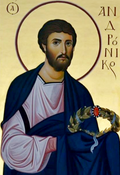 Andronicus of PannoniaApostle · Bishop of PannoniaJan 4
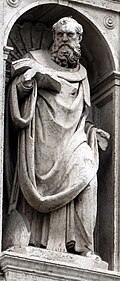 EpaphrasApostle · Companion of the Apostle PaulJan 4
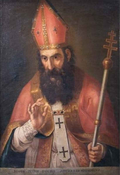 EvodiusApostle · Bishop of AntiochJan 4
 Apelles of SmyrnaApostle · Bishop of HeracleaJan 4
 AchaicusApostle · Of CorinthJan 4
 AmpliatusApostle · Greeted by the Apostle PaulJan 4
 Crispus of CorinthApostle · Bishop of ChalcedonJan 4
 Quartus of BerytusApostle · Bishop of BeirutJan 4