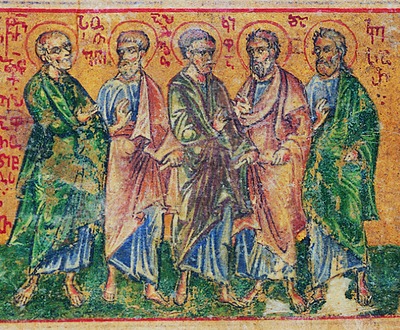
Apostle
Apollos
Apostle of the Seventy
Learned Jew of Alexandria who preached at Ephesus and Corinth, a fellow worker of the Apostle Paul.
Life
Saint Apollos the Apostle, one of the Seventy, was a Jewish Christian from Alexandria, a man gifted in speech and learned in the Scriptures, a fellow worker of the holy Apostle Paul. He had an important part in the beginnings of the Church at Ephesus and Corinth. The Church commemorates him on 30 March, on 8 December and, in the synaxis of the Seventy Apostles, on 4 January.
In the Acts of the Apostles
The Acts of the Apostles (18:24-28) says that Apollos was a Jew, born at Alexandria, "an eloquent man, competent in the Scriptures." Arriving at Ephesus around 52, he spoke with fervour about Jesus and taught accurately, though he knew only the baptism of John. Aquila and Priscilla, the Christian couple who had come to Ephesus with Paul, heard him in the synagogue, took him aside and explained the way of the Lord to him more accurately. Apollos wished to cross to Achaia. The brothers at Ephesus encouraged him and wrote to the disciples there to welcome him. At Corinth he greatly helped those who through grace had believed, for "he powerfully refuted the Jews in public, showing by the Scriptures that the Christ was Jesus."
At Corinth
In the First Epistle to the Corinthians, written around 55, Paul speaks warmly of Apollos. Divisions had appeared among the Corinthians: some said "I follow Paul," others "I follow Apollos," others "I follow Cephas." Paul answers: "I planted, Apollos watered, but God gave the growth" (1 Corinthians 3:6). There was no quarrel between Paul and Apollos. Paul writes that he strongly urged Apollos to go to Corinth with the brothers, but "it was not at all his will to go now, but he will come when he has opportunity" (16:12). In the Epistle to Titus (3:13), Paul asks that Zenas the lawyer and Apollos be sent on their way with care.
Tradition
Saint Jerome says that Apollos withdrew to Crete, grieved by the divisions at Corinth, and returned to Corinth after Paul had settled matters. The synaxarion calls him bishop of Caesarea, while other sources name him bishop at Smyrna or at Iconium. These accounts do not agree with one another. Tradition counts him among the Seventy apostles of the Lord. Some, among them Martin Luther, have supposed that Apollos wrote the Epistle to the Hebrews, but the Orthodox Church receives it as a writing of Saint Paul. No text has survived under his name.
Veneration
The Church remembers him on 30 March and on 8 December, with Sosthenes, Cephas, Tychicus, Epaphroditus, Caesar and Onesiphorus, and in the synaxis of the Seventy Apostles on 4 January. He is honoured as a learned and gentle man who let himself be guided with humility by Aquila and Priscilla.
Commemorated the same day January 4
 Symeon of JerusalemHieromartyr · Bishop of JerusalemJan 4
 EpaphroditusApostle · Envoy of the Church of PhilippiJan 4
 CleopasApostle · Disciple on the road to EmmausJan 4
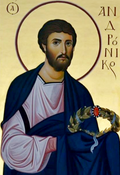 Andronicus of PannoniaApostle · Bishop of PannoniaJan 4
 EpaphrasApostle · Companion of the Apostle PaulJan 4
 EvodiusApostle · Bishop of AntiochJan 4
 Apelles of SmyrnaApostle · Bishop of HeracleaJan 4
 AchaicusApostle · Of CorinthJan 4
 AmpliatusApostle · Greeted by the Apostle PaulJan 4
 Crispus of CorinthApostle · Bishop of ChalcedonJan 4
 Quartus of BerytusApostle · Bishop of BeirutJan 4
 Thirteen Assyrian FathersHoly Venerables · Monastic missionaries in GeorgiaJan 4