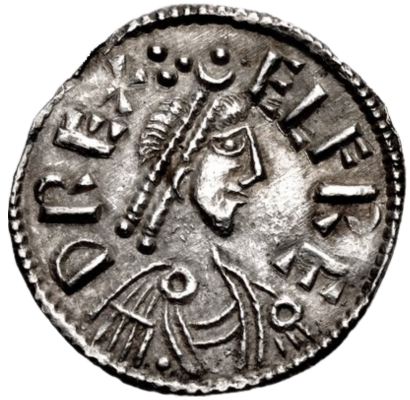
Right-Believing
Alfred the Great
King of Wessex
King of the West Saxons from 871 to 899, defender of Christian England against the Danes.
- Feast
- October 26old style November 8
- Reposed
- 8999th century
- Place
- Winchester
Life
Alfred the Great was king of the West Saxons from 871 and, from 886, king of the Anglo-Saxons, until his death in 899. He is honoured for his faith, for defending the Christian people against the Viking invasions, and for the care with which he spread learning and Christian books in the language of his people. In 2007 the Holy Synod of the Russian Orthodox Church canonized All Saints of the British Isles, among them King Alfred. He is commemorated on 26 October, and with the other saints of the isles on the third Sunday after Pentecost.
Youth
He was born around 849 at Wantage, the youngest son of King Aethelwulf and Queen Osburh. According to his biographer Bishop Asser, his mother offered a beautifully decorated book of English poems as a prize to the first of her sons who could memorize it, and Alfred did not learn to read until he was twelve. In 853 he was sent to Rome, where Pope Leo IV anointed him, and in 854 and 855 he went there again with his father, staying at the court of Charles the Bald. Three older brothers reigned in turn before him, and Alfred fought beside Aethelred, the third, against the Danes.
War and peace
He became king in April 871, in the midst of war. In January 878 the Danes attacked suddenly at Chippenham, and Alfred escaped with a small band through woods and swamp and withdrew to Athelney in Somerset. From there he gathered his army again and defeated the Danes at Edington. One of the terms of peace was that their king, Guthrum, accept Christianity; after three weeks Guthrum and twenty-nine of his chief men were baptized at Alfred's court at Aller, near Athelney, and Alfred was his godfather. The boundary between Wessex and the territories of the Danes, called the Danelaw, was fixed by treaty.
In 886 Alfred occupied and restored London and took the title king of the Anglo-Saxons. He strengthened the defence of the land with a network of thirty-three fortified towns, called burhs, reorganized the army, and in 896 ordered a small fleet to be built.
Teacher of his people
Alfred grieved to see how far learning had declined in England after the invasions. In the preface to his translation he said that very few men south of the Humber could understand their church services in English. He founded a court school for his own children, those of the nobles and others, summoned scholars from Mercia, Wales and abroad, and required officials to be able to read. He translated, or had translated, into Old English the Pastoral Care and the Dialogues of Saint Gregory the Great, the Consolation of Philosophy of Boethius and other works. His code of laws opens with the Ten Commandments and other passages from Exodus and the Acts of the Apostles. The Anglo-Saxon Chronicle was begun in his time.
He founded the monasteries of Athelney and Shaftesbury, the first new monastic houses in Wessex since the eighth century. Asser writes that the king carried with him a small book in which he had gathered psalms and prayers, and that he kept it with him always for prayer.
Repose and veneration
Alfred died on 26 October 899, aged fifty or fifty-one, and was buried at Winchester. His body was later moved to the New Minster and afterwards to Hyde Abbey. He is the only English king called "the Great". In 1441 Henry VI tried in vain to obtain his canonization from Pope Eugene IV. The Anglican Church keeps his memory on 26 October, and the Orthodox Church commemorates him on the same day.
Commemorated the same day October 26
 Demetrius the Myrrh-streamerGreat Martyr · Protector of ThessalonicaOct 26
 Amandus of StrasbourgSaint · First Bishop of StrasbourgOct 26
 Anthony of VologdaSaint · Bishop of Vologda and PermOct 26
 Lucian the HieromartyrHieromartyrOct 26
- Adalgott of DisentisVenerable · Abbot of DisentisOct 26
- Alanus and AlorusHoly Hierarchs · Bishops of QuimperOct 26
- Albinus of BuraburgSaint · Bishop of BuraburgOct 26
 Alor of QuimperSaint · Bishop of QuimperOct 26
- Aneurin and GwinocHoly VenerablesOct 26
 Aptonius of AngoulêmeSaint · Bishop of AngoulêmeOct 26
- ArtemidorusSaintOct 26
- Athanasius of MedikionVenerable · Monk of Medikion MonasteryOct 26