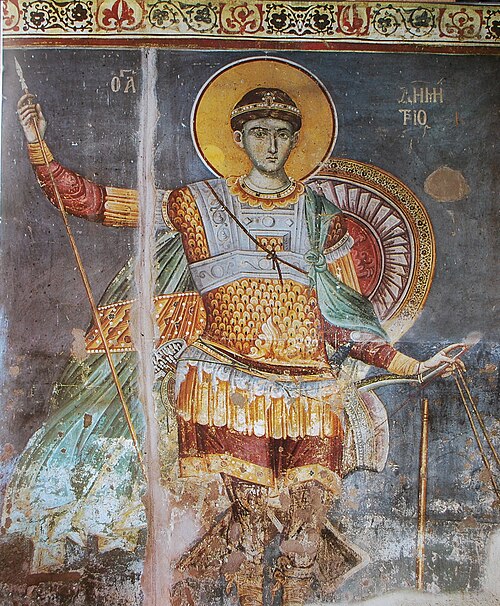
Great Martyr
Demetrius the Myrrh-streamer
Protector of Thessalonica
Martyr of Thessalonica, killed for his faith around 306, protector of his city.
- Feast
- October 26old style November 8
- Reposed
- 3064th century
- Place
- Thessaloniki
- Order
- Great Martyrs
Life
Saint Demetrius the Myrrh-streamer, a great martyr, died for Christ at Thessalonica around 306, in the great persecution under Diocletian and Galerius. The Church honours him as protector of Thessalonica and as one of the best-loved military saints. According to tradition, fragrant myrrh flowed from his tomb, which gave him the name Myrrh-streamer.
Life and martyrdom
According to his Life, Demetrius was born in Thessalonica in Macedonia to Christian parents who kept their faith secret. They baptized him in a house church in their home and raised him in the true faith. When his father, a Roman official in the city, died, the emperor Galerius appointed Demetrius to his place, with orders to defend the city and to stamp out Christianity.
Demetrius accepted the post, but on the same day he declared before everyone that he was a Christian. He preached in the city and led many to Christ. News reached the emperor, and Maximian, returning from a war against the Slavic tribes, stopped at Thessalonica. Demetrius entrusted his goods to his servant Lupus to give to the poor and prepared for the crown of martyrdom by fasting and prayer. Brought before the emperor, he confessed that he was a Christian and was thrown into prison.
At that time the emperor held fights in the amphitheatre. His favourite fighter Lyaeus defeated everyone who came out against him, among them Christians forced to fight, throwing them from a platform onto spears set point upwards. The Christian Nestor, with Demetrius’ blessing, fought Lyaeus and overcame him. The emperor, enraged, ordered Nestor put to death at once, and Demetrius the next morning. On 26 October soldiers entered the prison, found him at prayer, and pierced him with spears. Thessalonian Christians buried his body by night. Lupus took his master’s bloodstained garment and his ring, and many miracles were worked through them.
Relics and the basilica
Tradition holds that soon after his death a basilica was raised over his tomb. An Illyrian nobleman named Leontius, healed of paralysis, built a larger church there, and the relics were found while its foundations were dug. It is also told that the saint appeared to Leontius and would not let him take any part of the relics, so that Leontius took only the cloth stained with the martyr’s blood. The Basilica of Saint Demetrius, dating from the middle of the fifth century, is still the chief shrine dedicated to him. For a long time the tomb was honoured empty under a silver ciborium, and the myrrh that flowed gave rise to his name Myrrh-streamer. Archbishop John of Thessalonica wrote the first book of the saint’s Miracles around 610.
Historians note that the oldest records of a martyr at Sirmium (today Sremska Mitrovica) point to a Demetrius, a deacon, remembered on 9 April. For this reason some scholars think his veneration passed from Sirmium to Thessalonica when the city became the military centre of the region around 441-442. The Church, however, has kept its honour for the Great Martyr of Thessalonica.
Protector of the city
Over the centuries the people of Thessalonica believed the saint defended their city from the sieges of the Slavs and other enemies. So he came to be honoured as a warrior saint, often paired with Saint George. In the Greek countryside he also became patron of farmers and shepherds, taking over a role once given to the goddess Demeter. The crusaders took him as their patron, and the princes of the Rurik dynasty in Rus’ revered him; in the Russian Church the Saturday before his feast is a day of prayer for the departed. The Asen brothers, founders of the Second Bulgarian Empire, also took him as their protector.
The basilica was turned into a mosque after the Ottoman conquest in 1430 and became a church again in 1912. The relics apparently reached Italy during the Latin rule (late twelfth or early thirteenth century). Found in 1520 at San Lorenzo in Campo, part of them came back to Thessalonica, the head in 1978 and most of the rest in 1980, while some pieces remained in Italy. At Thessalonica a great fair, the Demetria, was held on his feast, and it was revived in the 1960s as a cultural festival.
The Romanian Orthodox Church keeps his feast on 26 October. Churches that use the old calendar keep it on 8 November, and among the Serbs it is the family slava Mitrovdan; the cities of Sremska Mitrovica and Kosovska Mitrovica bear his name. Demetrius and its forms are among the most common names in the Orthodox world, and his relics rest in the Basilica of Saint Demetrius in Thessalonica.
Commemorated the same day October 26
 Alfred the GreatRight-Believing · King of WessexOct 26
 Amandus of StrasbourgSaint · First Bishop of StrasbourgOct 26
 Anthony of VologdaSaint · Bishop of Vologda and PermOct 26
 Lucian the HieromartyrHieromartyrOct 26
- Adalgott of DisentisVenerable · Abbot of DisentisOct 26
- Alanus and AlorusHoly Hierarchs · Bishops of QuimperOct 26
- Albinus of BuraburgSaint · Bishop of BuraburgOct 26
 Alor of QuimperSaint · Bishop of QuimperOct 26
- Aneurin and GwinocHoly VenerablesOct 26
 Aptonius of AngoulêmeSaint · Bishop of AngoulêmeOct 26
- ArtemidorusSaintOct 26
- Athanasius of MedikionVenerable · Monk of Medikion MonasteryOct 26