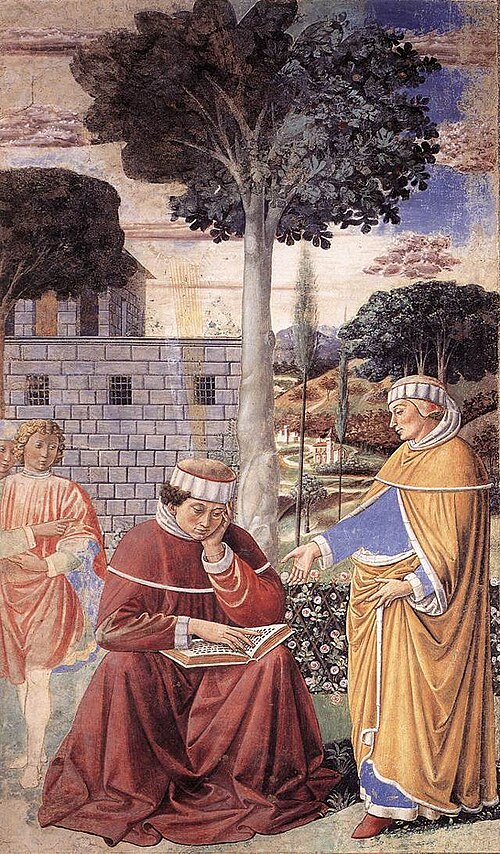
Saint
Alypius of Thagaste
Bishop of Thagaste
Bishop of Thagaste in present-day Algeria, a lifelong friend of St. Augustine, converted with him.
Life
Saint Alypius was bishop of Thagaste, in present-day Algeria, a lifelong friend of Blessed Augustine, who turned to the faith with him and afterward lived in Christ. He fell asleep around 430. His feast is on 15 August.
Youth
He came from an aristocratic family of Thagaste, a small town in the Roman province of Africa Proconsularis. He was a student of Augustine's at Carthage. As his friendship with Augustine deepened (Augustine called him the brother of my heart), so did his interest in Manichaeism, whose strict rule of chastity he admired, thinking that marriage would hinder the search for wisdom with his friends. He also studied law and went to Rome, where he served as a magistrate. A commonly cited event from the Confessions (6.8.13): the young Alypius, of very strong moral principles, was taken by friends to the violent games in the arena; at first he kept his eyes shut, but could not restrain himself because of the noise, opened his eyes and, to his horror, found pleasure in the spectacle and invited others too; then he repented and returned.
Conversion
In 384 or 385 he followed Augustine to Milan, where he heard the preaching of Saint Ambrose. He was present in the garden at Milan at Augustine's conversion, in 386. He and Augustine were baptised by Ambrose at the Easter vigil, on 25 April 387. After baptism they returned to Thagaste, where Alypius helped Augustine found the first monastery in North Africa, and lived a monastic life at Thagaste (388) and at Hippo (391). When Augustine was chosen bishop of Hippo, Alypius moved there, joining his monastic community, and was abbot of a local monastery.
The bishop
In 393-394 he went on pilgrimage to the Holy Land, where, at Augustine's charge, he visited Blessed Jerome at Bethlehem; on his return, in 394, he became bishop of Thagaste. The next year he wrote to Paulinus of Nola, asking for a copy of Eusebius's Ecclesiastical History. Paulinus, who wished to know what Alypius believed and taught, asked for some particulars of his life; Alypius asked Augustine to answer, which, according to John C. Kelly, was the impetus for the later Confessions. As bishop he took part in the African councils of the Church; he was chosen, with Possidius and Augustine, among the representatives of the Catholic bishops at the great debate with the Donatists at Carthage in 411, and took part in the council of Milevis (Numidia) in 416, of which he composed a written report for Pope Innocent. He travelled to Italy on church and political business (419, 428) and urged Augustine to write the unfinished treatise Against the Second Reply of Julian (429-430). When Augustine died, in 430, Alypius was still alive; of his last days nothing is known.
Veneration
There are no traces of his veneration until he was added to the Roman Martyrology by Pope Gregory XIII in 1584. The Augustinian friars commemorate him with Possidius on 16 May, and the Canons Regular of Saint Augustine on 17 August.
Commemorated the same day August 15
 TheotokosMost Holy · Ever-Virgin MaryAug 15
 TarsiciusMartyrAug 15
 Simplician of MilanSaint · Bishop of MilanAug 15
- Macarius the RomanVenerableAug 15
- Aedh of ClocharSaintAug 15
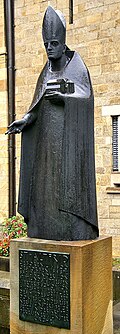 Altfrid of HildesheimSaint · Bishop of HildesheimAug 15
- Arduinus of RiminiVenerableAug 15
- Christos of IoanninaHieromartyr · New Hieromartyr of IoanninaAug 15
- ColmanSaintAug 15
- Eutychius of NicomediaMartyrAug 15
 GemmaMartyrAug 15
- NapoleonMartyr · Martyr of AlexandriaAug 15