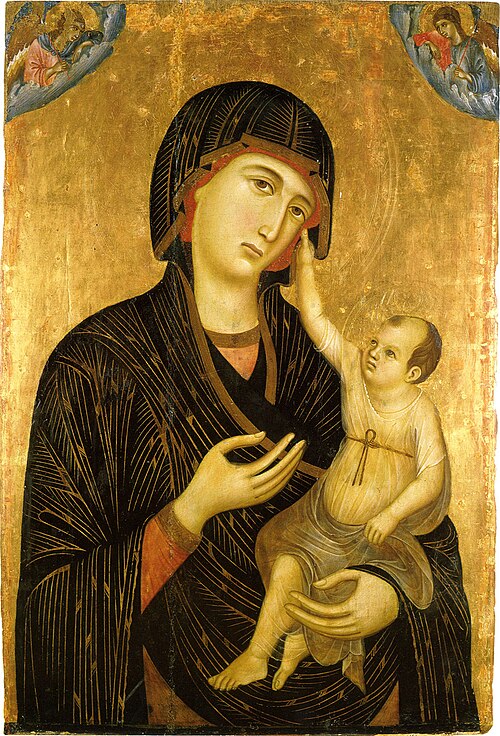
Most Holy
Theotokos
Ever-Virgin Mary
The Virgin Mary of Nazareth, mother of Jesus Christ, honored as the Most Holy Theotokos.
- Feast
- August 15old style August 28
- Reposed
- 481st century
- Place
- Herodian Kingdom of Judea
Life
The most holy Theotokos and ever-virgin Mary is she from whom the Son of God took flesh. The Church honours her above all the saints and heavenly powers and calls upon her in every service as protector of the faithful. The Gospels say little about her life, and part of what is known comes from the Holy Tradition and from early writings such as the Protoevangelium of James. In Orthodox worship she is venerated as the first and greatest of all the saints.
Birth and entrance into the Temple
According to tradition, the Virgin Mary was the daughter of the righteous Joachim and Anna. Anna had been barren and advanced in years when, in answer to prayer, she received the promise of a child. The Nativity of the Mother of God is kept on 8 September.
The same tradition says that at the age of three her parents brought her to the Temple in Jerusalem, where she grew up in prayer, until, at the age of betrothal, she was entrusted to the righteous Joseph as her protector. The Entrance into the Temple is kept on 21 November, and the Romanian people call it Ovidenie. There are no biblical or historical sources for this feast, only tradition.
The Annunciation and the birth of the Lord
The Gospel of Luke tells how the Archangel Gabriel announced to her in Nazareth that she would bear the Son of the Most High through the coming of the Holy Spirit upon her. She received the word with faith and humility: "Behold the handmaid of the Lord; be it unto me according to your word." She then went to her kinswoman Elizabeth, and Luke preserves her song of praise.
At Bethlehem she gave birth to Christ. The Church confesses that she remained a virgin before the birth, in it, and after it. She received the worship of the Magi, brought the Child to the Temple, and fled with Joseph into Egypt from Herod's wrath. The title ever-virgin (Aeiparthenos) was confirmed by the Fifth Ecumenical Council in 553.
Beside her Son
At the wedding at Cana of Galilee she interceded for people in need. The Gospel of John later shows her standing by the Cross. After the Ascension, the Acts of the Apostles names her in the upper room at Jerusalem with the apostles and the other disciples.
The truth about her was clarified in the struggle against the errors of the fifth century. The Third Ecumenical Council, held at Ephesus in 431, condemned the teaching of Nestorius, who wished to call her only the birth-giver of Christ, and confessed that the holy Virgin is truly Theotokos, since the One born of her is true God. The Orthodox Church does not accept the Roman Catholic doctrine of the Immaculate Conception, because it separates the Mother of God from the rest of mankind. For the Orthodox she is pure and free of personal sin, yet she shared the same human nature as all people.
The Dormition
The Church teaches that the Mother of God died as all people die, that is, she fell asleep. According to the Synaxarion, after the Ascension she remained in the care of the Apostle John the Theologian and lived in the home of his parents, near the Mount of Olives. The apostles were miraculously gathered at her Dormition, all except Thomas. Arriving a few days later, he wished to see her once more, and when the tomb was opened her body was no longer there. The Church confesses that her Son took her up to heaven with her body. The Greek word for the feast, Koimisis, means "falling asleep".
The feast rests on tradition, not on biblical or historical sources. As for the place of her repose, traditions name either Jerusalem or Ephesus.
Veneration
Her feasts begin and end the church year. The greatest are the Annunciation on 25 March and the Dormition on 15 August, which the Romanian people call Sfânta Maria Mare. Also kept are the Nativity (8 September) and the Entrance into the Temple (21 November). The Dormition is preceded by a fast of fourteen days, from 1 to 14 August.
The hymns in her honour, the Theotokia, form an essential part of Orthodox services. Orthodox veneration is above all praise and prayer rather than academic study. She is honoured for the sake of her Son, to safeguard right faith in the Incarnation.
Commemorated the same day August 15
 TarsiciusMartyrAug 15
 Alypius of ThagasteSaint · Bishop of ThagasteAug 15
 Simplician of MilanSaint · Bishop of MilanAug 15
- Macarius the RomanVenerableAug 15
- Aedh of ClocharSaintAug 15
 Altfrid of HildesheimSaint · Bishop of HildesheimAug 15
- Arduinus of RiminiVenerableAug 15
- Christos of IoanninaHieromartyr · New Hieromartyr of IoanninaAug 15
- ColmanSaintAug 15
- Eutychius of NicomediaMartyrAug 15
 GemmaMartyrAug 15
- NapoleonMartyr · Martyr of AlexandriaAug 15