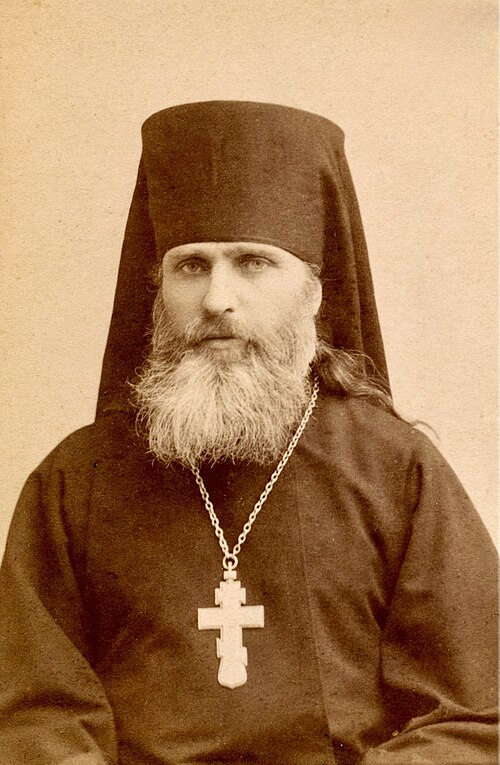
Saint
Ambrose of Georgia
Catholicos-Patriarch of Georgia
Scholar and Catholicos-Patriarch of Georgia from 1921 to 1927, known for his opposition to the Soviet regime.
Life
Saint Ambrose the Confessor was a scholar and Catholicos-Patriarch of All Georgia from 1921 to 1927, known for his opposition to the Soviet regime. He was canonized in 1995 by the Georgian Orthodox Church, as Saint Ambrose the Confessor.
He was born on 7 September 1861 in the village of Martvili, in a Georgia then ruled by Russia, as Besarion Khelaia. He studied at the church school in Samegrelo and graduated from the Tiflis seminary in 1885. In the same year he was ordained priest and sent to Abkhazia, where he served at Sukhumi, New Athos and Lykhny and taught the Georgian language. Under the pseudonym “Amber” he published a series of articles condemning the policy of Russification in Abkhazia and accusing the local Russian officials of stirring up anti-Georgian feeling among the Abkhaz. In 1893 he was widowed. In 1896 he enrolled at the Kazan Theological Academy, which he graduated in 1900-1901, with the degree of candidate in theology, with a thesis on “The Struggle of Christianity against Islam in Georgia.” While a student, on 11 February 1900, he was tonsured a monk with the name Ambrose; he was ordained hieromonk in 1901. He returned to Georgia and was archimandrite of the Chelishi monastery in Racha, where he labored much to gather and restore old manuscripts. One day, walking in the monastery yard, he noticed that his steps rang hollow, a sign of a void beneath; he dug there and found an ancient manuscript of the Holy Gospels, the famous Chelishi Gospel, of the ninth or tenth century. In 1904 he was transferred to Tiflis, to the synodal office, as archimandrite of the monastery of the Transfiguration.
In the 1900s, in the heated debates on the status of the Georgian Church, he was one of the leaders of the autocephalist movement, calling for the restoration of the autocephalous Orthodox Church of Georgia, abolished by the Russian Empire in 1811. The Georgian bishops pointed out that under the Russian exarchs sent from Saint Petersburg to run Georgia's church affairs, the Church lost property and estates worth some 140 million rubles, church schools had been closed, the use of Georgian in services was discouraged, twenty episcopal sees lay vacant and seven hundred and forty parishes were without pastors. The Georgians sent an appeal to the tsar, but nothing came of it; autocephaly was refused. The conference of Georgian clergy at Tbilisi in 1905 was dispersed by the police, and several autocephalists were arrested. Ambrose was banned from serving and confined in the Trinity monastery at Ryazan. In 1908 the Russian exarch of Georgia, Archbishop Nikon, was killed on 28 May in his residence at Tbilisi by unknown assailants. Learning of it, Ambrose was shaken: “The Christian principles that restrained human passions have been lost.” The accusations fell on the autocephalists, among whom he was one of the first. He was suspended from serving and exiled to Russia; he was acquitted in 1910 but could not return to Georgia until the events of 1917.
On 12 March 1917 a group of Georgian clergy proclaimed the autocephaly of their Church and elected Bishop Kyrion Catholicos-Patriarch. The Holy Synod of the Russian Church refused to recognize the step, and the result was a break in communion between the two Churches. Ambrose was soon consecrated metropolitan of Chkondidi, in western Georgia (on 15 October 1917), then transferred to Abkhazia. After the Soviet invasion of February-March 1921 Catholicos-Patriarch Leonid died of cholera, and Ambrose was elected his successor on 7 September 1921 and enthroned on 14 October in the cathedral of Mtskheta. Under the new Bolshevik regime the Church was deprived of juridical status, churches and monasteries began to be closed, the clergy were persecuted, and the property of churches and monasteries was confiscated. On 7 February 1922 Ambrose sent a memorandum to the Genoa Conference, in which he described the conditions under which Georgia had been living since the Red Army invasion, protested in the name of the Georgian people, deprived of their rights, against the Soviet occupation and demanded the intervention of civilized humanity against the acts of the Bolshevik regime. In February 1923 Ambrose and all the members of the Patriarchal Council were arrested and imprisoned. In March 1924 the Soviet authorities held a public trial. Besides sending the memorandum, Ambrose was accused of hiding the historical treasures of the Church, so that they would not be handed over to the Soviet state. All the clergy arrested with the patriarch showed their solidarity with Ambrose, who took all responsibility on himself. His last words at the trial were: “My soul belongs to God, my heart to my country, and with my body do what you wish, executioners.” He was sentenced to eight years in prison, with confiscation of property. He died on 29 March 1927.
Commemorated the same day March 16
 Alexander I of RomeHieromartyr · Bishop of RomeMar 16
 Aristobulus of BritanniaApostle · Bishop of BritainMar 16
 Heribert of CologneSaint · Archbishop of CologneMar 16
 Christodoulos of PatmosVenerable · Founder of the Patmos MonasteryMar 16
 Serapion of NovgorodSaint · Archbishop of NovgorodMar 16
- Eusebia of HamageVenerable · Abbess of HamageMar 16
- Papas of LarandaMartyrMar 16
- Abban of KilabbanVenerableMar 16
- Aedhan of Lis MorSaintMar 16
- Agapitus of RavennaSaint · Bishop of RavennaMar 16
- Allo of BobbioVenerable · Monk of BobbioMar 16
- Antoni MeskhiSaintMar 16