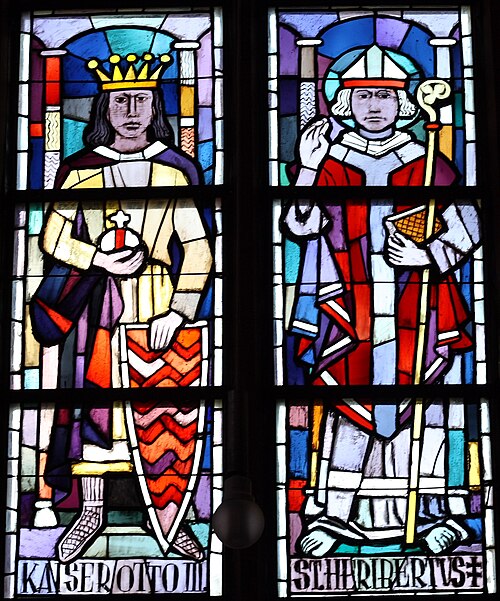
Saint
Heribert of Cologne
Archbishop of Cologne
Archbishop of Cologne from 999 until his death in 1021, chancellor of Italy for Emperor Otto III.
Life
Saint Heribert was archbishop of Cologne from 999 until his repose on 16 March 1021, and chancellor of Italy and of Germany under the emperor Otto III. He was revered in his lifetime, and his canonisation was confirmed around 1075. His feast is on 16 March (in the archdiocese of Cologne, on 30 August).
He was born around 970 at Worms, to Count Hugo and Tietwista; he had as half-brother Bishop Heinrich of Würzburg. He studied at the cathedral school of Worms and at Gorze abbey on the Moselle, where he was a fellow student of Bruno of Carinthia, the future Pope Gregory V. He wished to become a Benedictine monk, but his father disapproved. He returned to Worms as provost of the cathedral. Bishop Hildebold, chancellor of Germany, brought him to the imperial court. In 994 Otto III made him chancellor of Italy, and in 998, after Hildebold's death, also of Germany; for the first time both chanceries were united in one hand. He was ordained priest in 994 or 995. He was one of the participants in the programme of renewal of the Roman Empire. Being on the emperor's second expedition to Italy, in 999, he was chosen by the cathedral chapter archbishop of Cologne, in place of Evergerus, and received the confirmation of the emperor and of Pope Sylvester II, with the pallium, at Benevento, on 9 July 999. He was consecrated on Christmas of that year, in the cathedral of Cologne; before this he entered the city humbly and barefoot. He kept both chanceries. In the year 1000 he was present, at Aachen, when Otto opened the tomb of Charlemagne to honour him.
In January 1002 he was beside Otto at his death, in the castle of Paterno, and led the cortege bearing the body to Aachen. The cortege was stopped by Duke Henry of Bavaria, and Heribert, seized together with the imperial insignia he carried, was freed leaving as hostage his brother, the bishop of Würzburg, and promising to give back the Holy Lance. At the election of the king, in 1002, he supported Duke Hermann II of Swabia; afterward, according to some sources, he was on cool terms with Henry II, according to others he was reconciled and served him as adviser; the emperor came to respect his abilities, and the rift turned to friendship. In 1003 he founded Deutz abbey, on the Rhine, decided on already by Otto. He accompanied Henry on the expedition to Italy in 1004 and took part, in 1007, in the founding of the bishopric of Bamberg. He often sent alms to the poor and to priests to distribute. Taking a fever on a pastoral visitation, he hurried back to Cologne and died there in less than a week, on 16 March 1021, and was buried in his abbey at Deutz. His relics were enshrined in a golden reliquary on 30 August 1147 and are kept in the parish church of Köln-Deutz. Among his miracles is the ending of a drought, so he is invoked for beneficial rains.
Commemorated the same day March 16
 Alexander I of RomeHieromartyr · Bishop of RomeMar 16
 Aristobulus of BritanniaApostle · Bishop of BritainMar 16
 Ambrose of GeorgiaSaint · Catholicos-Patriarch of GeorgiaMar 16
 Christodoulos of PatmosVenerable · Founder of the Patmos MonasteryMar 16
 Serapion of NovgorodSaint · Archbishop of NovgorodMar 16
- Eusebia of HamageVenerable · Abbess of HamageMar 16
- Papas of LarandaMartyrMar 16
- Abban of KilabbanVenerableMar 16
- Aedhan of Lis MorSaintMar 16
- Agapitus of RavennaSaint · Bishop of RavennaMar 16
- Allo of BobbioVenerable · Monk of BobbioMar 16
- Antoni MeskhiSaintMar 16