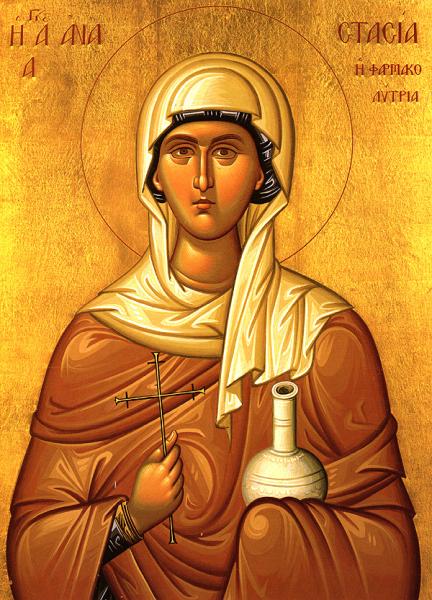
Great Martyr
Anastasia the Deliverer from Potions
of Sirmium
Great martyr of Sirmium, killed in 304, who aided Christians imprisoned for their faith.
- Feast
- December 22old style January 4
- Reposed
- 3044th century
- Place
- Sirmium
- Order
- Great Martyrs
Life
Saint Anastasia the Deliverer from Potions (Pharmakolytria), a great martyr, died for Christ at Sirmium in Pannonia (today Sremska Mitrovica in Serbia), in the persecution of Diocletian, in 304. She is commemorated on 22 December in the Orthodox Church and on 25 December in the Catholic Church. She has long been honoured as a healer and exorcist, and in the Slavic East as protector of women in childbirth.
Life according to tradition
Little is known of her, apart from the fact that she was killed in the persecutions of Diocletian; most stories are written several centuries after her death. According to the Life, of the sixth century, she was a Roman of noble family, daughter of Praetextatus, a prominent pagan, and of Fausta (in other sources, Flavia), a Christian, and a pupil of Saint Chrysogonus. After her mother’s death her father forced her to marry a wealthy pagan, Publius; she kept her purity, always feigning illness, while he squandered his wealth on pagan feasts and tormented her with prison and hunger when he learned that she went secretly to the Christians’ prisons. Publius died at sea, on a journey to Persia. Left free, Anastasia gave her wealth to the poor and began to tend the Christians in prison, strengthening them and encouraging them to martyrdom. She laboured not only at Rome but also in Illyricum and Macedonia, especially at Thessalonica, and as far as Nicomedia, whence she was also called “aleiptria”, “trainer” of the martyrs.
At Thessalonica she was teacher of the three sisters Agape, Chione and Irene, who died as martyrs, and for this Anastasia was imprisoned and tormented; according to tradition she was condemned to die of hunger and lived thirty days in prison without food. She was then put in a ship with other Christians, to be drowned, but God saved her. In the end, at Sirmium, she was bound by hands and feet to four stakes above a fire and so gave up her soul, in 304 (according to another tradition she was beheaded, on the island of Palmaria, on 25 December). Her body was buried in the house of Apollonia, made into a basilica. It is also told of Ulpian, a pagan priest, that wishing to dishonour her, he went blind and died.
Veneration
The legend is largely without historical foundation; what is certain is only that a martyr named Anastasia died at Sirmium and was remembered there. Before the liturgical reforms of the twentieth century, Anastasia had, alone in the Roman rite, a commemoration at the second Mass of Christmas, and her name was put in the Roman Canon of the Mass, as one of seven virgin martyrs. Toward the end of the fifth century her relics were moved from Sirmium to Constantinople, to the church until then called Anastasis (“Resurrection”), which then took her name. At Rome, the basilica of Sant’Anastasia al Palatino, at the foot of the Palatine, built in the third and fourth centuries, came to be regarded as dedicated to her. Portions of the relics reached all of Europe: in the early ninth century the emperor Nikephoros I gave a part to Bishop Donatus of Zadar, who placed it in the cathedral of Saint Anastasia; relics are also on Athos, at Rome and at Benediktbeuern. Her venerable head was kept at the monastery of Saint Anastasia the Deliverer in Chalkidiki, from which it was stolen on the night of 22-23 April 2012.
In the Slavic tradition the name “Deliverer” (Uzoreshitelnitsa, “she who looses bonds”) was understood as the loosing of the bonds of pregnancy, and so she was prayed to at childbirth. In 1417 a wooden church in her name was built at Novgorod in a single day, in thanksgiving for deliverance from plague. In July 1995 two icons of her, one of the Orthodox tradition and one of the Catholic, blessed by Pope John Paul II, were taken aboard the space station Mir. She is shown in tunic and maphorion, with the cross in her right hand and a small vessel of healing oil in her left. She is regarded as patron of pharmacists and physicians. In Bulgaria an island near Burgas bears her name.
Commemorated the same day December 22
 Peter MohylaSaint · Metropolitan of KyivDec 22
 ChrysogonusMartyrDec 22
- Nikephoros the LeperVenerableDec 22
- AmaswinthusVenerableDec 22
- AthernaseSaintDec 22
- ChaeremonSaint · Bishop of NilopolisDec 22
- Congalach of Ard AegoSaintDec 22
- Demetrius KiranovHieromartyrDec 22
- Didymus of RomeVenerableDec 22
- Eimhin of Ross GlasSaint · Bishop of Ross GlasDec 22
- ErnanVenerableDec 22
- Euodius of NicaeaMartyrDec 22