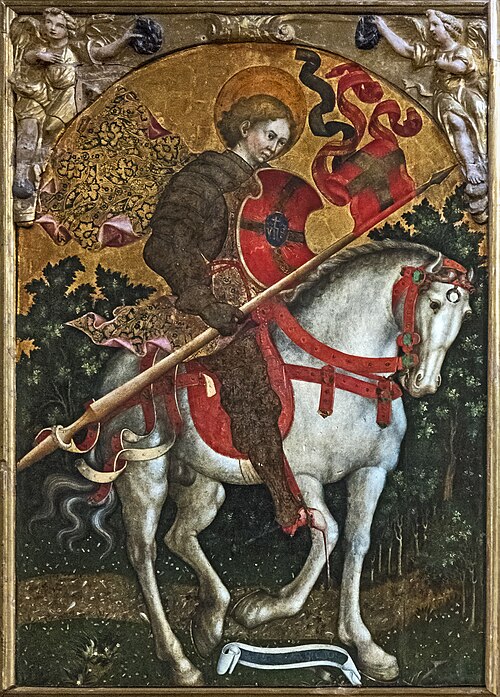
Martyr
Chrysogonus
Officer in the Roman army, martyred in the persecution of Diocletian and venerated at Aquileia.
- Feast
- December 22old style January 4
- Reposed
- 3034th century
- Place
- Aquileia
- Order
- Martyrs
Life
Saint Chrysogonus, martyr, was an officer in the Roman army, put to the sword in the time of the persecution of Diocletian and venerated at Aquileia. He is the teacher and spiritual father of the Holy Great Martyr Anastasia the Deliverer from Potions. The Orthodox Church commemorates him on 22 December, and the Catholic Church on 24 November. He is patron of the city of Zadar in Croatia.
Life According to tradition, Chrysogonus was an officer of the Roman army. Emperor Diocletian offered him the office of prefect of a province if he would renounce Christianity, but he refused and was condemned to death. His name, from the Greek, means gold-born, that is dear or precious. The earliest mention of him is in the Martyrology attributed to Jerome, on 31 May and on 24 November, as a martyr of Aquileia, killed in the persecution of Diocletian and honoured in the city where he suffered.
Around the sixth century a legend arose which made him a Roman and linked him with Saint Anastasia, to explain his veneration in the church of Rome which bears his name. According to it, Chrysogonus was the Christian teacher of Anastasia, daughter of the noble Roman Praetextatus. Cast into prison in the time of the persecution, he comforted by letters Anastasia, sorely tried, who asked him to pray for her husband, Publius, that he might receive the faith. Learning that many Christians in Rome, encouraged by Chrysogonus, would not renounce Christ, Diocletian ordered him brought in chains before him. Chrysogonus remained unmoved before flattery and threats and confessed Christ as the only true God. The emperor, enraged, ordered him taken to a desert place and beheaded. According to the legend, his body was thrown into the sea, but the waves brought it ashore, and the aged priest Zoilus buried it. Tradition places his death on 23 November. Some Greek sources speak of Nicaea as the place of his suffering, others of Aquileia.
Veneration The veneration of the martyr of Aquileia spread very early to Rome, where in Trastevere an ancient church, first mentioned in 499, bears his name. He is named in the Roman Canon, in the prayer Communicantes. The Orthodox commemorate him on 22 December together with his spiritual daughter, Saint Anastasia. At Zadar in Croatia a Romanesque church of the twelfth century was dedicated to him, and part of his relics is kept there in a reliquary made in 1326, in the Permanent Exhibition of Church Art.
Commemorated the same day December 22
 Anastasia the Deliverer from PotionsGreat Martyr · of SirmiumDec 22
 Peter MohylaSaint · Metropolitan of KyivDec 22
- Nikephoros the LeperVenerableDec 22
- AmaswinthusVenerableDec 22
- AthernaseSaintDec 22
- ChaeremonSaint · Bishop of NilopolisDec 22
- Congalach of Ard AegoSaintDec 22
- Demetrius KiranovHieromartyrDec 22
- Didymus of RomeVenerableDec 22
- Eimhin of Ross GlasSaint · Bishop of Ross GlasDec 22
- ErnanVenerableDec 22
- Euodius of NicaeaMartyrDec 22