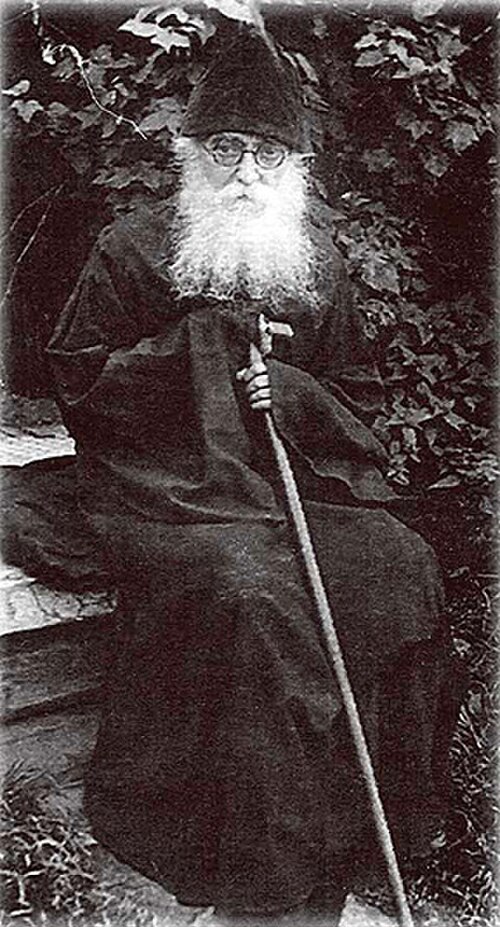
Saint
Anthony Abashidze
Archbishop of Taurida and Simferopol
Schema-archbishop of Georgian princely birth, archbishop of Taurida and Simferopol; died in 1942.
- Feast
- October 19old style November 1
- Reposed
- 194220th century
- Place
- Kyiv Oblast
- Order
- Hierarchs
Life
Saint Anthony Abashidze, Schema-Archbishop and Confessor, was a hierarch of Georgian birth, Archbishop of Taurida and Simferopol, who passed through revolution, exile and years of hidden life, refusing to accept Metropolitan Sergius's Declaration, and departed in the Kyiv Caves Lavra in 1942. A Russian hierarch, he served in Georgia, Ukraine, Turkestan and Crimea. He was canonized by the Orthodox Church in Ukraine as a locally venerated saint in 2011 and 2012, and his day of commemoration is 1 November.
Family and training
Born Prince David Ilyich Abashidze in 1867 at the family estate in the village of Vedzhini, Signagh district, Tiflis governorate, he descended from the Abashidze princes on his father's side and was related on his mother's side to the princely house of Bagration; sources give different birth dates, among them 2 and 12 October. He graduated from the First Classical Gymnasium of Tiflis (1888) and the law faculty of Novorossiya University (1891). On 15 September 1891 he entered the Kyiv Theological Academy, where on 16 November he was tonsured a monk with the name Demetrius and on 21 November ordained hierodeacon. In 1896 he graduated with the degree of candidate of theology with a thesis, "The Orthodox Iberian Church in the Struggle with Islam in the Seventeenth Century", was ordained hieromonk and taught Holy Scripture at the Tiflis seminary. He was then inspector at the Kutaisi seminary (1897) and the Tiflis seminary (1898), and in 1900, as archimandrite, rector of the Alexander missionary seminary.
Bishop in Georgia, Podolia, Turkestan and Crimea
On 16 March 1902 Emperor Nicholas II confirmed the Synod's decision to make him Bishop of Alaverdi, second vicar of the Georgian diocese, and on 23 April he was consecrated at Tiflis, then abbot of the Transfiguration monastery in Tiflis and chairman of the diocesan school council. From 1903 he was Bishop of Guria-Mingrelia and abbot of the Dormition monastery at Martvili, from 1905 Bishop of Balta, vicar of Podolia, and from 20 January 1906 Bishop of Turkestan and Tashkent.
In Turkestan he obtained the return to the diocese's care of the churches given before him to the military protopresbyter of Petersburg, travelled through all the towns and settlements of the region and supervised the building of new churches himself, whose number grew from 78 to 161. He founded the first spiritual periodical of Turkestan, the Turkestan Diocesan Gazette, began holding congresses of the clergy and headed the missionary committee. Difficult relations with the regional administration hindered church work, and criticism came also from deputies in the Duma. His defenders answered in a public letter that between 1906 and 1910 he had established a normal life in a frontier diocese, founded temperance societies, a mutual aid fund, a funeral fund and religious education societies at Tashkent and Vernyi, revived preaching, founded district cathedrals, opened many parishes, raised the education of the clergy by bringing good people from central Russia and asked the Synod for a seminary.
On 25 June 1912 he was named Bishop of Taurida and Simferopol, abbot of the Korsun monastery and chairman of the prison inspectorate. In 1913 he opened missionary courses and a temperance society at Simferopol. On 6 May 1915 he was raised to archbishop. In 1915 and 1916 he was ship's priest on the battleship Saint Panteleimon of the Black Sea fleet. On 5 March 1917 he addressed his flock with an epistle calling on them to forget all quarrels and to obey the provisional government diligently. In 1917 he was vice-chairman of the Fifth All-Russian Missionary Congress and a member of the Local Council, where he took part only in the first session, chaired the eighteenth section, and on 7 December was elected deputy member of the Holy Synod.
When Soviet power was proclaimed in Crimea in 1918, he wrote to Patriarch Tikhon about the sufferings of the peninsula, where church people were harassed in every way, the monasteries of Korsun, Kizil-Tash, Saint George at Balaklava, Chersonesos and Inkerman had been plundered or seized, and the consistory building had been declared property of the "Taurida republic". In 1919 he was one of the organizers and vice-chairman of the South-Eastern Russian Church Council, and in 1920 chairman of the provisional church administration of south-eastern Russia.
Years in retreat
After a stroke, he went blind in his right eye. From 14 September 1921 he lived in retirement at the Saint Paraskeva monastery at Toplovo near Feodosia. In 1922 he was sentenced to a year of forced labour, then amnestied, but on 11 April 1923 he was arrested and expelled from Crimea. He settled at the Kitaev Hermitage near the Kyiv Caves Lavra, in a house with Archimandrite Hermogenes Golubev, the future archbishop and confessor, and then, after its closure, in private lodgings.
He did not accept the Declaration of Metropolitan Sergius Stragorodsky and headed the Ukrainian group of those who ceased to commemorate him. Some scholars consider him, with Fr Anatoly Zhurakovsky, the author of the anti-Sergian Kyiv appeal "To the Children of the Russian Church". In 1928 he was tonsured into the great schema with the name Anthony, after Saint Anthony of the Caves. In 1933 he was arrested and sentenced to five years' imprisonment, suspended, and then lived in a house on Kozlovskaya Street near the lavra. According to some sources he served and ordained in secret, was regarded as the spiritual head of the Kyiv group of the catacomb Church and, from 1926 until his death, the first hierarch of the Georgian catacomb Church. In 1937 he secretly performed the funeral service of the exarch of Ukraine, Metropolitan Constantine Dyakov, tortured to death in prison.
On 27 September 1941, after the Germans occupied Kyiv and the lavra was reopened, he moved there, into the house of the former keeper of the Near Caves, where a small church was restored for him. From the end of 1941 he was deputy chairman of the Council of Bishops of the autonomous Ukrainian Church. He reposed on 1 November 1942 and was buried behind the altar of the church of the Exaltation of the Cross of the lavra, at the entrance to the Near Caves. He liked to repeat: "Episcopal authority was given to me not to punish but to forgive."
Awards and veneration
Among his distinctions were the Order of Saint Vladimir third class (1903) and second class (1911), the Order of Saint Anna first class (1908), a panagia on the ribbon of Saint George for wartime merit (1915) and the Order of Saint Alexander Nevsky with swords (1916). On 21 June 2011 the Holy Synod of the Orthodox Church in Ukraine canonized him as a locally venerated saint, and on 22 April 2012 Metropolitan Vladimir of Kyiv performed the rite of numbering Schema-Archbishop Anthony among the locally venerated saints of the Kyiv diocese. The confessor is commemorated on 1 November (19 October Old Style).
Commemorated the same day October 19
 JoelProphet · The ProphetOct 19
 John of RilaVenerable · Hermit of RilaOct 19
 VarusMartyr · Soldier from EgyptOct 19
 Frideswide of OxfordVenerable · Patron of OxfordOct 19
 CleopatraSaintOct 19
 Gratus of OloronSaint · First Bishop of OloronOct 19
 Savinian of SensHieromartyr · Bishop of SensOct 19
- Potentianus of SensHieromartyr · Bishop of SensOct 19
- AaronVenerableOct 19
- AbselemaSaint · Bishop of EdessaOct 19
- Alexander NikolskyHieromartyrOct 19
- AltinusMartyrOct 19