Venerable
Frideswide of Oxford
Patron of Oxford
English princess and abbess, patron of Oxford and its university; she died in 727.
- Feast
- October 19old style November 1
- Reposed
- 7278th century
- Place
- Oxford
- Order
- Venerables
Life
Venerable Frideswide was an English princess and abbess, the patron of the city of Oxford and its university. She died on 19 October 727, the day on which she is remembered. She is regarded as the founder of a monastery later incorporated into Christ Church Cathedral in Oxford.
She was the daughter of Dida of Eynsham, a sub-king of Mercia whose lands covered western Oxfordshire and the upper reaches of the Thames. The earliest narrative about her, the Life of Saint Fritheswith the Virgin, survives in a manuscript of the early twelfth century. According to it she was born to King Dida and his wife Safrida and, while still young, founded a monastery with her father's help. Her parents died soon after. Algar, king of Leicester, wanted to marry her, although she had vowed virginity. When she refused, Algar tried to abduct her, and Frideswide fled into the wilderness. In her flight she found a ship sent by God, which carried her to Bampton. Algar searched for her at Oxford, but the people refused to tell him where she was, and he was struck blind. In one version he was healed through her prayers.
Later Frideswide sought deeper solitude and moved to Binsey. So as not to have to fetch water from the distant Thames, she prayed to God and a well sprang up. Its water had healing power and many came to it. A well rebuilt in the nineteenth century can be found at the church of Saint Margaret at Binsey. Frideswide then returned to Oxford and remained abbess until her death. Her monastery was an important landowner in the region, but it was destroyed in 1002, in the time of the St. Brice's Day massacre, when a group of Danes was burned in a church by order of King Ethelred.
Her relics were honoured in a shrine at the abbey, where a monastery of Augustinian canons was later built. In 1180 Archbishop Richard of Dover moved the relics to a new shrine in the monastery church, in the presence of King Henry II. Even Catherine of Aragon visited the shrine during her last pregnancy. In 1440 Archbishop Henry Chichele officially declared her patron of Oxford and of the university. The shrine was vandalized several times during the dissolution of the monasteries, and in 1546 the monastery church became the cathedral of the diocese of Oxford, as it remains today. Queen Mary restored the shrine in 1558, but later the Calvinist canon James Calfhill desecrated it, intending to suppress the cult, and her remains were mixed with those of Catherine Dammartin, wife of Peter Martyr Vermigli, and so they remain.
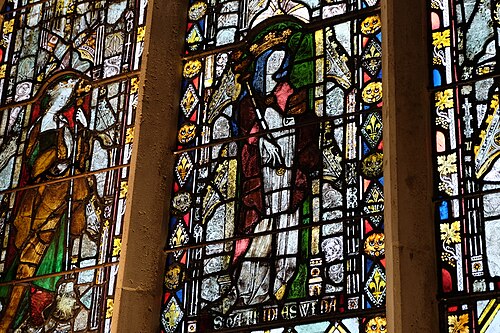
Her feast is kept on 19 October, the day of her death; the translation of her relics is remembered on 12 February and their discovery on 15 May. She is shown with the staff of an abbess, a fountain springing up beside her and an ox at her feet. She appears in medieval stained glass and in one by Edward Burne-Jones, in the chapel of Christ Church Cathedral where her shrine is also found. Pilgrimages to Christ Church have been revived.
Commemorated the same day October 19
 JoelProphet · The ProphetOct 19
 John of RilaVenerable · Hermit of RilaOct 19
 VarusMartyr · Soldier from EgyptOct 19
 Anthony AbashidzeSaint · Archbishop of Taurida and SimferopolOct 19
 CleopatraSaintOct 19
 Gratus of OloronSaint · First Bishop of OloronOct 19
 Savinian of SensHieromartyr · Bishop of SensOct 19
- Potentianus of SensHieromartyr · Bishop of SensOct 19
- AaronVenerableOct 19
- AbselemaSaint · Bishop of EdessaOct 19
- Alexander NikolskyHieromartyrOct 19
- AltinusMartyrOct 19