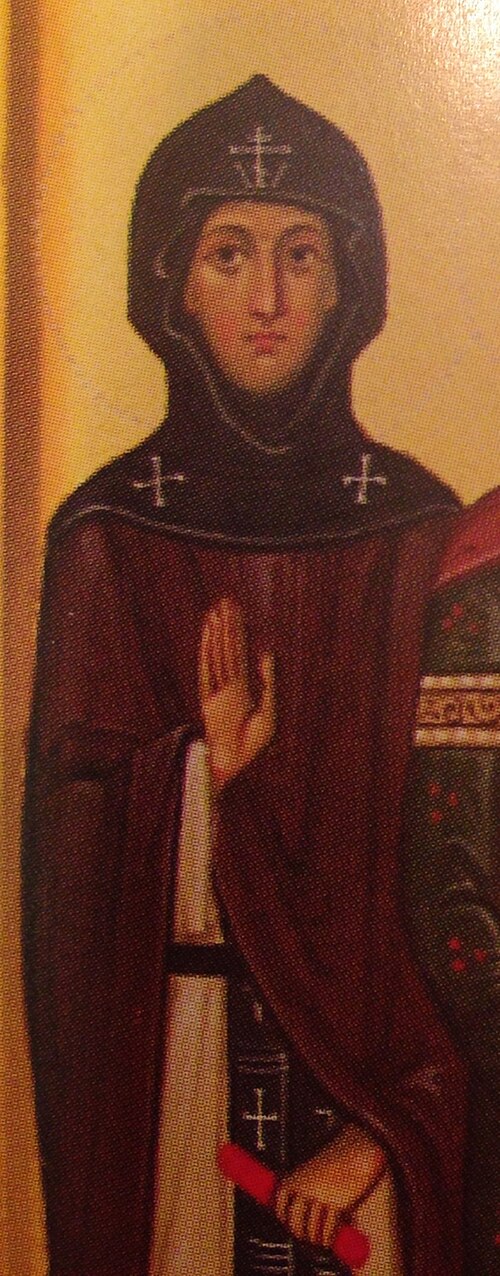
Venerable
Anthousa the Younger
Abbess, daughter of Emperor Constantine V
Daughter of Emperor Constantine V, she embraced monastic life in Constantinople and is honored as a venerable.
- Feast
- April 18old style May 1
- Reposed
- 8099th century
- Place
- Constantinople
- Order
- Venerables
Life
The Holy Venerable Anthousa the Younger (Anthusa of Constantinople, Anthousa of Omonoia) was the daughter of the Byzantine emperor Constantine V and abbess in Constantinople, in the last part of the eighth century and the beginning of the next. She was born in 750 or 757 and fell asleep in 801, 808 or 809. Her feast is on 18 April (in Byzantine calendars, on 12, 17 and 18 April).
Birth
During a campaign in Paphlagonia, the emperor Constantine V, an iconoclast, summoned the abbess Anthusa of Mantineia (Saint Anthousa the Elder), whom he had earlier tortured for venerating icons, and asked for her prayers because of the empress's difficult pregnancy. The abbess predicted the birth of twins, and the daughter was named in her honour. The account was used by Saint Nicodemus the Hagiorite in the Great Synaxaristes. Details of her birth are uncertain. According to one source, she and her brother, the future emperor Leo the Khazar, were twins born on 25 January 750 to Constantine's first wife (Tzitzak), while another states that she was born in 757, a date which would make Eudokia, the third wife, her mother and rule out her being a twin, since it is known for certain that Leo was born on the former date.
Monastic life
When she came of age, her father urged her to marry, but Anthusa desired monasticism and did not follow the emperor's command; under her imperial clothes she secretly wore a hair-shirt. After her father's death she used all her personal property to help the poor and orphans, and gave what was left to monasteries. The devout Empress Irene, wife of Leo and so Anthusa's sister-in-law, held her in high regard and, when in 780 she became regent for her young son Constantine VI, invited her to share the government with her. Anthusa declined. At court she wore clothes befitting her position as the late emperor's daughter, but underneath she wore a hair-shirt. She entered the monastery of Saint Euthymia and was tonsured by Patriarch Tarasios of Constantinople (in 784, according to one source). Later she founded and headed as abbess the Omonoia Monastery ("omonoia" means "concord" or "charity") in Constantinople, known for its strict regulations. As abbess she herself cleaned the church and served the sisters at table.
Her repose and veneration
According to one source, Anthusa lived to the age of fifty-two and died in 801; others claim she died in 808 at the age of fifty-seven (according to Russian and Bulgarian sources, in 809, aged 52). Short lives of her are in the Menologion of Basil II and the Synaxarion of the Church of Constantinople (tenth century). A Russian translation of a short life was made in the first half of the twelfth century and put in the Prologue under 17 April; a translation made on Athos in the fourteenth century is in the verse Prologue under 12 April. No service for her is known, but the Greek menaia have a verse synaxarion for her. In the Catholic Church she is patroness of convents.
Commemorated the same day April 18
 Cyril VI of ConstantinopleHieromartyr · Patriarch of ConstantinopleApr 18
 CalocerusMartyr · Martyr of BresciaApr 18
 John the New of IoanninaNew MartyrApr 18
- Cosmas the ConfessorConfessor · Bishop of ChalcedonApr 18
- Vissarion SelininHieromartyr · PriestApr 18
- Abraham of the High MountainVenerableApr 18
- Acindynus of NicomediaMartyrApr 18
- Auxentius of ChalcedonVenerableApr 18
 Aye of HainautVenerableApr 18
- Basil RatishviliVenerableApr 18
- Bitheus and GenocusHoly VenerablesApr 18
- Caesarius of NicomediaMartyrApr 18