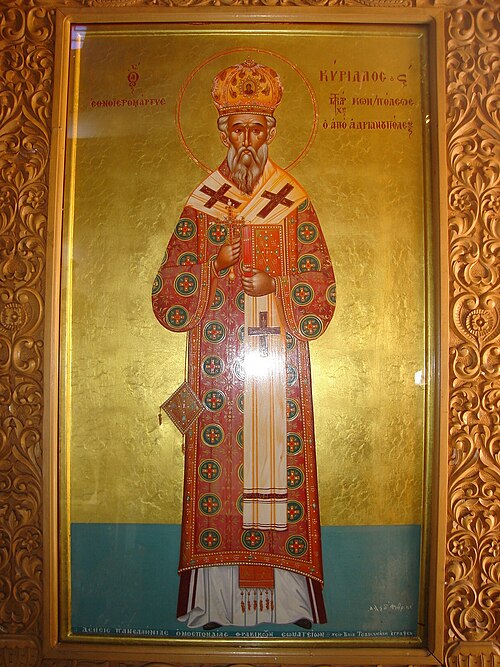
Hieromartyr
Cyril VI of Constantinople
Patriarch of Constantinople
Ecumenical Patriarch from 1813 to 1818, put to death by the Ottomans at Adrianople in 1821.
Life
The Holy Hieromartyr Cyril VI, in the world Konstantinos Serpentzoglou, was ecumenical patriarch of Constantinople from 1813 to 1818 and was hanged by the Turks at Adrianople, on Easter of 1821, at the start of the Greek war of independence. The people called him Ethnomartyras, martyr of the nation. The Church commemorates him on 18 April.
Early life and service as a bishop
He was born in 1769 (other sources say 1775) at Adrianople, in Thrace, of poor parents, originally from Caesarea. He studied in his native city, as a gifted pupil, and gained the protection of Metropolitan Callinicus, later Patriarch Callinicus V, who ordained him deacon in 1791 and took him as secretary. When Callinicus was elected patriarch, in 1801, he made him great archdeacon of the Patriarchate, and Cyril was occupied above all with the organisation of the Patriarchal School, then moved to Kuruçeșme. In September 1803 he was elected metropolitan of Iconium (Konya), where he stayed seven years and worked for founding schools, helping poor students, distributing books and enlightening the people. In 1810 he was moved to the metropolis of Adrianople.
Ecumenical patriarch
On 4 March 1813, after the resignation of Patriarch Jeremias IV, he was elected ecumenical patriarch. He was one of the most learned patriarchs; he knew Turkish too and often taught in church in Turkish the Christians who did not know Greek. He wrote several books, among them a Bulgarian-Greek dictionary, with the help of Bulgarian friends. He took special care of schools: he founded a music school, reorganised the hospital of the nation, printed many books, mainly religious, put the finances of the Patriarchate in order and reopened the patriarchal press and the Great School of the Nation. In 1815 he allowed the monastery of Saint Nicholas at Thera to be rebuilt, and in 1818, by a sigillion, declared the monastery of Kykkos in Cyprus patriarchal and stavropegial. It is speculated that he was an adviser of the Filiki Eteria. According to some, Sultan Mahmud II forced him to resign, which happened on 13 December 1818. He withdrew to Adrianople.
Martyrdom
When the Revolution of 1821 broke out, his name was included in the sultan's order to execute about thirty clerics and notables of Adrianople. He was hanged on 18 April 1821 (Old Style, 22 April New Style) at the gate of the metropolis, on the same day that Patriarch Gregory V was hanged at Constantinople. His body stayed hanging three days (the first time the rope broke, and the Turks took this for superstition) and was then thrown into the Maritsa. Later a villager found his remains and buried them; his grave is still in the yard of a house in the village of Pythio, beside the river.
Veneration
He was recognised as a saint by the Holy Synod of the Church of Greece in 1993, and the Ecumenical Patriarchate canonised him on 11 February 2022 (in other notes, 11 January). He is commemorated on 18 April or on Thomas Sunday.
Commemorated the same day April 18
 Anthousa the YoungerVenerable · Abbess, daughter of Emperor Constantine VApr 18
 CalocerusMartyr · Martyr of BresciaApr 18
 John the New of IoanninaNew MartyrApr 18
- Cosmas the ConfessorConfessor · Bishop of ChalcedonApr 18
- Vissarion SelininHieromartyr · PriestApr 18
- Abraham of the High MountainVenerableApr 18
- Acindynus of NicomediaMartyrApr 18
- Auxentius of ChalcedonVenerableApr 18
 Aye of HainautVenerableApr 18
- Basil RatishviliVenerableApr 18
- Bitheus and GenocusHoly VenerablesApr 18
- Caesarius of NicomediaMartyrApr 18