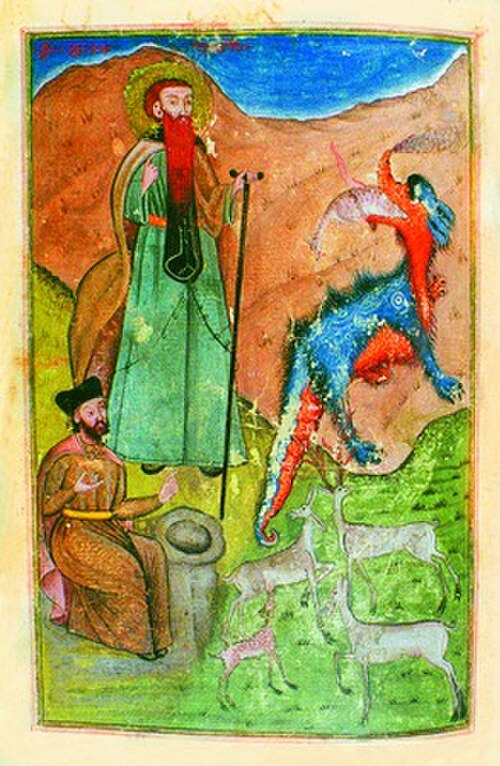
Holy Venerables
Thirteen Assyrian Fathers
Monastic missionaries in Georgia
Group of monastic missionaries who came from Mesopotamia to Georgia in the 6th century to strengthen Christianity.
- Feast
- January 4old style January 17
- Era
- unknown
- Order
- Venerables
Life
The Thirteen Assyrian Fathers (also called Syrian) are a synaxis of monastic missionaries who came, in the middle of the sixth century, from Syria or Mesopotamia to Georgia and are regarded as the founders of Georgian monasticism. They are commemorated as a synaxis on 7 May by the old calendar, 20 May by the new, according to the Serbian source.
Arrival in Georgia
According to tradition, they were disciples of Simeon the Stylite. Saint John of Zedazeni and his twelve disciples came to Kartli around the middle of the sixth century and settled on Mount Zedazeni. The Serbian source relates that, two hundred years after Saint Nino preached the Gospel in Georgia, the Mother of God appeared to John, an ascetic of Antioch, and commanded him to choose twelve disciples and go to Georgia to strengthen the Orthodox faith, which John did. On arrival they were received with honor by the people of Kartli, headed by King Parsman (the Russian and Ukrainian sources give the number IV, the Serbian speaks only of the prince of the land) and by the Catholicos-Archbishop Eulavius (Eulalius in the Serbian source), and they at once began, with zeal, to strengthen the people in the faith. The head of them all was Saint John of Zedazeni.
Then they dispersed to different parts of the country and became confessors and founders of the first monasteries. Two of the Fathers, Abibus of Nekresi and Jesse of Tsilkani, were bishops. According to the Serbian source, with apostolic zeal they strengthened the faith of Christ in Georgia, founded many monasteries and left many disciples after them.
Their names
Their list is this: John of Zedazeni, Abibus of Nekresi, Anthony of Martkopi, David of Gareja, Zeno of Ikalto, Thaddeus of Stepantsminda, Jesse of Tsilkani, Joseph of Alaverdi, Isidore of Samtavisi, Michael of Ulumbo, Pyrrhus of Breti, Stephen of Khirsa and Shio of Mgvime.
Sources and open questions
Lives of the Assyrian Fathers are related in a cycle of medieval Georgian hagiographic texts, unattested outside these sources. Some were formally composed for an eighteenth-century synaxarion, but four of them survive in original form, as does a metaphrastic version. Their dating and authorship are disputed: Catholicoi Arsen I (830-887) and Arsen II (955-980) have been proposed as authors of some, and other, unattributed texts may be older, from the late seventh century. The Russian and Ukrainian sources say that extensive redactions of the lives have come down to us.
Many monasteries in Georgia today bear the names of the Assyrian Fathers and are said to have been founded and led by them and their numerous disciples. In the Middle Ages these foundations played an important role in forging Georgian Christian identity; their monasteries also served the development of barren places and became centers of Georgian literature and learning. Tradition, written and oral, names as many as nineteen Assyrian monks active in Georgia in the sixth century, and the number thirteen seems largely symbolic. Modern scholarly opinion is divided on whether they were Assyrians, Assyrian-educated Georgians, missionaries or refugees from Syria, miaphysite or diophysite, at a time when Georgia was mainly miaphysite, as an English source says.
Commemorated the same day January 4
 ApollosApostle · Apostle of the SeventyJan 4
 Symeon of JerusalemHieromartyr · Bishop of JerusalemJan 4
 EpaphroditusApostle · Envoy of the Church of PhilippiJan 4
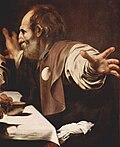 CleopasApostle · Disciple on the road to EmmausJan 4
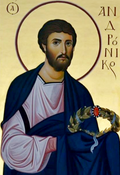 Andronicus of PannoniaApostle · Bishop of PannoniaJan 4
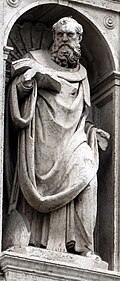 EpaphrasApostle · Companion of the Apostle PaulJan 4
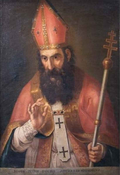 EvodiusApostle · Bishop of AntiochJan 4
 Apelles of SmyrnaApostle · Bishop of HeracleaJan 4
 AchaicusApostle · Of CorinthJan 4
 AmpliatusApostle · Greeted by the Apostle PaulJan 4
 Crispus of CorinthApostle · Bishop of ChalcedonJan 4
 Quartus of BerytusApostle · Bishop of BeirutJan 4