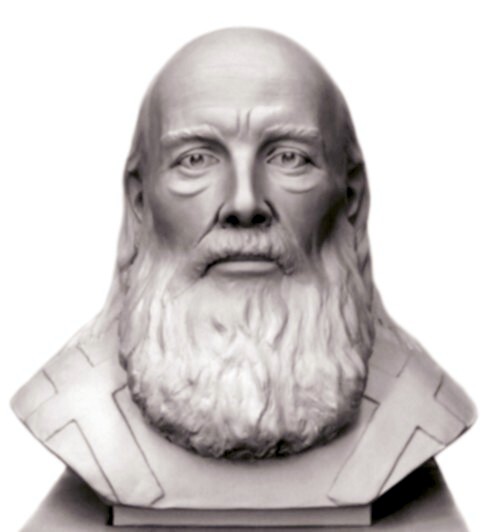
Saint
Arsenius of Elassona
Archbishop of Suzdal
Greek born in Thessaly, archbishop of Suzdal and Tarusa, who died at Suzdal in 1625.
Life
Saint Arsenius of Elassona, also called Arsenius the Greek, was a Greek archbishop from Thessaly who came to Russia as an envoy of the Ecumenical Patriarchate, took part in the founding of the Patriarchate of Moscow and remained there until his death, as archbishop of the Cathedral of the Archangel in the Kremlin and then of Tver and Suzdal. He was also the first rector of the Lviv Brotherhood School, author of a famous school statute and of a Greek-Slavonic grammar, and a valuable witness of the Time of Troubles. He reposed in 1625, and his relics rest in Suzdal.
Family and youth
Most of what is known of his life comes from his own writings and from a Greek life found in the Soumela Monastery near Trebizond. He was born in January 1550 in the village of Kaloriana (today Kalogriana) near Trikala in Thessaly, and in the world was named Apostolis. His father, Theodore, was a priest, and his mother, Chrysanthi, was the sister of Metropolitan Neophytos of Larissa and the niece of Saint Bessarion of Larissa. He had four elder brothers: Joasaph, bishop of Stagoi, Mark, bishop of Demetrias, and the hieromonks Athanasius and Pachomius.
Around 1560 his father died, and his mother entered monastic life. His upbringing was taken on by his eldest brother, Bishop Joasaph, who gave him his first education. From 1568 to 1572 he studied at the school of the teacher Matthew. In 1572 he was tonsured a monk with the name Arsenius, and a few days later Metropolitan Jeremiah of Larissa, the future Patriarch Jeremiah II, ordained him hierodeacon. After the death of his brother Joasaph he lived in the Monastery of Dousiko, where in 1579 he became a hieromonk, and at the end of that year he was appointed priest of the patriarchal church of the Pammakaristos in Constantinople. His contemporaries praised his inner nobility, his intelligence, his learning and his gift for writing.
Archbishop and envoy
On 21 February 1584 he became Archbishop of Dimonikos and Elassona, where he lived until March 1585. With the blessing of Patriarch Theoleptos II he led an embassy to Moscow to commemorate the late Tsar Ivan IV. The pious Tsar Feodor Ivanovich received him very kindly and after a month allowed the envoys to return, sending generous alms to the patriarch.
Rector in Lviv
On the way back the embassy stopped in Lviv. There, attached to the Dormition church, an Orthodox brotherhood had long existed to protect the faithful from Latin influence, and it took special care of its school. The brethren and Bishop Gedeon (Balaban) begged him to stay and head the brotherhood school. Moved by their entreaties, Arsenius agreed, sent the tsar's gifts on to Constantinople and remained in Lviv from 1586 to 1588 as the school's first rector.
He drew up for the school a statute, the “School Order”, one of the oldest school statutes in Europe, in the tradition of the Greek school. At its heart was the equality of pupils: in school the rich could be above the poor only in learning. Before lunch the teacher was to teach the children reading and writing, grammar, rhetoric, dialectic, music, the Holy Gospel and the Apostle, and after lunch the paschalion, arithmetic and church singing. On Saturdays after Vespers he was to speak to them about piety and their Christian duties towards parents and neighbours, and on Sundays and feasts to explain the feast and the readings from the Gospel and the Apostle. The teacher was required to be devout, wise, sober and chaste. The statute became a model for the brotherhood schools of Ukraine, Belarus and Lithuania.
For two years he taught Greek and Slavonic in Lviv and guided the compiling of a Greek-Slavonic grammar, printed in 1591 under the title “Adelphotes”, which later served as a model for the grammars of Lavrentiy Zizaniy and Meletius Smotrytsky. At the end of 1587 Patriarch Jeremiah II sent the Lviv Brotherhood a charter blessing the brotherhood and its school, thereby confirming Arsenius's work.
The founding of the Moscow Patriarchate
In 1588 Arsenius accompanied Patriarch Jeremiah II to Moscow, where they negotiated the establishment of the Patriarchate in Russia. In 1589 he took part, in the Dormition Cathedral, in the election of the first patriarch of Russia, carried the act of election to the tsar and took part in the enthronement of Saint Job. At the farewell audience of the Greek envoys, Tsar Feodor allowed him to remain in Moscow, and he settled in the Kremlin near the tsar's palace. He described his journey and stay in Moscow in a long Greek poem, “The Labours and Sojourn of the Humble Archbishop Arsenius, Who Also Writes of the Elevation of the Patriarch of Moscow”, printed in Turin in 1749 and translated into Russian in 1879, a valuable source for the history of the Russian Church at the end of the sixteenth century.
Archbishop of the Archangel Cathedral
At the end of 1596 or the beginning of 1597 he became archbishop of the Cathedral of the Archangel in the Kremlin, where the tombs of the tsars lay, and served as a kind of representative of the Eastern patriarchs in Moscow. Though a foreigner, he won the respect of all. In 1599 Tsar Boris Godunov granted him lands in the districts of Borovsk, Klin and Moscow. With their income he built and adorned churches, among them the church of the Miracle of the Archangel Michael in the Andronikov Monastery in Moscow, and made many gifts to Russian and Greek monasteries. He also left a description of a shroud (epitaphios) made of pure gold at Boris Godunov's command, with figures of Christ, the Mother of God and the apostles, a treasure later taken to Poland by False Dmitry.
In the Time of Troubles
Living in the Kremlin, he witnessed during the Time of Troubles (1604-1613) the changes of rulers, uprisings, the plundering of foreigners, fires and the deaths of those close to him. He took part in the coronation of False Dmitry I, himself placing the Cap of Monomakh on his head, and in the coronation of Marina Mniszech. He was present at the killing of the pretender and the election of Tsar Vasily Shuisky, and then at the appearance of the second pretender. In a fire in the Kremlin his house also burned. To save it from desecration by the Poles he hid the wonderworking Vladimir icon of the Mother of God in a safe place. He endured hunger, want and illness.
In 1611 he led the Orthodox clergy of Moscow and negotiated with King Sigismund III. At the end of 1612, while he was ill, Saint Sergius of Radonezh appeared to him in a dream and announced that Russia's misfortunes would soon end. At the end of the year he met the liberating Russian army together with all the clergy of Moscow, and in May 1613 he welcomed the young Tsar Michael Romanov and his mother and accompanied them to the tombs of the tsars, where he served a moleben.
Archbishop of Tver and Suzdal
In 1613 he became Archbishop of Tver and Kashin, keeping the title of archbishop of the Archangel Cathedral, and signed sixth, at the Assembly of the Land, the charter electing Tsar Michael. Around 1615 he was appointed Archbishop of Suzdal and Tarusa and gave up his service at the Archangel Cathedral. In 1620 he took part in the council that decided on the reception of Latins and their heresies, and in 1625 in the investigation of the miracles of the Kazan icon of the Mother of God.
Repose and veneration
He reposed on 29 April 1625 in Suzdal and was buried in the Cathedral of the Nativity of the Mother of God in Suzdal. In 1660 a wooden shrine was made over his grave and his image was painted, and icons of him began to appear in some churches. In 1668 Archbishop Stephen of Suzdal found his relics incorrupt. Calendars of the late seventeenth century record the day of his repose (29 April) and the finding of his relics (28 April). The existence of a Greek life shows that he was also honoured in the Orthodox East.
In 1982, at the initiative of Archbishop Serapion (Fadeev) of Vladimir and Suzdal, his name was entered in the Synaxis of the Saints of Vladimir. On 22 February 2015 his relics were translated from the Cathedral of the Nativity to the Dormition church of Suzdal.
Commemorated the same day April 13
 HermenegildMartyr · Visigothic PrinceApr 13
 Artemon of LaodiceaHieromartyr · Priest of LaodiceaApr 13
 Crescens of MyraMartyrApr 13
 Martha TestovaVenerable Martyr · NunApr 13
- AgathodorusMartyrApr 13
- Agathonike of PergamonMartyrApr 13
- Celsus of VercelliSaint · Bishop of VercelliApr 13
- Eleutherius of PersiaMartyrApr 13
- GerontiusMartyrApr 13
- GuinochSaint · BishopApr 13
- Martius of ClermontVenerableApr 13
- Martyrius of JerusalemSaint · Patriarch of JerusalemApr 13