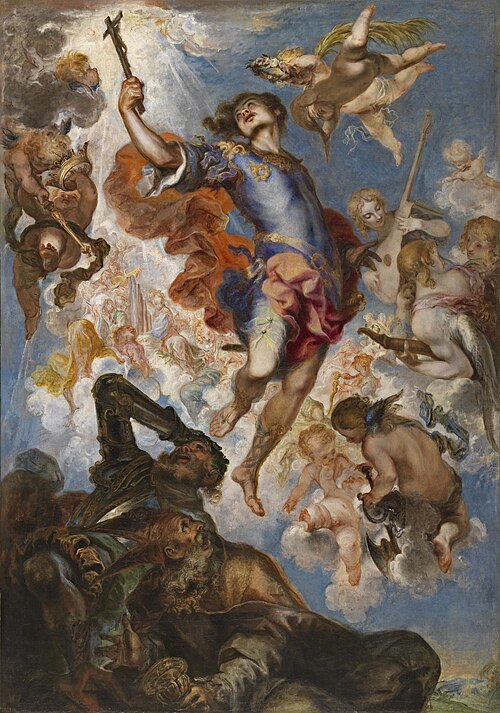
Martyr
Hermenegild
Visigothic Prince
Son of the Visigothic king Liuvigild who embraced the Nicene faith and was killed in 585.
Life
Saint Hermenegild, martyr, was the son of the Visigothic king Leovigild and died in 585, put to death by his father, after receiving the faith of Nicaea. He is commemorated on 13 April.
Marriage and conversion
Hermenegild was the eldest son of Leovigild and the brother of Reccared. He was raised an Arian, the faith of the Visigoths of that time, and his father made him, together with his brother, co-ruler. In 579 he married Ingund, daughter of the Frankish king Sigebert I of Austrasia, who was an Orthodox believer. Hermenegild’s stepmother, Goiswintha, pressed Ingund, who was twelve, to give up her faith, but she remained firm. Leovigild sent his son to the south, to govern on his behalf. There he came under the influence of Leander, bishop of Seville, elder brother of Isidore, and passed from Arianism to the Orthodox faith. His family demanded that he return to Arianism, but he refused.
The revolt and his end
Around that time a revolt began against Leovigild. The accounts of the time put it down to politics rather than difference of faith. He asked the Byzantine Empire for help, but without result. For a time the Suebi supported him, but in 583 Leovigild subdued them again. Hermenegild fled to Seville, and when the city fell, in 584, he went to Córdoba. Leovigild paid the Byzantines thirty thousand pieces of gold and they withdrew, taking with them Ingund and their son. Hermenegild took refuge in a church; Leovigild did not violate the sanctuary, but sent Reccared to offer peace, and he accepted. Afterwards Goiswintha stirred up discord again, and Hermenegild was imprisoned at Tarragona or Toledo. It is told that at Easter an Arian bishop was sent to him, but the saint would not receive Holy Communion from him. The king ordered him beheaded, and he was killed on 13 April 585.
His memory
Isidore of Seville and John of Biclaro, writers of the time, mention only the revolt, not the conversion. Gregory of Tours tells of the conversion and judges him harshly, as a traitor. Pope Gregory the Great is the first to call him a martyr, in the Dialogues, and regarded his death as the foundation of the conversion of his brother Reccared, and through him of the Visigothic kingdom. His veneration grew in Spain; in 1585 Pope Sixtus V authorized it there, and later Pope Urban VIII extended it to the whole Church. In the Orthodox Church he is known from Greek and Slavic calendars.
Commemorated the same day April 13
 Arsenius of ElassonaSaint · Archbishop of SuzdalApr 13
 Artemon of LaodiceaHieromartyr · Priest of LaodiceaApr 13
 Crescens of MyraMartyrApr 13
 Martha TestovaVenerable Martyr · NunApr 13
- AgathodorusMartyrApr 13
- Agathonike of PergamonMartyrApr 13
- Celsus of VercelliSaint · Bishop of VercelliApr 13
- Eleutherius of PersiaMartyrApr 13
- GerontiusMartyrApr 13
- GuinochSaint · BishopApr 13
- Martius of ClermontVenerableApr 13
- Martyrius of JerusalemSaint · Patriarch of JerusalemApr 13