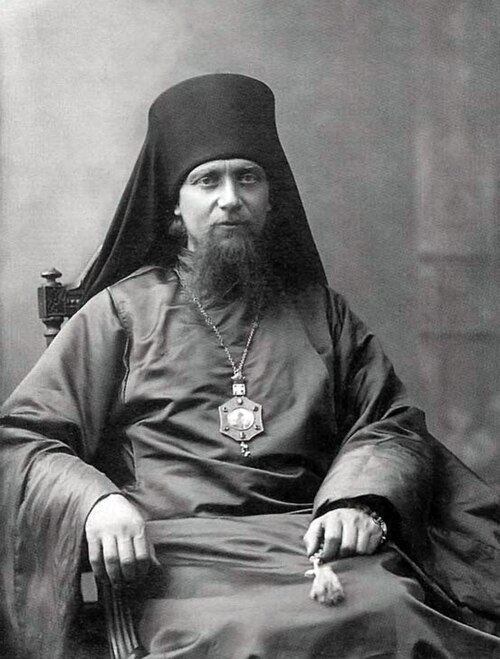
Confessor
Athanasius Sakharov
Bishop of Kovrov
Bishop of Kovrov, confessor and hymnographer, born in 1887 and died in 1962; canonized in 2000.
- Feast
- October 15old style October 28
- Reposed
- 196220th century
- Place
- Petushki
- Order
- Confessors
Life
Saint Athanasius Sakharov, Bishop of Kovrov, confessor, was one of the bishops of the Russian Church who passed through the whole Soviet persecution without denying the faith. Of his more than forty years as a bishop, some three and a half decades were spent in prisons, camps and exile. The Church also honours him as a liturgist and hymnographer, one of the authors of the service to All Saints Who Shone Forth in the Land of Russia.
Childhood and schooling
He was born on 2 July 1887 (Old Style), on the feast of the Placing of the Robe of the Mother of God at Blachernae, in the village of Tsarevka in the Kirsanov district of Tambov province. He was baptised Sergei. His parents, Gregory and Matrona, lived in Vladimir. His father, a native of Suzdal, was a civil official with the rank of court councillor, and his mother came from a peasant family.
His father died while Sergei was still small. After her husband's death Matrona lived an increasingly devout, almost monastic life, and her example marked the boy deeply. He loved the long services of the Church and told his friends and classmates that he wished to become a priest. As a child he learned to sew, a skill he later used to make church vestments and embroider covers for icons.
Learning did not come easily to him, but he did not slacken, and to everyone's surprise he finished the school year at the top of his class. At only twelve he composed his first troparion, to the Shuya-Smolensk icon of the Mother of God. He completed the theological school at Shuya in 1902 and the Vladimir Theological Seminary in 1908.
During his seminary years revolutionary unrest broke out in Vladimir: in the summer of 1901 students held a secret meeting, and in December they went on strike and refused to attend classes. Sergei kept away from all this, unwilling to involve himself in politics. He then studied at the Moscow Theological Academy, graduating in 1912 as a candidate of theology with a thesis on the disposition of the believing soul as reflected in the Lenten Triodion.
Monk and teacher
On 12 October 1912 he was tonsured a monk with the name Athanasius, after Saint Athanasius the Great of Alexandria. Two days later he was ordained hierodeacon, and on 17 October hieromonk. From 6 October 1912 he had already been appointed to teach pastoral subjects at the Poltava seminary.
In August 1913 he became superintendent of the theological school at Klevan in the diocese of Volhynia, and from September of that year he taught homiletics at the Vladimir seminary. He also led the religious and moral readings and the popular talks held at the Dormition Cathedral in Vladimir. From 1914 he sat on the council of the Orthodox Brotherhood of Saint Alexander Nevsky.
In 1917 he was a delegate to the diocesan and all-Russian congresses of clergy and laity and to the second all-Russian monastic congress. He received the pectoral cross and the rank of hegumen. From 1918 to 1920 he represented the monastics on the Vladimir diocesan council. On 20 January 1920 he was raised to the rank of archimandrite and became superior of the Nativity Monastery in Vladimir.
At the Council of 1917-1918
At the monastic congress held in the Trinity-Saint Sergius Lavra he was elected a substitute member of the Local Council of the Russian Church, and from January 1918 he took part in its work. He served in the sections on worship, on monasticism and on church discipline.
He proposed a new edition of the service books that would include all the services, printed and manuscript, to Russian saints, and urged that the veneration of local saints be strengthened in every diocese. He also asked that liturgical distinctions be tied to particular ministries and no longer handed out as rewards, a proposal the section approved. At a plenary session he was co-rapporteur on the rules for the canonisation of saints in the Russian Church.
After the Council restored the feast of All Saints Who Shone Forth in the Land of Russia, Father Athanasius worked with Professor Boris Turaev of Petrograd University on composing its service. This work would stay with him for the rest of his life.
A bishop in the years of persecution
On the eve of his consecration he was summoned to the secret police, where he was threatened and rebuked for accepting the episcopate. He was not deterred. On 17 June 1921 he was consecrated Bishop of Kovrov, vicar of the diocese of Vladimir, by Metropolitan Sergius (Stragorodsky) of Vladimir, Archbishop Evdokim (Meshchersky) of Nizhny Novgorod and Bishop Barnabas (Belyaev) of Pechersk. The next day he was also made superior of the Bogolyubovo Monastery.
On 30 March 1922 he was arrested for the first time and released the following day. On 12 April he was arrested again, together with Metropolitan Sergius, Archbishop Paul (Borisovsky) of Suzdal and the former Bishop Basil (Zummer), in the so-called Suzdal church case. The vestry of one church had been robbed, and the authorities used this to accuse the bishops of resisting the confiscation of church valuables. On 9 June he was sentenced to a year in prison, but was freed under an amnesty the next day. Metropolitan Sergius, banished to Nizhny Novgorod, entrusted him with the church administration of Vladimir and its district.
Bishop Athanasius firmly opposed the Renovationist movement. He was arrested again in July and September 1922 and taken to Moscow, to the Taganka prison. For "stirring up the masses on religious grounds" he was sentenced to two years of exile in the Zyryan region of Komi. The exile began on 14 November 1922 and was spent in the town of Ust-Sysolsk and the village of Kerchomya, until January 1925.
In February 1925 he returned to Vladimir and took charge of the diocese as first assistant to Archbishop Nicholas (Dobronravov), who had been exiled to Moscow. In May the secret police forced him to sign an undertaking not to govern the diocese. In September he nevertheless went to the Renovationist diocesan assembly, called those present to repentance and walked out.
In November 1925 the temporary administration of the diocese was given to Bishop Damian (Voskresensky), who in December joined the Provisional Supreme Church Council, a body set up without canonical basis and with secret police support. Bishop Athanasius then took the care of the diocese upon himself. On 15 January 1926 he blessed the faithful, in the absence of an Orthodox bishop, to seek spiritual guidance from the Orthodox bishops of neighbouring dioceses. He was arrested that same day. Released on 15 March 1926, by which time Bishop Damian had repented, he urged the faithful to turn to him.
From November 1926 he administered the diocese of Ivanovo. The authorities demanded that he either leave of his own accord or cease all church activity, but he refused to abandon his flock.
Solovki and Turukhansk
On 2 January 1927 he was arrested and taken to Moscow, to the Lubyanka and Butyrka prisons. He was sentenced to three years for supposedly belonging to the group of bishops led by Metropolitan Sergius. He served his term in the Solovki camp, at the work sites on Popov Island, Raznovolok, Chupa and Kem. He worked as a watchman and briefly as a bookkeeper, and fell ill with typhus.
In February 1930 he was exiled for three years to the Turukhansk region. In the first half of 1932 he lived there with Metropolitan Cyril, also in exile. In 1933 he returned to the Vladimir region and withdrew from the jurisdiction of Metropolitan Sergius, judging that he was exceeding his powers as deputy locum tenens of the patriarchal throne. His position was close to that of Metropolitan Cyril.
The northern camps
On 18 April 1936 he was arrested on charges of "links with the Vatican" and "with White Guards in Ukraine". These charges were never actually raised under questioning, and the bishop rejected them entirely. The investigators wanted only to know why he refused to cooperate with Metropolitan Sergius, who had declared his loyalty to the Soviet state. For founding a "counter-revolutionary organisation of the True Orthodox Church" he was sentenced to five years in the White Sea-Baltic camps.
In the camp he worked for a time as a cash collector, but criminal inmates stole the money from him and another year was added to his sentence. He then worked at the timber yard, at tree felling and at building a log road. He was a barracks orderly and foreman of a team weaving bast shoes. He was one of the few bishops to survive the mass shootings of prisoners in the camps in 1937 and 1938.
At the start of the war with Germany he was transferred to the Onega camps, walking some 400 kilometres and carrying his own belongings. Again he worked in the timber yard and went hungry, since he could not meet the work quota. In June 1942 he was released and exiled to the Omsk region, where he worked as a night watchman. From January to November 1943 he lived in the town of Ishim.
The last sentence
On 7 November 1943 he was arrested in Ishim, accused of pro-fascist and anti-Soviet agitation and of spreading rumours, and taken to Moscow. Under questioning in April 1944 he openly stated that he could not reconcile himself to a power that did not recognise religion and waged a struggle against it. He added that these were his personal convictions, which he had imposed on no one, and that he had called no one to fight the state.
In 1944 he was sentenced to eight years in the camps in the case of the so-called "anti-Soviet church underground". He passed through camps in Siberia, then at Temnikov and, from July 1947, Dubravlag. He worked cleaning latrines and weaving bast shoes, and from 1947 he was classed as an invalid on account of his age. Kargopol and Mariinsk were also among the places of his imprisonment.
From prison he wrote to his flock that he was far better off there than at liberty, and that the true Orthodox Church was to be found there. In 1945, on learning of the election of Patriarch Alexis I, the bishop and the imprisoned priests with him, who had not commemorated Metropolitan Sergius, agreed together to commemorate the new Patriarch. He later explained that Patriarch Alexis preached no heresy condemned by the Fathers, had been judged by no lawful church authority and was recognised by all the Orthodox patriarchs, so that he could not say that the sacraments celebrated by him and his clergy were without grace. In 1955 Patriarch Alexis received him into communion without asking any repentance for a supposed schism.
Last years at Petushki
After his release he lived from May 1954 to March 1955 in a home for invalids at Zubova Polyana. He was then allowed to move to Tutaev, and in October 1955 he settled in Petushki, in the Vladimir region.
There he gave himself wholly to the study of Orthodox worship and of the lives of the Russian saints. He wrote a substantial work on the commemoration of the departed according to the order of the Orthodox Church. On 6 November 1956 he was appointed chairman of the liturgical and calendar commission of the Moscow Patriarchate's publishing department, and made many corrections to the calendar of saints.
His obituary in the Journal of the Moscow Patriarchate said that everyone who met him felt love, warmth and kindness. His many friends spent hours in conversation with him, hearing of his discoveries in liturgics and hagiography or his deep explanations of liturgical texts, and each went away spiritually enriched and at peace. He reposed in the Lord on 28 October 1962 at Petushki.
Liturgical work
In the 1920s he began to expand the service to All Russian Saints approved by the Council of 1917-1918. He also proposed a second, fixed feast in their honour, on which every Russian church would celebrate only this service, unhindered by any other. He thought it fitting to keep it on 16 (29) July, directly after the feast of Saint Vladimir, enlightener of Russia, so that the feast of the Equal-to-the-Apostles prince would serve as a forefeast to the celebration of all the saints who grew from the seed of faith he had sown.
In 1946 the Moscow Patriarchate published the service to All Saints Who Shone Forth in the Land of Russia in his edition, and from then on the feast came to be kept everywhere on the second Sunday after Pentecost. On the orders of the authorities, however, the text was censored and every reference to the new martyrs was removed.
Once settled in Petushki, he collected and ordered the services to Russian saints. In his letters he asked friends to find and send him services to locally venerated saints, and from them he corrected details of the lives and drew up lists of local saints. The texts he received were carefully edited and brought into a uniform style. In this way several hundred services and akathists came into his archive, which he prepared for "Supplementary Menaia" containing the services of Russian saints missing from the pre-revolutionary Menaia.
He also composed several orders of supplicatory services, among them prayers for those travelling by air, for those in various afflictions, of thanksgiving for alms received, and for the peace of the whole world and the ending of wars. His ideas came to fruition in the Service Menaia published between 1978 and 1989, known informally as the "Green Menaia", which contain the final, fuller text of the service to All Russian Saints and a great number of services not previously found in the liturgical books.
Veneration
In August 2000 the Council of Bishops of the Russian Orthodox Church numbered him among the saints as a holy hierarch and confessor, among the New Martyrs and Confessors of Russia. He is commemorated on 15 October, the day of his repose according to the Old Style calendar, and is especially honoured in the Vladimir region, where his ministry began and where his life came to its end.
Commemorated the same day October 15
 Lucian of AntiochHieromartyr · Presbyter and scholar of AntiochOct 15
 Sarbelus and BebaiaHoly Martyrs · Martyrs of EdessaOct 15
 Aurelia of RegensburgSaintOct 15
- Euthymius the YoungerVenerable · Monk of ThessalonicaOct 15
 John of SuzdalSaint · Bishop of SuzdalOct 15
 Lucian of the Kiev CavesHieromartyr · Presbyter of the Kiev CavesOct 15
- Magdalene of MălainițaSaintOct 15
- Agileus of CarthageMartyrOct 15
- Antiochus of LyonSaint · Bishop of LyonOct 15
- Aurelia of StrasbourgSaintOct 15
- Baoithin of Le'sSaintOct 15
- Bebaia of EdessaMartyrOct 15