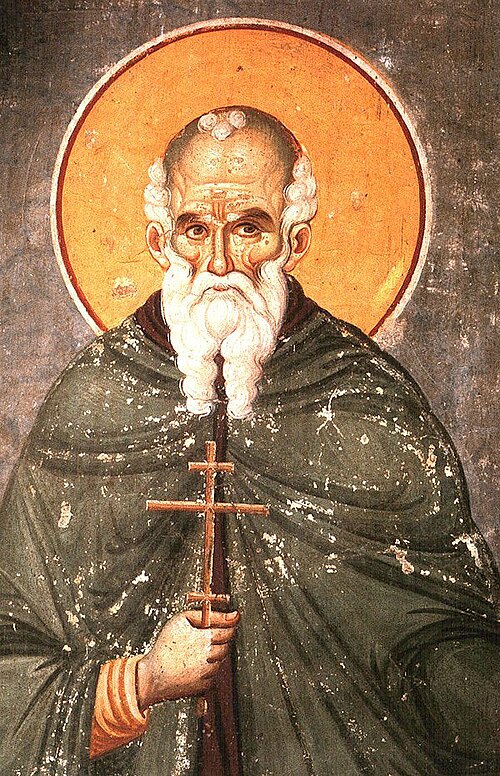
Venerable
Athanasius the Athonite
Founder of the Great Lavra
Byzantine monk, founder of the Great Lavra and of organized monastic life on Athos, who died around 1003.
- Feast
- July 5old style July 18
- Reposed
- 100010th century
- Place
- Mount Athos
- Order
- Venerables
Life
Saint Athanasius the Athonite, venerable, was a Byzantine monk, founder of the Great Lavra and of organized monastic life on Mount Athos. He fell asleep around the year 1000 or 1003, crushed by the collapse of the dome of the church he was building. He is commemorated on 5 July.
Childhood and learning
He was born in Trebizond, around 920-930, of parents who came from Antioch, and received at baptism the name Abraham. He was orphaned early. According to some sources, his father had died before his birth, and his mother soon after, having given him his name. He was raised by a nun, a friend of his mother, who died when he was seven. From her he came to know and love the Christian faith and monastic life. Later he was taken to Constantinople and put in the school of the renowned rhetor Athanasius. He was a brilliant pupil, who quickly outstripped his fellows and came to teach the younger ones himself, winning great fame. He lived austerely, slept little, sat on a chair, ate only bread and water. When his teacher began to envy him, Abraham left the school.
The monastic calling
At that time Saint Michael Maleinos, abbot of the monastery of Kyminas in Bithynia, came to Constantinople. Abraham told him his life and his wish to become a monk, and Michael, seeing his spirituality, grew fond of him and taught him about salvation. At one of these talks the abbot’s nephew, Nikephoros Phokas, then a commander, later emperor, came to him. Abraham and the depth of his thought left a strong impression on Nikephoros. He came to Kyminas, where he was tonsured a monk with the name Athanasius, and stayed there four years. When Michael wished to make him abbot, Athanasius withdrew into the wilderness, then left in 958 for Mount Athos.
On Athos
At first, to remain unknown, he went to the monastery of Zygou, under the name Barnabas. But he was found out and became known as a scholar and as disciple of an old hermit, and many came to see him. Because so many sought him, he moved to a place hard to reach, Melana, where he lived in solitude. Nikephoros Phokas, who was preparing for a battle with the Saracens, called him to bless him and urged him to found a monastery on Athos, in which to gather the scattered hermits. With much gold sent by the emperor, Athanasius began in 963 the building of the church and founded the Great Lavra, which took in several sketes of the mountain. The emperor promised him that he would become a monk himself at the Lavra, but political circumstances and his untimely death kept him from keeping his word. The year 963 is regarded as the beginning of communal monastic life on the Holy Mountain. Around the great church cells were built, a kitchen, a refectory, hospitals, guesthouses and an aqueduct. Soon three other monasteries followed, which exist today.
Opposition and the Tragos
Athanasius met great opposition from the hermits of the mountain, who did not welcome his coming and his attempt to bring order and discipline into their lives. After the death of Nikephoros Phokas, in 969, his enemies prevailed and he had to leave Athos and go to Cyprus, where he stayed until the new emperor, John Tzimiskes, again began to support the Great Lavra. In 972 the monastery received its first charter, kept today at the Protaton, in Karyes, called the Tragos, that is, “goat”, because it was written on goatskin parchment. Spurred by a divine vision, Athanasius returned at once to Athos as abbot and gave a typikon for communities, after those composed by Theodore the Studite and Basil the Great. The old accounts say that his great achievement was to bring to communal life and obedience those who had lived until then as hermits, and to draw so many monks that abbots of many monasteries wished to be simple monks at his Lavra.
Repose and veneration
All his life Athanasius laboured at the building and ordering of the monastery. He died in an accident, when the dome of a church he was working on collapsed, crushing him under the masonry. After his death he was venerated as a saint. Two old lives of him survive. A historic bridge, some five or six kilometres from the Lavra, is attributed to him by tradition. The Great Lavra is in use today and is called by the local people simply “the Lavra”.
Commemorated the same day July 5
 Elizabeth FeodorovnaVenerable Martyr · Grand Duchess of RussiaJul 5
 Barbara YakovlevaVenerable Martyr · Nun of the Martha and Mary ConventJul 5
 Stephen of NicaeaSaint · Bishop honored at Reggio CalabriaJul 5
 Agapitos of OptinaConfessor · Monk of OptinaJul 5
- Lampadus of IrenopolisVenerableJul 5
- Feodor RemezNew Martyr · Secretary of Grand Duke SergeiJul 5
- Grand Duke Sergei MikhailovichNew Martyr · Grand Duke, martyr of AlapayevskJul 5
 Prince Konstantin KonstantinovichNew Martyr · Prince, martyr of AlapayevskJul 5
 Prince Vladimir PaleyNew Martyr · Prince and poet, martyr of AlapayevskJul 5
- Agatho and TriphinaHoly MartyrsJul 5
- Andrija (Šiljak)Hieromartyr · of PljevljaJul 5
- Anna of RomeMartyrJul 5