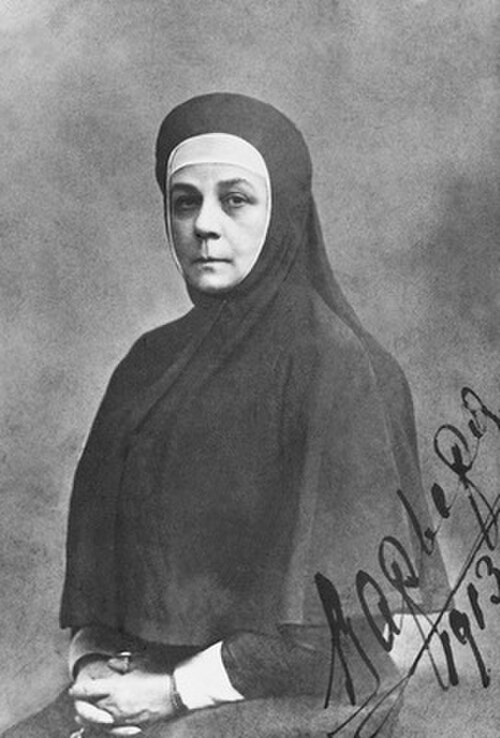
Venerable Martyr
Barbara Yakovleva
Nun of the Martha and Mary Convent
Nun at the convent of Grand Duchess Elizabeth Feodorovna, killed by the Bolsheviks at Alapayevsk in 1918.
Life
The Holy Venerable Martyr Barbara Yakovleva (Nun Barbara, in the world Varvara Alexeyevna Yakovleva) was a nun of the Martha and Mary Convent of Grand Duchess Elizabeth Feodorovna, killed by the Bolsheviks at Alapayevsk, in the night of 18 July 1918, with her abbess. Her feast is on 5 July (Old Style, the day of her death), 29 January (Synaxis of the New Martyrs and Confessors of Russia) and 2 August (Synaxis of the Saints of Moscow).
Life before the convent
Very little sure information about her life before entering the Martha and Mary Convent is known. According to documents, she was from Tver, of the townspeople class. She was born around 1880 (in 1911 she was 31). She knew Russian, English and German. While living at Tver she was directly connected with the Moscow residence of the Grand Duke, the Nikolaevsky Palace in the Kremlin; a document of 13 January 1906 names her as a resident of the Kremlin. She arrived at the Martha and Mary Convent from Yalta on 20 August 1910, and in the same year was one of the first sisters. Small in stature and deeply pious, she had served Elizabeth as maid before taking the veil; she was called Varya. The Grand Duchess and other women also took vows then.
As sisters of Grand Duchess Elizabeth's convent, the women were known throughout Moscow for acts of charity: they took food to the homes of the poor, set up a home for women suffering from tuberculosis, a hospital to care for the sick, and homes for the physically disabled, for pregnant women and for the elderly, and an orphanage. Their charitable work later spread to other cities in Russia. Abbot Seraphim (Kuznetsov) described her as a sister "rare in modesty and obedience," "a faithful keeper of all the traditions of the convent"; though she was the closest to the Grand Duchess, she was not proud of it, but was, like an ordinary sister, accessible to all, gentle and courteous: "No one will remember her with ill." She was Elizabeth Feodorovna's cell-attendant and was always with her.
Exile and martyrdom
On 7 May 1918 Elizabeth Feodorovna was arrested. She was led to the car with Varvara Yakovleva and Sister Ekaterina Yanysheva; the sisters ran after the car as long as their strength lasted. Varvara followed her into exile at Perm with Sister Ekaterina. When the Grand Duchess was moved to Yekaterinburg, Varvara, despite the exhortations and threats of the authorities, would not leave her abbess; she asked in writing to be imprisoned on the same terms as the other prisoners, in full submission, without protest, to feed herself from her own means and not to request release until the end of the imprisonment of the others. She wished to share the abbess's fate, in view of her age and the rule of the convent, which does not allow leaving the abbess alone. The group was confined at Yekaterinburg, then at Alapayevsk.
In the afternoon of 18 July 1918 they were herded at gunpoint into the woods outside Alapayevsk, clubbed on the back of the head and thrown one by one into a mineshaft. All but Grand Duke Sergei Mikhailovich, who had been shot in the head, survived the fall. They could be heard singing hymns from the bottom of the shaft; one by one they lost consciousness and died. According to another source, Varvara was thrown alive into one of the abandoned shafts of the Lower Selimskaya iron mine near Alapayevsk, and the murderers threw earth and old logs on top.
Relics and veneration
The body of Nun Barbara was found on 22 October 1918 by the administration of Admiral Kolchak. Together with the remains of the grand dukes it was carried across Russia, hidden from the Bolsheviks. At Chita, in the Theotokos Monastery, Varvara's body was clothed in monastic habit, and in 1920 it was brought to Beijing and buried in the crypt of the church of Saint Seraphim. Soon, in fulfilment of Elizabeth Feodorovna's wish to be buried in the Holy Land, the bodies of Varvara and the Grand Duchess were taken to Jerusalem, where on 28 January 1921 the bodies of the martyrs were received with honour by Greek and Russian clergy, Princess Victoria and Russian emigres. On 30 January Patriarch Damianos of Jerusalem served the memorial service and the burial of the remains of Elizabeth Feodorovna and Nun Barbara in the crypt of the church of Saint Mary Magdalene Equal-to-the-Apostles in Gethsemane.
On 1 November 1981, by decision of the Council of Bishops of the Russian Orthodox Church Outside Russia, Grand Duchess Elizabeth and Nun Barbara were glorified in the Synaxis of the New Martyrs and Confessors of Russia, as victims of Soviet oppression, and in May 1982 (the Sunday of the Myrrh-bearing Women, 1 May) their relics were moved solemnly from the crypt of the church, where only private veneration was possible, to the upper church, where they were placed in marble shrines by the iconostasis. On 4 November 1992 Varvara was glorified as a saint, with Grand Duchess Elizabeth, by decision of the Council of Bishops of the Russian Orthodox Church. In the same year the Martha and Mary Convent resumed, for the first time since its closing in 1926, its social work. On 8 June 2009 the Prosecutor General of Russia rehabilitated her posthumously, with the other Alapayevsk martyrs.
Commemorated the same day July 5
 Elizabeth FeodorovnaVenerable Martyr · Grand Duchess of RussiaJul 5
 Athanasius the AthoniteVenerable · Founder of the Great LavraJul 5
 Stephen of NicaeaSaint · Bishop honored at Reggio CalabriaJul 5
 Agapitos of OptinaConfessor · Monk of OptinaJul 5
- Lampadus of IrenopolisVenerableJul 5
- Feodor RemezNew Martyr · Secretary of Grand Duke SergeiJul 5
- Grand Duke Sergei MikhailovichNew Martyr · Grand Duke, martyr of AlapayevskJul 5
 Prince Konstantin KonstantinovichNew Martyr · Prince, martyr of AlapayevskJul 5
 Prince Vladimir PaleyNew Martyr · Prince and poet, martyr of AlapayevskJul 5
- Agatho and TriphinaHoly MartyrsJul 5
- Andrija (Šiljak)Hieromartyr · of PljevljaJul 5
- Anna of RomeMartyrJul 5