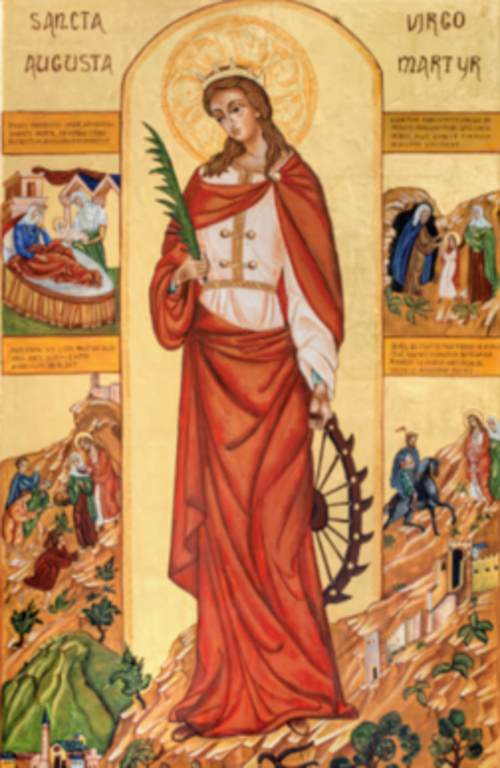
Martyr
Augusta of Treviso
Virgin and martyr
Virgin martyr of the Roman era, venerated at Treviso, Ceneda and Serravalle.
Life
Saint Augusta, virgin and martyr of the Roman era, is venerated at Treviso, Ceneda and Serravalle in northern Italy. Her life is preserved mostly in legendary accounts. The Church commemorates her on 27 March.
Sources
Her Acts were written in the sixteenth century by Minuccio Minucci of Serravalle, secretary to Pope Clement VIII and apostolic protonotary. They were printed at Cologne in 1581 in the collection De probatis sanctorum historiis by the German scholar Laurentius Surius. The account is thought to rest on older legends and traditions. Her name is in Ferrarius's Catalogue of Saints but not in the Roman Martyrology. Some sources place her about the year 100, others in the fifth century.
The story according to tradition
According to her legendary Acts, Augusta was the daughter of Matrucus, pagan chief of the Alemanni, who had conquered and ruled the already Christianized Friulians. In another version Matrucus was one of the captains placed in Venetia after Alaric came into Italy in 402. Augusta's mother died in childbirth, and her father, in his grief, loved his daughter dearly.
Augusta was secretly baptized by a hermit who lived near Serravalle castle and began to live by the Gospel, comforting the Christians persecuted by her father, helping them and praying with them. Some miracles are ascribed to her. When Matrucus learned of it he reproached her, and she firmly defended her faith. He imprisoned her and knocked out her teeth. For a long time she was by turns imprisoned and tortured. She was condemned to the stake but came out unharmed, then was bound to a wheel and thrown from a hill, yet even then suffered no harm. In the end Matrucus beheaded her with his sword at Serravalle, now a district of Vittorio Veneto.
Afterwards, it is said, her father repented, buried her body with honour, spent the rest of his life seeking the truth, and left Serravalle for Germany, his homeland.
Veneration
It is told that her relics were found a few years after her death on the hill named Santa Augusta after her, which overlooks Serravalle, and that a church was built there in the fifth century. The translation of her relics was kept on 1 August and their discovery on 22 August; the main feast is 27 March. The oldest chapel, of the Holy Virgin and Martyr Augusta, has Renaissance frescoes by Giovanni Antonio da Meschio, and her relics are the goal of pilgrimages. With Saint Tiziano she is patron of the city of Vittorio Veneto.
Commemorated the same day March 27
 Rupert of SalzburgSaint · Bishop of SalzburgMar 27
 BaruchProphet · Disciple of the Prophet JeremiahMar 27
 John of EgyptVenerable · Hermit of EgyptMar 27
 Matrona of ThessalonicaMartyr · Martyr of ThessalonicaMar 27
 Ferapont of MonzaVenerableMar 27
 HananiProphetMar 27
- Acutus of AfricaSaintMar 27
- AlkeldaMartyrMar 27
- AmphilochiusMartyrMar 27
- FionntainSaintMar 27
- Haimo of HalberstadtSaint · Bishop of HalberstadtMar 27
- MacedonSaintMar 27