Venerable
John of Egypt
Hermit of Egypt
Hermit of the Nitrian Desert, at first a carpenter, who at twenty-five chose a life of solitude.
- Feast
- March 27old style April 9
- Reposed
- 3944th century
- Place
- Asyut
- Order
- Venerables
Life
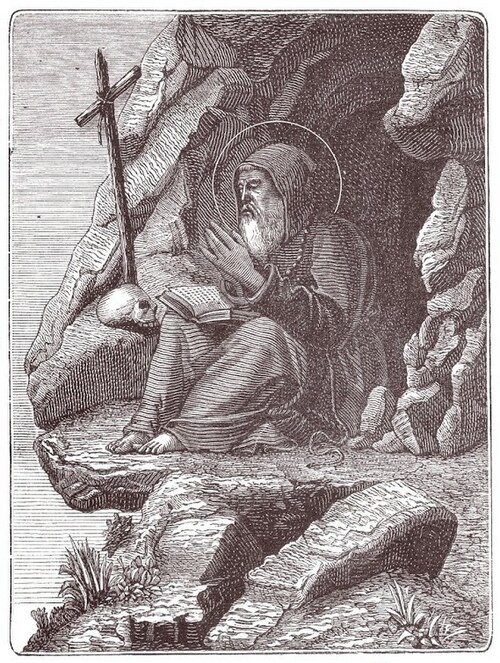
The Venerable John of Egypt (John the Seer, John of Lycopolis) was one of the hermits of the Egyptian desert in the fourth century, at first a carpenter, who at twenty-five chose a life of solitude. He fell asleep in 394. His feast is on 27 March (in the West), and in the Orthodox Church also on 12 June and in the Synaxis of the Saints of Egypt, on 19 January.
He was born around 305 at Lycopolis (now Asyut), of poor parents, and trained as a carpenter. At twenty-five he took the monastic habit under the guidance of an elderly hermit, with whom he stayed ten years, learning from him. John Cassian tells that the elder directed him to water a dry stick every day for a whole year; after this test of obedience the elder threw the stick away. After the elder's death John spent five years travelling and visiting monasteries. According to Alban Butler he was noted for seemingly absurd acts such as rolling rocks from place to place or cultivating dead trees. In the end he withdrew to the top of a cliff near Lycopolis, to avoid all meeting with people, and carved in the rock three small cells, one for sleeping, one for work and one for prayer, then walled them up with himself inside, leaving only a small window. Through it he spoke to the people who brought him bread and water twice a week; on those days crowds gathered to hear him. He ate nothing until sunset and lived fifty years on dried fruit and vegetables; he refused bread and ate nothing cooked. He lived so into his nineties.
He was believed to have the gift of prophecy and saw into the heart of everyone who came to him, able to guess his name, desire and thought. He foretold to the emperor Theodosius the Great several victories and, according to Palladius, who wrote his life, to a monk the office of bishop. To each visitor he gave teaching on humility, as the foundation virtue, showing by examples how pride had cast down many lofty characters. The Prologue of Ohrid tells that he endured great attacks of evil spirits. Blessed Augustine writes that he was tempted by devils and performed healings: he cured a woman of blindness and then appeared to her in a vision, so as not to see her in person. The last three days of his life he spent without food or water, in prayer alone, and he was found in his cell, with his body in an attitude of prayer.
Commemorated the same day March 27
 Rupert of SalzburgSaint · Bishop of SalzburgMar 27
 BaruchProphet · Disciple of the Prophet JeremiahMar 27
 Matrona of ThessalonicaMartyr · Martyr of ThessalonicaMar 27
 Augusta of TrevisoMartyr · Virgin and martyrMar 27
 Ferapont of MonzaVenerableMar 27
 HananiProphetMar 27
- Acutus of AfricaSaintMar 27
- AlkeldaMartyrMar 27
- AmphilochiusMartyrMar 27
- FionntainSaintMar 27
- Haimo of HalberstadtSaint · Bishop of HalberstadtMar 27
- MacedonSaintMar 27