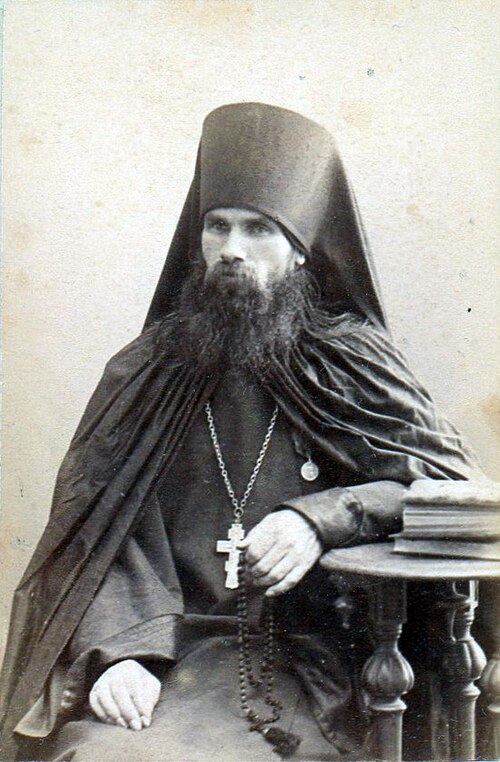
Venerable Martyr
Barlaam Konoplyov
Archimandrite and abbot
Archimandrite and abbot of the Belogorsk Saint Nicholas monastery, born in 1858 and killed in 1918.
Life
Saint Barlaam Konoplyov, Venerable Martyr (in the world Vasily Efimovich Konoplyov, 1858 to 1918), was an archimandrite, founder and abbot of the Saint Nicholas monastery at Belaya Gora, in the Perm region. Born into a family of Old Believer peasants, he became a missionary among the Old Believers and a bearer of understanding between them and the Church, in the arrangement called Edinoverie. He was arrested in August 1918 by the Bolsheviks, with the most prominent monks of the monastery, and perished in circumstances that remain unclear. The Bishops' Council of 2000 numbered him among the saints.
Childhood and search for the truth
He was born on 18 (30) April 1858 in the Yugo-Knaufsky works, Osa district, Perm province (today the village of Kalinino, Perm region), in a family of mining-works peasants, Old Believers without priests. To which Old Believer group he belonged is not clear: in a petition to Bishop Peter he wrote that he had been baptized by three immersions, in the name of the Father and the Son and the Holy Spirit, by a simple man of the runaway-priest group, the teacher Anton Gerasimov Zverev. Present scholars suppose his family was among the chapel-going Old Believers (chasovenny), widespread in Perm province. From childhood he sought God and Truth. He wrote of himself that at ten he learned to read, prayed with the priestless, with old men and ordinary people, and, grown up, came to love reading Scripture.
First he became a reader of books among the priestless Old Believers. The diocesan missionary, Father Stefan Lukanin, hearing of the famous schismatic Konoplyov, set himself the aim of bringing him to right belief. He held many conversations with him, astonishing him by his knowledge of Scripture and sincere conviction. Later, in his autobiography, Father Barlaam wrote of them with gratitude. In 1891, with a companion, he went to Volsk, Saratov and Moscow, seeking the true Church, and came to the conviction that the Belaya Krinitsa (Austrian) hierarchy of the Old Believers was the true Church. After a few months doubts seized him again and he resolved to go to Moscow once more, to go about libraries, where he became convinced of the truth of the Russian Church and of the need to join it for salvation. He was received with love by the abbot of the Edinoverie monastery of Saint Nicholas, Father Paul, stayed a week with them and saw with his own eyes in old books the words over which the Old Believers quarrel and call innovation and heresy, such as the name Jesus, the Creed without the addition "True", alleluia thrice. He visited libraries and saw at the Lavra of Saint Sergius a book written by the hand of Venerable Cyril of Belozersk, with the Creed lacking that addition. Returned home, he spent more years in doubt, praying "that the Heavenly King, if I err in anything, show me the right way".
Entering the Church and monasticism
After many conversations with the missionary, on 17 (29) October 1893, in the cathedral of Perm, Bishop Peter (Losev) of Perm and Solikamsk joined Vasily to the Russian Church by chrismation. On 6 November the bishop clothed him as rassophore and he settled on Belaya Gora, where all desiring monastic life began to gather around him. On 1 (13) February 1894 he received monastic tonsure with the name Barlaam. The next day Bishop Peter ordained him hierodeacon, and on 22 February hieromonk. From then he was named head of the missionary monastery under construction on Belaya Gora. On 20 January (1 February) 1897 the Holy Synod issued a decree founding the Saint Nicholas monastery at Belaya Gora and named Hieromonk Barlaam its first abbot. This is the date of the legal founding of the monastery, which in fact already existed.
He made pilgrimages to Athos and the Holy Land. He was hegumen (1902), dean of the convents (1905) and monasteries (1910) of the Perm diocese, archimandrite (1910), member of the Perm Church Archaeological Society, honorary member of the Perm branch of the Union of the Russian People (1914) and participant in the All-Russian Monastic Congress (1917). On 8 (21) December 1910, at an audience, he gave Emperor Nicholas II a book on the history of the Belaya Gora monastery and photographs of the monastery. He received the Order of Saint Anne, third class (1914) and second (1916). He was a member of the Local Council of the Russian Church of 1917 and 1918, elected from the monastics, as substitute for Archbishop Anthony (Khrapovitsky), in sections II, III, VII, X and XI, and took part in the first session. He laid down his mandate on 20 December 1917.
His end and glorification
On 25 August 1918 the Bolsheviks arrested and took to an unknown place the most active residents of the monastery. Very probably they were tortured and the bodies thrown into the river Kama. At the Jubilee Bishops' Council of the Russian Church of 13 to 16 August 2000, Archimandrite Barlaam (Konoplyov) was glorified as venerable martyr. He is commemorated three times a year: on 12 (25) August, the day of death, on the following Sunday in the Synaxis of the New Martyrs and Confessors of Russia, and in the Synaxis of the Saints of the Perm Metropolis, on the first Sunday after the commemoration of the holy hierarchs of Perm Gerasim, Pitirim and Jonah, a feast entered in the calendar with the blessing of Patriarch Kirill on 10 May 2015. Of his writings there remain the autobiography (1894), a chronicle of the monastery (1897) and the rules of conduct for the brotherhood (1905).
Commemorated the same day August 12
 John NikolskyHieromartyr · PriestAug 12
- Gratilian of Falerii NoviMartyrAug 12
- Rufus of CapuaHieromartyr · Bishop of CapuaAug 12
- Palamon of the ThebaidVenerable · Hermit of the ThebaidAug 12
- Alexander Arapov of BelogorskVenerable MartyrAug 12
- Alexis LopatinHieromartyrAug 12
- Anicetus of NicomediaMartyrAug 12
- Anthony Arapov of BelogorskVenerable MartyrAug 12
- Arcadius Noskov of BelogorskVenerable MartyrAug 12
- Barnabas Nadezhdin of BelogoryeVenerable MartyrAug 12
- Basil InfantievHieromartyrAug 12
- Beighin of Ia Coluim CilleVenerableAug 12