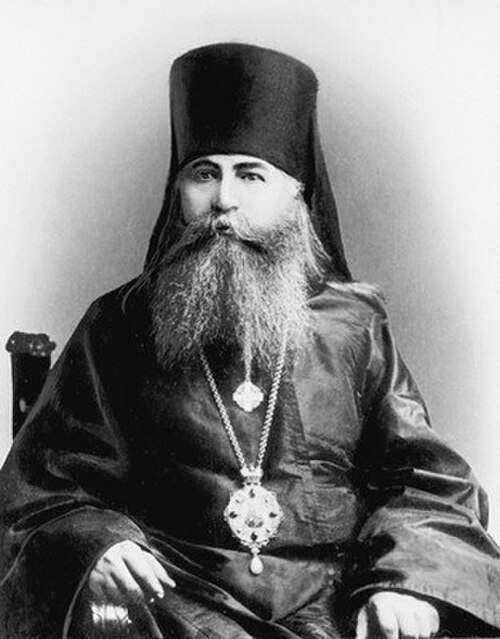
Hieromartyr
Basil Bogoyavlensky
Archbishop of Chernigov and Nezhin
Archbishop of Chernigov from 1916, retired in 1917; killed in 1918 in the Okhansk district of Perm province.
Life
Saint Basil Bogoyavlensky, the Hieromartyr (1867 to 1918), was archbishop of Chernigov and Nezhin, a member of the Holy Synod of the Russian Church and a participant in the Local Council of 1917 and 1918. Sent by Patriarch Tikhon to Perm to investigate the murder of Archbishop Andronik, he was himself shot by soldiers on a train in late August 1918. The Russian Church numbered him among the saints in the year 2000.
Family and training
Basil Dmitrievich Bogoyavlensky was born on 1 February 1867 in the village of Staroe Seslavino, in Tambov province. He was the third of ten children of the priest Dmitry Ivanovich Bogoyavlensky (1840 to 1885), of the church of the Archangel in the village, and Elizaveta Alexandrovna. His grandfather John Stefanovich, founder of the church library at Seslavino, and his forefathers on his grandmother's side had served as priests in the same church. His father and grandfather had been deans of the district. He was a fourth cousin of Metropolitan Vladimir (Bogoyavlensky).
He graduated from the theological school at Tambov in 1882 and the Tambov seminary in 1888, and then the Kazan Theological Academy, with the degree of candidate in theology (1900). There too he defended his master's thesis (1907), "The Second Book of Maccabees: An Introductory Study".
The priest
On 20 September 1888 he was ordained deacon and assigned to the church of the Nativity of Christ at Staraya Degtyanka, where he was also a teacher in a parish school. On 11 March 1890 he was ordained priest at the church of the Protection of the Mother of God at Ovsyanki, in the diocese of Tambov, where he served until 1896, also directing the parish school and teaching religion in it. His wife's incurable illness made him leave his native diocese and move to Kazan, where he attended the academy and continued priestly service, at the Trinity-Theodorovsky convent (1897), at a cemetery church (1901) and at Kazan Cathedral (1905). He was a founding member of the Mother of God brotherhood at the cathedral, a teacher of religion in several schools and a member of committees and of the Church Historical and Archaeological Society.
After his wife's death, no later than 1904, he raised their only son, Dmitry, himself. Her name was Elizaveta Ivanovna, and in the family her portrait, painted, according to their granddaughter, by Ilya Repin, was kept for a long time. In 1908 he received monastic tonsure at the Alexander Nevsky Lavra and was soon named rector of the Chernigov seminary, with the rank of archimandrite.
The bishop
On 26 July 1909 he was consecrated bishop of Sumy, vicar of the diocese of Kharkov. He directed the restoration of the Kuryazh Transfiguration monastery. From March 1911 he was bishop of Novgorod-Seversk, vicar of the diocese of Chernigov, and on 12 May 1911 bishop of Chernigov and Nezhin.
On his initiative and with his preface the album "Pictures of Church Life in the Diocese of Chernigov" was published. The Saint Nicholas Diocesan House was built (today the seat of the Chernigov philharmonic), with a church, a concert hall for sacred music and religious education, and several diocesan institutions, among them some for charity. Already when vicar at Kharkov he had built two new houses for pilgrims who came to venerate the relics of Saint Theodosius. In the diocese of Chernigov he organized a tuberculosis sanatorium for the seminary students. He was spoken of as an excellent administrator and a skilful manager. Above all he cared for works of mercy and for the education of the people under the Church's care: in the six years of his episcopate six new schools were founded for all classes, among them for adults and for girls, and a plan for a higher Orthodox pedagogical institute for women was close to realization.
He received the Order of Saint Vladimir, third class (1912) and second class (1916). On 1 July 1916 he was named acting chairman of the Publishing Council attached to the Holy Synod, and on 5 October 1916 he was raised to archbishop. He was a present member of the Holy Synod in 1916 and 1917.
The trials of 1917
After the February revolution he was arrested twice by the revolutionary authorities of Chernigov province, at the instigation of the Over-Procurator Vladimir Lvov, and was accused of arbitrariness and simony by part of the Chernigov clergy. By decision of the Provisional Government, like other hierarchs, he was removed from the Holy Synod. On 6 May he was sent into retirement as abbot of the Saint Nicholas Terebensky hermitage in the diocese of Tver, but on 11 August 1917 he was named administrator, with the rights of abbot, of the Zaikonospassky stavropegial monastery in Moscow.
In 1918 he was a member of the Local Council of the Russian Church and took part in its third session. He headed the commission for turning the Donskoy monastery in Moscow into a monastery especially for retired bishops.
Martyrdom
At the end of July 1918 Patriarch Tikhon sent him to Perm at the head of a commission to investigate the circumstances of the murder of Archbishop Andronik (Nikolsky). The commission also included Archimandrite Matthew (Pomerantsev), rector of the Perm seminary, and Alexei Danilovich Zverev, a layman of the Moscow diocese and a missionary. After the inquiry they left Perm, but their train was stopped on 27 August 1918 (new style), beyond the bridge over the Kama river.
Red soldiers entered the carriage, took the members of the commission out of the train and shot them, finishing the wounded with bayonets. There are several accounts of the bodies. By one, they were thrown from the Kama bridge into the river. By another, the soldiers buried them at the place of execution but, fearing pilgrimages to the graves of the archbishop and the others killed, dug them up and burned them. One testimony says only the clothes were burned and the bodies were taken in a boat and sunk in the Kama, bound with chains.
Glorification
Bishop Basil's name was entered in the working list of New Martyrs and Confessors of Russia during preparation for the canonization carried out by the Russian Church Outside Russia in 1981, but the list was published only at the end of the 1990s. The Jubilee Bishops' Council of the Russian Orthodox Church in August 2000 numbered him among the New Martyrs and Confessors of Russia for veneration throughout the Church. The other members of the synodal commission, killed with him, were canonized at the same time. On 4 May 2017 the Holy Synod also included him in the synaxis of the Fathers of the Local Council of the Russian Church of 1917 and 1918, commemorated on 5 (18) November.
The saint is commemorated on 14 (27) August, the day of his killing, on 25 January (7 February) in the Synaxis of the New Martyrs of Russia and on 5 (18) November with the Fathers of the Local Council. He left a few works, among them a study of diocesan congresses of the clergy (1902), the study of the second book of Maccabees (1907), the order for the translation and burial of the body of Archbishop Dimitry of Kazan (1908), the album of Chernigov church life (1911) and several pastoral addresses.
Commemorated the same day August 14
 MicahProphet · The ProphetAug 14
- Alexis ZverevMartyr · MissionaryAug 14
 Nazarius LezhavaHieromartyr · Metropolitan of KutaisiAug 14
- Eleutherius PechennikovVenerable Martyr · Schema-archimandriteAug 14
- Germane JajanidzeSaintAug 14
- Marcellus of ApameaHieromartyr · Bishop of ApameaAug 14
- Matthew PomerantsevHieromartyr · ArchimandriteAug 14
- Simeon the New MartyrNew MartyrAug 14
- AeglonVenerable · Anchorite and hegumen of SketisAug 14
- Alexander UrodovConfessorAug 14
- BessarionNew Martyr · ArchdeaconAug 14
- BrocadhSaintAug 14