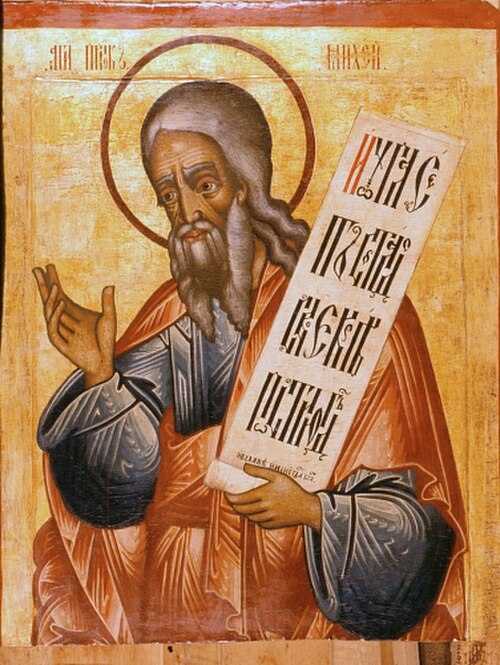
Prophet
Micah
The Prophet
One of the twelve minor prophets, who foretold the birth of the Messiah at Bethlehem.
Life
Saint Micah the Prophet is the sixth of the twelve minor prophets of the Old Testament. His name means "Who is like the Lord?" He is best known for the prophecy that names Bethlehem as the birthplace of the Messiah. The Orthodox Church commemorates him on 14 August.
Micah came from Moresheth, a village in south-western Judah, near Gath, which is why he is called the Morasthite. His book says that he prophesied in the days of Jotham, Ahaz and Hezekiah, kings of Judah, that is, in the second half of the eighth century before Christ. He was therefore a contemporary of Isaiah, Hosea and Amos. According to the synaxarion he laboured for nearly fifty years and belonged to the tribe of Judah.
Unlike Isaiah, who lived in the city and spoke at the royal court, Micah was a man of the countryside, and he spoke for the small and the oppressed against the powerful. He denounced the injustice of the rich, who seized the houses and fields of the poor, and rebuked judges, priests and false prophets who reconciled the people with their sin. Yet he did not stop at rebuke: the book ends with the promise of forgiveness.
The Book of Micah has seven chapters. Its first part announces the fall of Samaria, the capital of the northern kingdom, which came in 722 before Christ, and then the ruin of Jerusalem. Micah says Zion will be ploughed like a field and the temple mount become a heap of ruins. About a century later the elders recalled, in the days of Jeremiah, that King Hezekiah had heard these words and repented instead of putting the prophet to death (Jeremiah 26:18-19).
The best-known prophecy is in the fifth chapter: "But you, O Bethlehem Ephrathah, who are little among the clans of Judah, from you shall come forth for me one who is to be ruler in Israel, whose origin is from of old, from ancient days" (Micah 5:2). When the Magi asked where the King would be born, the scribes sent them to this verse (Matthew 2:5-6). The Church sees here the announcement of the birth of the Lord Jesus Christ from the Virgin in Bethlehem of Judea, and of His eternity before the ages.
Another of his sayings sums up what the Lord asks of man: "He has told you, O man, what is good; and what does the Lord require of you but to do justice, and to love kindness, and to walk humbly with your God?" (Micah 6:8). The book also foretells a time when the nations will go up to the mountain of the Lord and swords will be beaten into ploughshares (4:1-4), and it ends in praise of God, who pardons iniquity and casts sins into the depths of the sea (7:18-19).
The synaxarion says that the holy relics of the prophet were found in the fourth century at Baraphsatia, near Eleutheropolis, through a revelation given to Zeuinos, the bishop of the city. For this reason his feast on 14 August is tied to that discovery. He should not be confused with Micaiah the son of Imlah, who prophesied in the time of King Ahab (1 Kings 22).
His word about Bethlehem is recalled often in the hymns of the Church around the Nativity of the Lord, and a reading from his book is appointed at the Vespers of the Nativity.
Commemorated the same day August 14
 Basil BogoyavlenskyHieromartyr · Archbishop of Chernigov and NezhinAug 14
- Alexis ZverevMartyr · MissionaryAug 14
 Nazarius LezhavaHieromartyr · Metropolitan of KutaisiAug 14
- Eleutherius PechennikovVenerable Martyr · Schema-archimandriteAug 14
- Germane JajanidzeSaintAug 14
- Marcellus of ApameaHieromartyr · Bishop of ApameaAug 14
- Matthew PomerantsevHieromartyr · ArchimandriteAug 14
- Simeon the New MartyrNew MartyrAug 14
- AeglonVenerable · Anchorite and hegumen of SketisAug 14
- Alexander UrodovConfessorAug 14
- BessarionNew Martyr · ArchdeaconAug 14
- BrocadhSaintAug 14