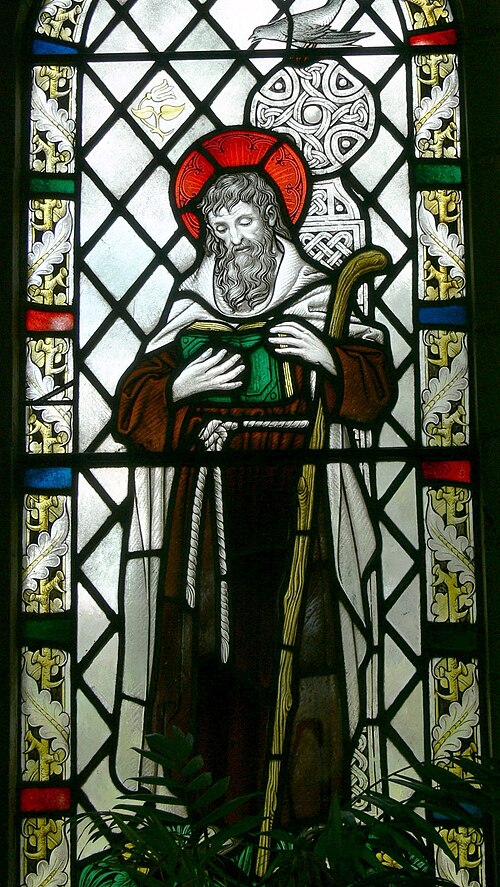
Saint
Brynach
Welsh saint of Pembrokeshire
Welsh saint of the 6th century tied to Pembrokeshire, where several churches are dedicated to him.
- Feast
- April 7old style April 20
- Reposed
- 6006th century
- Place
- Nevern
Life
Saint Brynach (Bernach, Brenach) was a Welsh saint of the sixth century, tied to Pembrokeshire, where several churches are dedicated to him. He is commemorated on 7 April, the day of his death according to the English source. Welsh tradition calls him Brynach Wyddel (the Irishman).
According to a twelfth-century life, early in the sixth century Brynach travelled (from where is not stated) to Rome and Brittany, and then on to Milford Haven. He built various oratories near the rivers Cleddau, Gwaun and Caman and at the foot of Mynydd Carningli (the Mountain of the Angels), his most famous foundation. The monastery founded by him was at present-day Nevern (in Welsh, Nanhyfer). The land was given to him by the local lord, Clether, who retired to Cornwall. Brynach was harassed for a while by King Maelgwn of Gwynedd, until he worked miracles and the two came to terms. His church, beside the river Nevern, is his lasting memorial. The Norman church of Saint Brynach is on the site of the saint's sixth-century clas, an important ecclesiastical centre. The Russian source says that he built himself a hermit's hut and a church at the place called Carn-Engyle (Mountain of the Angels), above Nevern, and that the place received this name because the saint lived in unceasing communion with angels. Some authors identify him with Saint Brannock of Braunton, whose commemoration is on 7 January. The story says that the first cuckoo of spring sings in the churchyard.
The Life of Saint Brynach portrays him as something of a wild fellow in his youth but very virtuous after his conversion. The descriptions of his adventures (including amorous and ghostly encounters) display a degree of humour unusual among writers of saints' lives. The name Brynach may be a form of the Irish name Bernach, which has led to the speculation that he came from Ireland: Iolo Morganwg, followed by Baring-Gould, supposed that he was the same as the chieftain Fernach who came to Wales from Ireland with the young Brychan of Brycheiniog; Egerton Phillimore, however, rejects this identification. A Brennach Wyddel of the North appears in the Welsh Triads, but Rachel Bromwich does not believe the saint is meant. His troparion in English calls him the one who left his native Ireland to seek God in Pembroke's solitude. Dedications of churches to him in Pembrokeshire include Nevern, Dinas Cross, Llanfyrnach, Henry's Moat and Pontfaen; in Carmarthenshire Llanboidy and a chapel in Llanddarog, with scattered dedications in Glamorgan, Brecknockshire and Monmouthshire. Their distribution is similar to that of the Ogham stones of south Wales and defines a distinct Irish-influenced province that existed in the Age of the Saints.
Commemorated the same day April 7
 HegesippusSaint · Church writerApr 7
 Justin PopovićVenerable · Archimandrite of Ćelije MonasteryApr 7
 George the Standard-BearerSaint · Archbishop of MytileneApr 7
 Daniel of PereslavlVenerable · Founder of Danilov MonasteryApr 7
 CalliopiusMartyrApr 7
 Arkady DobronravovHieromartyr · ArchpriestApr 7
- Rufinus of KemetHieromartyr · DeaconApr 7
- 200 Martyrs of SinopeHoly MartyrsApr 7
- AedhSaintApr 7
- Agapitus the BlindVenerable · SchemamonkApr 7
- Ammon of the PentapolisMartyrApr 7
- Aquilina the YoungerMartyrApr 7