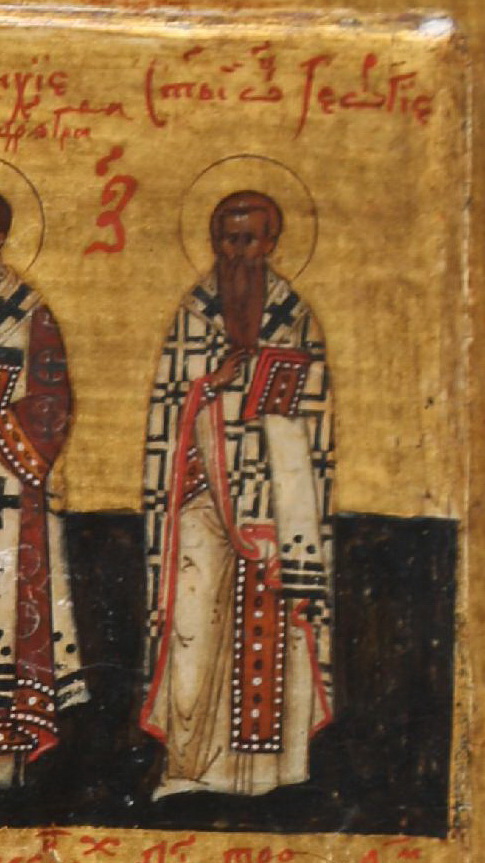
Saint
George the Standard-Bearer
Archbishop of Mytilene
Archbishop of Mytilene from 804 until his deposition in 815, a confessor of the holy icons.
Life
Saint George the Standard-Bearer (George the Confessor) was archbishop of Mytilene from 804 until his deposition in 815, born around 776 and died on 7 April 821 (the Serbian source gives about 816). He is venerated in the Orthodox Church and commemorated on 7 April (20 April by the Gregorian calendar, according to the Serbian source).
He was born around 776 into a wealthy family on the coast of Anatolia, opposite the island of Lesbos. After his parents' death he gave his inheritance to the poor and, at eighteen, became a monk at a local monastery, where he stayed two years. Later he moved to the island of Lesbos and became an ascetic. He gained renown for his piety and, after the death of the bishop of the island, was chosen by the people of Lesbos to succeed him and was ordained archbishop of Mytilene in 804. In 813, in the time of the emperor Michael I, George went to Constantinople to settle some cases, but remained a further two years at the request of Nikephoros, the Ecumenical Patriarch of Constantinople. At the onset of his reign, Leo V, Michael's successor, restored iconoclasm and began to persecute the venerators of icons. In 815 George, together with the Patriarch and others, approached the emperor and petitioned for an end to the persecution. Forthright in his criticism of the emperor, George was flogged with a hundred lashes and exiled to a barren island in the Sea of Marmara. Leo V appointed an iconoclast named Leo as his successor at Mytilene. The Serbian source says that he was summoned by the emperor to Constantinople to a council of bishops which was to destroy, as the emperor wished, the veneration of icons, but he took up the defence of the holy icons, was abused and driven off to the lands of Cherson.
In exile George led a strict life and survived on wild greens. Christians began to travel to the island to confess their sins, hear his teaching and be healed. Several miracles are attributed to him during his exile, among them the healing of a man possessed by a demon, a deaf person, a blind person and others. George became known as the simeiophoros (standard-bearer, wonder-worker). After six years in exile he died on 7 April 821 and was buried on the island. A bright star is said to have shone over the city of Mytilene at the time of his death. In 846 to 847, after the end of iconoclasm, his remains were brought to Lesbos and buried at a place known as the Tria Kyparissia, near the chapel of Saint John the Baptist. His right hand was later moved to Mytilene in the eighteenth century.
Commemorated the same day April 7
 HegesippusSaint · Church writerApr 7
 Justin PopovićVenerable · Archimandrite of Ćelije MonasteryApr 7
 BrynachSaint · Welsh saint of PembrokeshireApr 7
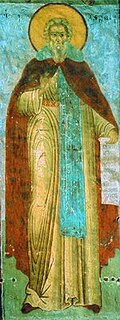 Daniel of PereslavlVenerable · Founder of Danilov MonasteryApr 7
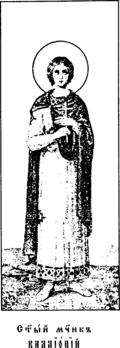 CalliopiusMartyrApr 7
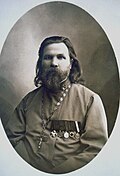 Arkady DobronravovHieromartyr · ArchpriestApr 7
- Rufinus of KemetHieromartyr · DeaconApr 7
- 200 Martyrs of SinopeHoly MartyrsApr 7
- AedhSaintApr 7
- Agapitus the BlindVenerable · SchemamonkApr 7
- Ammon of the PentapolisMartyrApr 7
- Aquilina the YoungerMartyrApr 7