Saint
Chrysolius
Patron of Comines
Saint of Armenian origin, patron of Comines, whose relics were venerated at Bruges.
- Feast
- February 7old style February 20
- Reposed
- 3034th century
Life
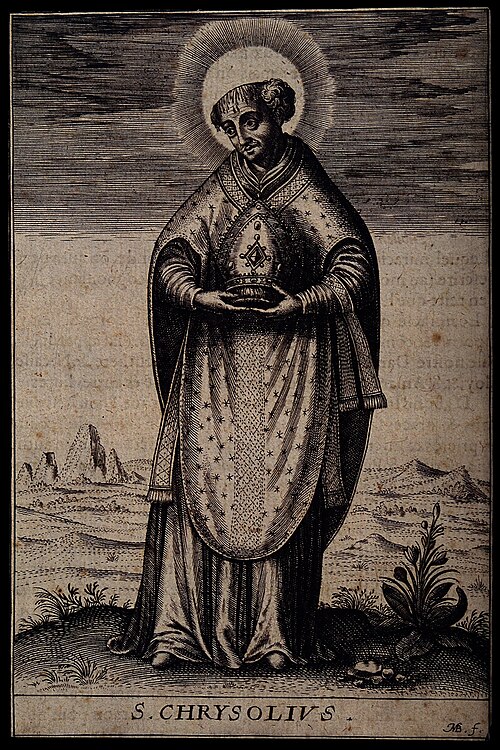
Saint Chrysolius (French Chrysole), called the Armenian, is the patron saint of Comines, today divided between Belgium and France; his relics were venerated in the basilica of Saint Donatian at Bruges. Our sources present him as a saint of the Roman Catholic Church in Belgium, commemorated on 7 February, and show no Orthodox glorification; his life is known only from legend.
The legend
According to tradition, Chrysolius was an Armenian of royal descent who fled to Rome during the persecution of Diocletian, was received by Pope Marcellus I and sent to northeastern Gaul, where he preached at Verlinghem. One source places him at the end of the second century and says he set out to preach in Roman Gaul together with Saint Quentin; the same source says that Quentin was seized at Amiens, while Chrysolius went farther north and proclaimed Christianity, perhaps the first to do so, in the area of Bruges, Comines and Tournai. The dates do not agree, and our data's years 250 and 303 have no support in the text.
The legend also says that he was a disciple of Saint Denis and was sent with Saint Piatus to preach in the area of Cambrai and Tournai. He became a bishop and, stopped by Roman soldiers, was condemned to be beheaded; the top of his skull was sliced off. According to the legend, the piece broke into three parts and a miraculous spring gushed out where each fell. Chrysolius took up the piece of his skull and walked to Comines, where he died, after crossing the ford of the river Deûle, which now bears his name. Another version says that he was beheaded at Quesnoy-sur-Deûle and, holding his head in his hands, reached Comines, where a spring burst forth; a third, that his head was cut off at Verlinghem and from there he went to Comines carrying the bishop's mitre in his hand.
Veneration
The water of the springs where pieces of his head are said to have fallen was believed to cure ailments of the throat and eyes. For centuries Catholics in Belgium venerated two severed heads of the saint, kept in two churches; in the twentieth century doubts arose over their authenticity. In 1967 the bishop of Bruges ordered one of the heads to be sent to the Belgian town of Komen, on the French border. In both Comines, Belgian and French, there are churches of Saint Chrysolius; the church of Saint-Chrysole was rebuilt in neo-Byzantine style between 1922 and 1929, after its predecessor was destroyed in the First World War. His image also appears in the rosette of the façade of the church of Saint-Vaast at Wambrechies, among Saints Hubert, Benedict and Bernard.
Commemorated the same day February 7
 Luke of SteirisVenerable · Founder of Hosios Loukas MonasteryFeb 7
 Parthenius of LampsacusSaint · Bishop of LampsacusFeb 7
 WunnaSaint · Noblewoman of WessexFeb 7
 Alexander ShchukinHieromartyr · Archbishop of SemipalatinskFeb 7
 Maximus of NolaSaint · Bishop of NolaFeb 7
 Paul III of BresciaSaint · Bishop of BresciaFeb 7
- Margaret GunaropuloVenerable Martyr · Abbess of the Menzelinsk ConventFeb 7
- Cyprian YatsenkoNew MartyrFeb 7
- Mastridia of JerusalemVenerableFeb 7
- Vladimir ElizarovVenerable Martyr · MonkFeb 7
- AdauctusMartyrFeb 7
- Adaucus of PhrygiaMartyr · Martyr of PhrygiaFeb 7