Saint
Paul III of Brescia
Bishop of Brescia
Bishop of Brescia in the late sixth and early seventh century.
- Feast
- February 7old style February 20
- Born
- 5506th century
- Order
- Hierarchs
Life
Paul III was bishop of Brescia in the late sixth and early seventh century. He is a locally venerated saint of the Catholic Church, in the diocese of Brescia, and is commemorated on 7 February. Almost nothing is known of his deeds.
In the lists of the bishops of Brescia, Paul III appears as successor of Dominator and predecessor of Paterius. It is thought that he received the see of Brescia around the year 600. His episcopate was probably very short, because his second successor, Anastasius, became bishop in 604.
It is supposed that, like most Italian bishops of the time, he was involved in the dispute over the Three Chapters. Some historians identify him with one of three unnamed Italian prelates who refused to sign the condemnation of the supporters of the Three Chapters, on which their metropolitan insisted. It is supposed that the decision of the bishop of Brescia came not from attachment to schism but from unwillingness to deepen the division among the Christians of northern Italy. Also in his time a certain Bertician tried to obtain the see of Brescia by bribery, but did not succeed.
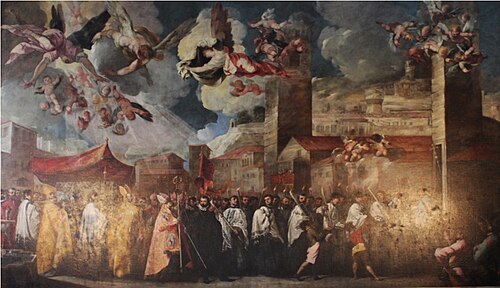
The medieval martyrologies give 7 February as the day of his death. It is thought that he was buried in the basilica of San Andrea de Rebuffone, and afterward his remains were moved to another church, where the other holy bishops of Brescia were also buried: Dominator, Anastasius and Dominic. On 1 November 1581 the relics of these saints were carried to another church, and on 16 February 1604 to the old cathedral of Brescia, where they are kept to this day.
Like all the bishops of Brescia of the third to seventh centuries, from Anatolius to Deusdedit, Paul III was numbered already in the Middle Ages among the locally venerated saints. The main celebration is held at Brescia on 7 February, and in the diocese the days of the translation of the relics, 16 February and 1 November, are also kept.
Commemorated the same day February 7
 Luke of SteirisVenerable · Founder of Hosios Loukas MonasteryFeb 7
 Parthenius of LampsacusSaint · Bishop of LampsacusFeb 7
 ChrysoliusSaint · Patron of CominesFeb 7
 WunnaSaint · Noblewoman of WessexFeb 7
 Alexander ShchukinHieromartyr · Archbishop of SemipalatinskFeb 7
 Maximus of NolaSaint · Bishop of NolaFeb 7
- Margaret GunaropuloVenerable Martyr · Abbess of the Menzelinsk ConventFeb 7
- Cyprian YatsenkoNew MartyrFeb 7
- Mastridia of JerusalemVenerableFeb 7
- Vladimir ElizarovVenerable Martyr · MonkFeb 7
- AdauctusMartyrFeb 7
- Adaucus of PhrygiaMartyr · Martyr of PhrygiaFeb 7