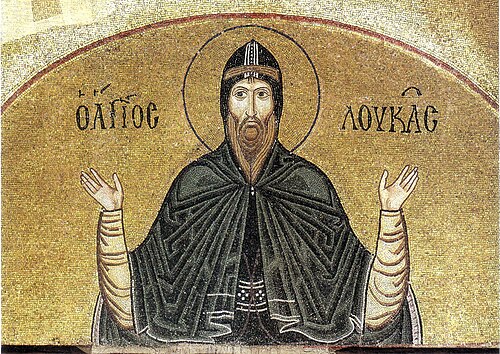
Venerable
Luke of Steiris
Founder of Hosios Loukas Monastery
Monk of Hellas and wonderworker of the tenth century, founder of Hosios Loukas Monastery.
- Feast
- February 7old style February 20
- Reposed
- 95110th century
- Place
- Hosios Loukas
- Order
- Venerables
Life
The Venerable Luke of Steiris, called also Luke of Hellas, Luke the Wonderworker, was a Byzantine monk of the tenth century who lived in the themes of Hellas and Peloponnese in Greece and founded the Hosios Loukas monastery on the slopes of Mount Helicon, between Delphi and Livadeia, near the Gulf of Corinth, in Boeotia. He lived from 896 to 953. He is one of the earliest saints seen levitating in prayer. He is commemorated on 7 February, and the translation of his relics on 3 May. His relics are kept in his monastery.
Childhood and calling
He was born in the Greek village of Kastorion in Phocis, in July 896, the third of the seven children of Stephen and Euphrosyne, parents who came from the island of Aegina, fleeing Arab raids. His Life, written by an unknown monk of Hosios Loukas who had been his disciple, begins, as usual, with signs of his closeness to God from childhood: he did nothing childishly, ate no meat, eggs, milk or cheese, and on Wednesday and Friday fasted until evening. Son of poor farmers, he worked in the fields and tended sheep. Once, going out to sow, he gave nearly all the grain to the poor and sowed what was left, but God gave him a greater yield than in other years. He also gave away his clothes, for which his parents scolded him. His mother saw that in prayer he stood not on the ground but in the air. As a child he tried twice to leave home for a life of prayer in solitude. The first time he wished to go to Thessaly, but was seized by soldiers waiting for runaway slaves and was brought home. The second time he succeeded better: he met two monks travelling from Rome to Jerusalem, who took him to a monastery in Athens, where he received the small habit. His mother, left a widow, prayed day and night for her son's return, and God appeared in a dream to the abbot, commanding him to send him home. He stayed home, but after four months, with his mother's blessing, he left again.
Asceticism
At fourteen, with his mother's blessing, he went to a desolate place on a mountain called Ioannou, or Ioannitza, where he lived seven years as an ascetic. The Life records, with symmetry, that during this time he received the great habit from two monks travelling from Jerusalem to Rome, probably the same two from whom he had received the small habit. His fame spread, and miracles are ascribed to him, among them revealing to two brothers the place where their dead father's treasure was buried. Proofs of his holiness include sleeping in a trench to remind himself of death, or the visit in a dream of an angel who drew from him "a certain fleshly member", freeing him from the temptations of the flesh. He lived on barley bread alone and worked by day in the garden and fields, not for himself but for the poor and visitors.
Exile and return
He had to leave Ioannitza because of the invasion of the Bulgarian emperor Symeon, which he had foretold. With the villagers following, he fled to a nearby island, and nearly perished when attacked by Bulgarians on a stolen ship. After the invaders withdrew, at twenty-one, he enrolled in a school at Corinth, but soon left, finding the other students not serious enough. He then served a stylite at Zemena for ten years (or at Patras, according to another source). He was stranded in the Peloponnese on an errand, because the harbour master would not let him return to Hellas, fearing raids. The hagiographer says: "God perhaps arranged these things beneficially, lest, dwelling too long in the land of Pelops, he do an injustice to his fatherland." After Symeon's death in 927 and the accession of his more peaceful son Peter, Luke returned to Ioannitza to found his community. He drew so many disciples that he could no longer bear the distraction and withdrew farther into the wilderness. Three years later he was displaced again, by a Magyar invasion. As before, he withdrew with the villagers to an island, which he found suitable for solitude, and stayed three years, enduring terrible thirst. In the end his companions persuaded him to leave, and he settled for the rest of his life in the more welcoming surroundings of the present Hosios Loukas, where he founded his hermitage around 946, in the area of Steiris. Here the brethren gathered around the elder and a small monastery grew, with a church dedicated to the Great Martyr Barbara. Dwelling in the monastery, the saint worked many miracles, healing sicknesses of soul and body.
Prophecy and veneration
Saint Luke fell asleep in 953 and was buried in his cell, over which a small church was later built. The monastery flourished after his death, which is linked with the story that, asked about the deliverance of Crete from the Saracens, Luke said: "Romanos will save Crete", and when asked whether he meant the emperor Romanos I, answered: "Not he, but another." Crete was freed in 961 by Emperor Romanos II; remembering the prophecy, he sent builders to Hosios Loukas, with an order to build a church after the likeness of Hagia Sophia. The saint's Life was written in 962 by an anonymous disciple. After the building of the katholikon, his relics were placed in the crypt and later in the church. In the second half of the thirteenth century the monastery was plundered by the prince of Achaia, Geoffrey II of Villehardouin, who took the relics to Venice, a small portion remaining at a monastery on Athos. In 1986 the relics returned to the monastery.
Commemorated the same day February 7
 Parthenius of LampsacusSaint · Bishop of LampsacusFeb 7
 ChrysoliusSaint · Patron of CominesFeb 7
 WunnaSaint · Noblewoman of WessexFeb 7
 Alexander ShchukinHieromartyr · Archbishop of SemipalatinskFeb 7
 Maximus of NolaSaint · Bishop of NolaFeb 7
 Paul III of BresciaSaint · Bishop of BresciaFeb 7
- Margaret GunaropuloVenerable Martyr · Abbess of the Menzelinsk ConventFeb 7
- Cyprian YatsenkoNew MartyrFeb 7
- Mastridia of JerusalemVenerableFeb 7
- Vladimir ElizarovVenerable Martyr · MonkFeb 7
- AdauctusMartyrFeb 7
- Adaucus of PhrygiaMartyr · Martyr of PhrygiaFeb 7