Venerable
Columba of Iona
Abbot of Iona
Irish monk and abbot, founder of the abbey of Iona and missionary of Christianity in Scotland.
- Feast
- June 9old style June 22
- Reposed
- 5976th century
- Place
- Iona
- Order
- Venerables
Life
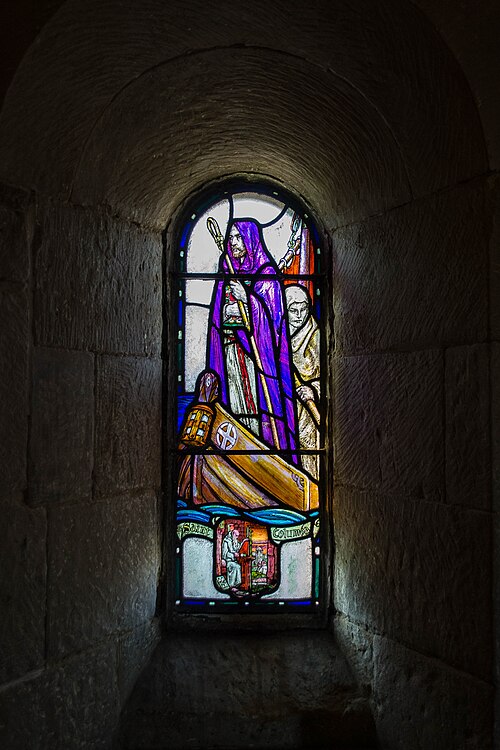
The Holy Venerable Columba of Iona was an Irish monk and abbot, the founder of the monastery on the island of Iona and the enlightener of Scotland. His Irish name, Colm Cille, means dove of the Church. He is one of the Twelve Apostles of Ireland and, with Patrick and Brigid, one of its patrons. The Orthodox Church commemorates him on 9 June (the Menaion date; by the civil calendar of Churches on the old calendar it falls on 22 June).
Youth in Ireland
He was born on 7 December 521 at Gartan in Donegal, to Fedelmid and Eithne, of a royal kindred, the Uí Néill, descended from Niall of the Nine Hostages. His parents may still have been pagans and gave him the name Crimthann, meaning fox. He was raised by the priest Cruithnechán, who baptized him, and the name Colum, dove, later became Columba.
He studied at the monastic schools of Movilla and Clonard, under the two saints named Finnian, and then at Glasnevin, under Mobhí. He was one of the twelve disciples of Finnian of Clonard who are remembered as the Twelve Apostles of Ireland. He was ordained priest and founded monasteries, among them Derry, Durrow, Kells and Swords. It is said that he founded a hundred churches.
Leaving Ireland
Adomnán, the writer of his Life, says that Columba left Ireland two years after the battle of Cúl Dreimhne in 561. Another Life tells that the battle arose from a quarrel with Finnian of Movilla over a psalter that Columba had copied. The high king judged in favour of Finnian: to every cow her calf, so to every book its copy. Scholars warn that the link between the quarrel, the battle and his departure is uncertain.
A synod at Teltown is said to have excommunicated him unjustly, in his absence. Saint Brendan of Birr ran to kiss him, saying he had seen a pillar of light going before him and angels beside him. The synod withdrew its charge. Full of remorse, Columba resolved to win for Christ as many souls as had been lost in the battle, and to live as a pilgrim.
Iona
In 563 he set out with twelve companions in a wicker boat covered with hides. They reached the coast of Kintyre and then settled on the island of Iona, given by Conall, king of Dál Riata. They built cells and a chapel and began to preach the Gospel, baptize and found churches, on the neighbouring islands and inland. Iona became a notable Christian centre for northern Britain and a school of missionaries. Columba is said to have copied three hundred books, and Latin hymns are attributed to him, among them the Altus Prosator.
He visited the Pictish king Bridei at Inverness and won his respect, though not his conversion. Adomnán tells that in the river Ness, Columba stopped a beast that had killed a Pict and was threatening his disciple Lugne; some link it with the Loch Ness legend. In 574 he anointed Aedan mac Gabrain as king, a rite recalling Samuel's anointing of Saul and David. In the same or the following year he went to the assembly at Druim Ceat in Ireland, where he founded the monastery of Drumcliff.
Adomnán wrote his Life in three books: on the gift of prophecy, on miracles and on visions of angels. He even tells that in 634 the saint appeared to King Oswald before a battle and promised him help.
His repose
Thirty years after his arrival on Iona, Columba saw angels who had come to take his soul, but the prayers of the churches gave him four more years. In May 597 he spoke to the brethren of his approaching death. On a Saturday he blessed the barn and said that tomorrow, on the day of rest, he would go the way of the fathers. A white horse that carried the milk came and laid its head on his breast, weeping.
In his cell he copied a psalter as far as the verse of Psalm 33 which says that those who seek the Lord lack no good thing, and said: here I must stop, let Baithene write what follows. He gave the brethren his last command, to love one another and to follow the example of the holy fathers. At the midnight office he went into the church before the others and knelt before the altar. Those who followed saw the church filled with angelic light. They found him lying on the ground and, before he gave up his spirit, he opened his eyes with joy and blessed the brethren with his hand.
He fell asleep in the night toward 9 June 597 and was buried on Iona. It is said that his relics were taken up in 849, because of the Viking raids, and divided between Scotland and Ireland. He is the patron of the city of Derry.
Commemorated the same day June 9
 Cyril of BeloozeroVenerable · Founder of Kirillo-Belozersky MonasteryJun 9
 Alexander of KushtaVenerable · Hieromonk, founder of Kushta HermitageJun 9
 Alexei MechevRighteous · Archpriest in MoscowJun 9
 Kirill of VelskFool-for-ChristJun 9
- Vincent of AgenHieromartyr · Deacon from GasconyJun 9
- Agafia (Maranciuc) of CuselaucaFool-for-ChristJun 9
- Alexander PrusskyHieromartyrJun 9
- Amhalgaidh son of EochaidhSaintJun 9
- AnaniasMartyrJun 9
- Archimandrite RodionSaintJun 9
- BaitheneVenerable · Abbot of IonaJun 9
- CruimtherSaintJun 9