Fool-for-Christ
Kirill of Velsk
Honored in the Arkhangelsk region; his incorrupt relics were found near Velsk, where miracles took place.
- Feast
- June 9old style June 22
- Era
- unknown
- Order
- Fools-for-Christ
Life
Saint Kirill of Velsk (also called Kirill of Vaga) is a Russian saint of the Arkhangelsk region, whose incorrupt relics were found near the old trading post of Velsk (today the town of Velsk). According to tradition he was a tiun, a steward of a Novgorod governor, and died by drowning in the river Vaga. After his relics were found, many miracles took place at his tomb. He is commemorated on 9 June (old style) and on the second Sunday after Pentecost, in the Synaxis of All Saints Who Shone Forth in the Russian Land.
What is known of his life
Information about his life is scanty and rests on an oral tradition set down from the words of a blind old nun, Akilina, nicknamed Nakapa, who had heard it in her youth from old people. According to her, Kirill was tiun to the lieutenants of the posadniks of Novgorod, at a time when Novgorod had not yet been conquered by Moscow. On this basis E. E. Golubinsky held that he could have lived no later than 1478, while E. A. Ryzhova dates the saint's death to the late fourteenth or early fifteenth century.
The only episode Akilina told is the circumstances of his death. For an unknown reason the governor grew angry with his tiun, and the latter ran to drown himself in the river Vaga. He did not succeed, for the water miraculously parted from him in every direction. Seeing the wonder, the governor begged Kirill's forgiveness. Kirill answered, "God will forgive and have mercy," made the sign of the cross, fell face down in the water and this time drowned. Moved, the governor and his servants found the body and buried it with honour beside a church in the ordinary cemetery, not far from where the Vaga meets the Velya.
A later, Synodal redaction of the "Tale of Kirill of Velsk" also says that the saint was young ("in appearance young"). According to Ryzhova, this may be a later insertion meant to justify the iconographic tradition already formed, which showed Kirill as a youth. She also points out that it is unlikely that a Novgorod governor's tiun, who acted as steward and administrator of the Velsk trading post, would have been a young man.
The finding of the relics and the miracles
Around the middle or the second half of the sixteenth century the river washed his body out of the ground, and he appeared in a night vision to a local woman, Evlampia Tolshchebolova, asking her to rebury his relics and build a chapel over them. The astonished woman told the priests and the people; going to the river they found on the bank an old coffin, darkened by time, and carried it to the church. When they opened it, they were amazed to see that the body inside was incorrupt and the clothing as strong as new. The priests asked whether anyone knew who the dead man was, but none could answer. Only the old woman Akilina-Nakapa remembered the story of the governor's tiun's death which she had heard in childhood and, after telling it, asked to be led to the coffin. When she kissed it, the blind woman received her sight, and the witnesses, moved by the healing, placed the relics in a small chapel.
The "Tale of Kirill of Velsk", written at the end of the sixteenth or beginning of the seventeenth century, records nineteen miracles, most of them healings of various illnesses.
Veneration
His veneration as a saint formed among the people of Velsk and nearby villages by 1571 at the latest. On 1 September 1587 the relics were moved from the chapel to the church of Saint Nicholas, and the coffin was placed to the right of the altar. In the Time of Troubles this church was burned in Polish raids, and the relics suffered badly in the fire.
Later a wooden church of the Deposition of the Robe of the Mother of God was built, with a side chapel of Saint Kirill of Beloozero, and Kirill of Velsk's relics were moved there. Dedicating the altar to his namesake Kirill of Beloozero was a way of honouring the local saint Kirill of Velsk, not then officially glorified. On the feast of Kirill of Beloozero, the locals who came to the patronal feast set candles at the tomb and icon of Kirill of Velsk. By established custom the saint was also remembered at the all-night vigil and at matins, in the prayer "Save, O God, Thy people".
Shortly before 1783 the archpriest of the Velsk church that held the tomb asked Bishop Benjamin for permission to repair the floors, put in a new iconostasis, and move the relics to the stone church of the Holy Trinity during the works. The bishop asked the Synod for a decision. Before sending the letter he demanded from Velsk a description of the saint's life and information on his veneration, and ordered a secret examination of the tomb, which showed that the relics had become burnt human bones in a linen bag.
On the basis of these facts the Synod decided to end the veneration of the relics and ordered the bishop to lower the tomb secretly underground where it stood, and to stop naming Kirill in prayers. In 1784 the coffin was buried under the floor. The church was taken down in 1810, and the relics are now considered lost.
Despite the Synod's ban, veneration did not cease. Even more than seventy years after the official prohibition, icons of the saint hung in many houses, offices, and even in the iconostasis and refectory of the Holy Trinity cathedral of Velsk. In 1907-1909 a chapel in his honour was built, without Church permission and at the parishioners' expense (destroyed in the second half of the 1930s). In the early twentieth century a yearly fair, the "Kirillovsky torzhok", was held on the cathedral square of Velsk, and Kirill's day was celebrated in the town until the late 1930s. In the mid-1970s Kirill of Velsk was officially canonized in the Synaxis of All Saints Who Shone Forth in the Russian Land, among the blessed. In 1986 a side chapel of the Dormition church in Velsk was consecrated in his name, and in 2009 a new chapel. Today he is regarded as the heavenly patron of Velsk; on the town's day, which usually coincides with his commemoration, a festival called "Kirill's Day" is held, with fairs and popular festivities.
Iconography
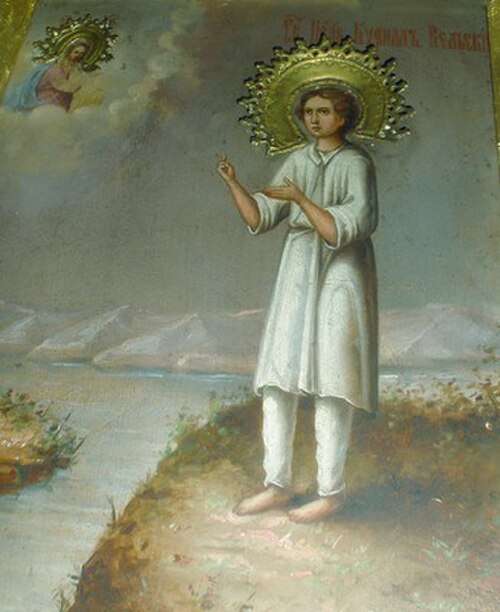
The first icons of Kirill of Velsk appeared no earlier than 1682 and no later than 1783. The saint was usually shown young and beardless, in a shirt tied with a belt. His iconography may have been influenced by the widespread practice in the Russian North of venerating righteous youths (Artemius of Verkola, Jacob of Borovichi, John of Ustyug, Procopius of Ustyan), who were painted in a white shirt. The earliest surviving icon, of the mid-eighteenth century, shows Kirill of Velsk together with the Great Martyr Panteleimon, standing full length and turned toward the centre, praying to the Mother of God with the Child. Kirill is painted as a youth with short, curly brown hair, in white trousers and a belted shirt with a red border pattern, his hands crossed on his chest.
How he is seen today
According to L. A. Dmitriev, the life of Kirill of Velsk is an example of the glorification and veneration of saints who did not perform feats for the faith and were not monks, churchmen or statesmen, but ordinary people of the folk, whose unhappy fate stirred human compassion.
Commemorated the same day June 9
 Columba of IonaVenerable · Abbot of IonaJun 9
 Cyril of BeloozeroVenerable · Founder of Kirillo-Belozersky MonasteryJun 9
 Alexander of KushtaVenerable · Hieromonk, founder of Kushta HermitageJun 9
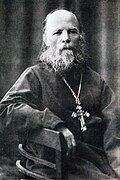 Alexei MechevRighteous · Archpriest in MoscowJun 9
- Vincent of AgenHieromartyr · Deacon from GasconyJun 9
- Agafia (Maranciuc) of CuselaucaFool-for-ChristJun 9
- Alexander PrusskyHieromartyrJun 9
- Amhalgaidh son of EochaidhSaintJun 9
- AnaniasMartyrJun 9
- Archimandrite RodionSaintJun 9
- BaitheneVenerable · Abbot of IonaJun 9
- CruimtherSaintJun 9