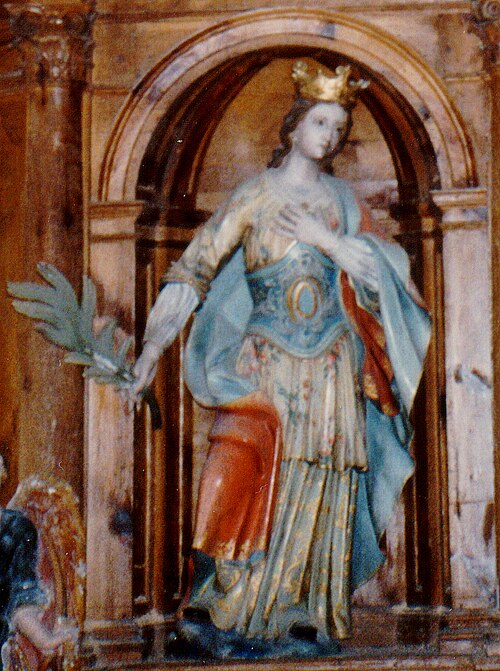
Martyr
Columba of Sens
Virgin from Spain who fled to Gaul to avoid being denounced as a Christian, martyred at Sens in 273.
- Feast
- December 31old style January 13
- Reposed
- 2733rd century
- Place
- Sens
- Order
- Martyrs
Life
The Holy Martyr Columba of Sens was a virgin from Spain who fled to Gaul so as not to be denounced as a Christian and received a martyr's death at Sens, in 273. Her feast is on 31 December.
According to tradition she was born into a noble pagan family in the north-west of the Iberian Peninsula (Galicia, in some sources at Zaragoza); her earlier name may have been Eporita. Her stories are in part legendary. She left Spain as a child, at sixteen according to some sources, for Gaul, according to some accounts because she had been told that there flourished a more beautiful religion and because she had an insurmountable horror of idols. At Vienne she was baptised and received the name Columba (dove). She went on to Sens, where she was martyred. The emperor Aurelian, who ruled between 270 and 275, passed through Sens and put all the Christians there to death, but Columba alone found favour in his eyes, because of the nobility and beauty of her features. He wanted her to marry his son; she refused, and he shut her up in a place of shame in the town's amphitheatre. A guard tried to dishonour her, but a she-bear kept nearby in the amphitheatre attacked him and saved her. Aurelian wished to burn both Columba and the bear alive, but the bear escaped, and a rain put out the fire. Columba was condemned to death and beheaded, perhaps near a fountain called d'Azon. Her body was left on the ground, but a man, Aubertus, who had prayed to her to restore his sight, took care of the burial. Over her relics a chapel was raised, and then the abbey of Sens, a place of pilgrimage in her honour.
She was venerated throughout France; the historical monuments of Sens still testify to this devotion. She is patron of Andorra. In icons she is shown as a crowned maiden, in chains, holding a book and a peacock's feather, with a she-bear or a dog on a chain; her principal attribute is the she-bear. Her cult was probably a combination with that of another virgin martyr, Columba of Spain. The Italian poet Lucrezia Marinella wrote in 1595 an allegorical Christian epic poem about her, and the municipality of Santa Comba in Galicia bears her name.
Commemorated the same day December 31
 Theophylact of OhridSaint · Archbishop of OhridDec 31
- Marius of AvenchesSaint · Bishop of AvenchesDec 31
 Melania the YoungerVenerable · Ascetic of RomeDec 31
 Dositej VasićConfessor · Metropolitan of ZagrebDec 31
- Sabiana of SamtskheVenerable · Abbess in SamtskheDec 31
- Gelasius of NilopolisVenerable · Abbot in EgyptDec 31
- Hermes of BononiaSaint · Exorcist of BononiaDec 31
- Michael BerezinHieromartyr · PriestDec 31
 Barbatian of RavennaVenerableDec 31
- Cyriacus of BisericaniVenerableDec 31
- Cyriacus of TazlauVenerableDec 31
- Dominanda of RomeMartyrDec 31