Confessor
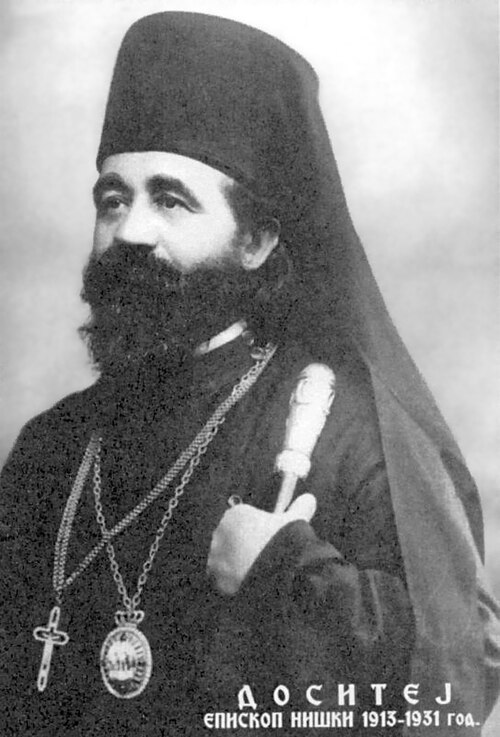
Dositej Vasić
Metropolitan of Zagreb
First Serbian Metropolitan of Zagreb, a victim of Ustasha persecution during the Second World War.
- Feast
- December 31old style January 13
- Reposed
- 194520th century
- Place
- Belgrade
- Order
- Confessors
Life
Saint Dositej (Dositheus) Vasić, Hieromartyr and Confessor, born Dragutin Vasić, was bishop of Niš and the first metropolitan of Zagreb in the Serbian Orthodox Church. He was born in Belgrade on 5 December 1877 and fell asleep in the Lord there on 13 January 1945, from the sufferings he endured in the Ustasha prison in Zagreb. The Serbian Church numbered him among the saints in 2000, and his commemoration is on 13 January (31 December in the old calendar).
Studies
He attended the gymnasium and seminary in Belgrade. While still a seminary student he became a monk and was ordained deacon, in 1899. In 1900, as a stipendiary of the fund of Metropolitan Michael Jovanović, he was sent to the Theological Academy of Kiev, which he finished in 1904 as hieromonk, with the title of candidate (master) of theology. He then spent two years of theology and philosophy at the University of Berlin and studied theoretical and experimental philosophy at Leipzig. In 1907 he returned home and taught as lecturer at the Saint Sava seminary in Belgrade. In 1909, with a scholarship from the ministry of education, he went to France, where he studied philosophy and the social sciences at the Sorbonne and the School of Higher Social Studies, and at the end of 1910 he moved to Geneva. There the start of the First Balkan War found him, in the autumn of 1912. He returned home and helped with all his strength the liberation and union of the Serbian people.
Bishop of Niš
On 25 May 1913 he was consecrated bishop of Niš. In the wars he gave soldiers spiritual support, and at the start of the First World War he laboured much for refugees and orphans. After the Serbian army's retreat he did not leave his residence, and right after the occupation of Niš he was interned by the Bulgarian occupation authorities. Sources record that immediately afterwards the occupiers cruelly killed 150 priests. He could return to his see only in 1918, with his health greatly shaken by captivity.
In 1918 he was deputy of the central committee for the union of the Serbian Church. After his return he organized homes for orphans, worked much with young people, founded charitable societies and opened, at one of the monasteries of the diocese, a home for blind children. By his care monuments were raised to Serbian national heroes who gave their lives for the freedom of the fatherland, and a monument was set up to Bishop Melentije of Niš and the priests killed in 1821.
After the formation of Yugoslavia, conditions were favourable for uniting the Serbian dioceses and metropolitanates into a single Church. Bishop Dositej, as assistant to the president of the Council of Bishops, took part in the negotiations with the Patriarchate of Constantinople for the restoration of the Serbian patriarchate, and on 12 September 1920, at Sremski Karlovci, the union of the Serbian Orthodox Church and the restoration of the patriarchate were solemnly proclaimed.
Mission to Czechoslovakia and Subcarpathian Rus
Soon, at the request of several Subcarpathian Rusyns, Czechs and Slovaks, the Council of Bishops sent Bishop Dositej to Czechoslovakia. On 21 August 1920 he reached Subcarpathian Rus and visited the village of Iza, the centre of Orthodoxy in those parts, where he was given a solemn welcome, and then several villages where he served. At Velikie Luchki he received three Uniate schoolteachers into the Orthodox Church. In August 1920, under his chairmanship, delegates from 60 Orthodox villages discussed the first questions of organization of the Church of Subcarpathian Rus and asked him not to withdraw his care from it and to take over its governance until the final canonical decision. A statute for the new Church was drawn up, and to have it approved by the central authorities the bishop went to Prague, where on 28 and 29 August 1921 the Second Council of the Czechoslovak Church was held. He then returned to Serbia and gave the Council of Bishops a report on Orthodoxy in Czechoslovakia and Subcarpathian Rus. Serbian sources say he spent three years in Czechoslovakia as an excellent missionary and afterwards kept contact with the young Church there. In January 1922 he took part in an international conference on aid to the starving in Soviet Russia.
Metropolitan of Zagreb
In 1931 the diocese of Zagreb was formed from parts of the dioceses of Plaški and Pakrac. On 8 October 1932 the Council of Bishops unanimously elected him metropolitan of Zagreb, and he was enthroned on 9 April 1933. He laid firm foundations for the new metropolitanate and gave it the standing proper to such a political and cultural city. In Zagreb he founded the monastery of Saint Paraskeva (Petka). He also governed the dioceses of Plaški and Banja Luka and helped the aged bishop Miron Nikolić of Pakrac until the latter's death in 1941. During the illness of Patriarch Varnava he ran the affairs of the Serbian Church as the senior member of the Synod, and after Varnava's death until the election of Patriarch Gavrilo Dožić in 1938 he governed the archdiocese of Belgrade and Karlovci. On 29 September 1935, on the feast of Saint Wenceslas, he took part in the consecration of the cathedral of Saints Cyril and Methodius in Prague, and in 1939 he went again to Czechoslovakia for the consecration of the new Orthodox cathedral at Olomouc. He spoke Russian, Czech, German and French well, and received several Serbian and foreign decorations.
Suffering and repose
Immediately after the proclamation of the Independent State of Croatia, on 10 April 1941, the metropolitan was arrested by the Ustasha, together with his deacon, Lazar Živadinović. On the day of arrest he was ill and lying in bed; they led him into the street half dressed, and the crowd mocked and struck him. He was locked in the prison in Petrinjska Street, and a Belgian consul, Arnold Robert, who saw his disfigured body through an opening in the door of cell 8, said that what these men were doing was savagery.
Gravely ill, he was moved to a hospital of nuns, which for him was more a prison than a place of healing. According to testimonies, the nuns did not treat him but tormented and humiliated him almost daily, and his beard was torn out almost entirely. The head of the Ustasha police in Zagreb, Božidar Cerovski, testified that the metropolitan was so mutilated that he was loaded barely alive onto the train for Belgrade. After years of attempts by General Nedić to save him, he was brought to Zemun in a freight wagon, and the German occupation authorities took him over and led him to Belgrade. A Belgrade prison doctor told that two SS soldiers brought into his office a man in rags, breathing hard and unable to speak, his body covered in bruises; the Germans said they had found him in the police prison in Zagreb and, learning he was a Serbian bishop, decided to move him to Belgrade. At the insistence of the Serbian government he was released from hospital and was long treated. He fell asleep on 13 January 1945 at the Vavedenje monastery in Belgrade, from the effects of the torments, and was buried in the monastery yard.
Canonization
On 22 May 2000 the Council of Bishops of the Serbian Orthodox Church numbered him among the saints, in the rank of confessors, together with other Serbian new martyrs who suffered in the middle of the twentieth century at the hands of the Croatian Ustasha and the communist terror. On 27 December 2000 the Holy Synod of the Russian Church entered him in its diptychs with eight other Serbian new martyrs, and on 23 December 2010 the Synod of the Ukrainian Orthodox Church included him also in the Synaxis of the Saints of Subcarpathian Rus. On the evening of 12 May 2008 his holy relics were carried in prayer from the grave in the yard of the Vavedenje monastery into the church itself.
Commemorated the same day December 31
 Theophylact of OhridSaint · Archbishop of OhridDec 31
- Marius of AvenchesSaint · Bishop of AvenchesDec 31
 Melania the YoungerVenerable · Ascetic of RomeDec 31
 Columba of SensMartyrDec 31
- Sabiana of SamtskheVenerable · Abbess in SamtskheDec 31
- Gelasius of NilopolisVenerable · Abbot in EgyptDec 31
- Hermes of BononiaSaint · Exorcist of BononiaDec 31
- Michael BerezinHieromartyr · PriestDec 31
 Barbatian of RavennaVenerableDec 31
- Cyriacus of BisericaniVenerableDec 31
- Cyriacus of TazlauVenerableDec 31
- Dominanda of RomeMartyrDec 31