Venerable
Cornelius of Pereslavl
the Silent
Ascetic of Pereslavl, a schemamonk and silent one, born in Ryazan into a wealthy merchant family, who died in 1693.
- Feast
- July 22old style August 4
- Reposed
- 169317th century
- Place
- Pereslavl-Zalessky
- Order
- Venerables
Life
Saint Cornelius of Pereslavl, called the Silent (born Conon, 1643 to 1693), was a monk and schemamonk in the monastery of Saints Boris and Gleb near Pereslavl-Zalessky, an ascetic of silence, enclosure and fasting. He is commemorated on 22 July (Old Style). His veneration was established for the whole Russian Orthodox Church by the Council of Bishops on 3 February 2016.
Childhood and entry into the monastery
He was born in the city of Ryazan, in a wealthy merchant family; his parents were called Gordius and Theodora. At baptism he received the name Conon. As a child he left home in secret and entered the Lukianov hermitage near Pereslavl-Zalessky as a novice, under the elder Paul. After five years, in 1659, he came to the monastery of Saints Boris and Gleb at Peski, where there were then only four monks. The superior and hieromonk Sergius did not receive him for a time, because of his youth; he said nothing and made himself understood only by signs. The brothers judged that he was no more than fifteen, from which 1643 was calculated as his year of birth.
In spite of the refusals the youth did not leave the monastery: he lived outside the wall and spent the nights at the gate, begging unceasingly to be received. At last, seeing his patience, Sergius received him as a novice, taking him for deaf and mute. He worked zealously at the household tasks, but, thinking himself unworthy, did not sit at table with the brothers and fasted, eating the leftovers three times a week. The monks mocked him as a simpleton or a fool. After five years he was tonsured a monk by the monastery's spiritual father, Hieromonk Barlaam, with the name Cornelius.
His struggle
After the tonsure he took on greater labours: he came to church before everyone and left last, so that no one saw him sleeping in a bed. After three years he asked the superior to make him a separate cell, so that he might live in enclosure. The superior, seeing him a tested monk, perfect in virtues, built him a small wooden cell. When he let him into the enclosure he told him that the Lord would bless him and strengthen him against the invisible enemies. The saint shut himself in and began a very strict life: day and night he prayed and wore himself down with fasting. Once the monks found him barely alive and carried him out of the cell. After three months of illness the abbot persuaded him to stay with the brothers.
For thirty years he kept up the same struggle: he kept silence, spent the nights in prayer, never missed a service and served as sacristan, while working in the bakery and the kitchen, digging the earth and planting vegetables and fruit trees. Though his body was worn out, he dug a well with his own hands for the brothers. According to the brothers, he foretold the future to many and made known by signs the end of his life. When he foretold in silence, he moved his hand like a writing reed.
Repose
Before his death he went to the monastery of Saint Nicholas, to their common spiritual father, Abbot Barlaam, confessed, received communion and, at his request, was clothed in the schema. At the confessor's request he told of himself that he came from Pereslavl-Ryazansky, that his father was called Gordius and his mother Theodora, that their house stood at the edge of the town, and that he had left his parents' home for the salvation of his soul. Returning to his monastery, he received anointing and a few hours later, on the same day, 22 July 1693, he reposed, after almost thirty-five years at Boris and Gleb. He was buried in the monastery's chapel.
Veneration
Eight years later, in 1701, when trenches were being dug for the foundation of the stone church of the Smolensk icon of the Mother of God, his coffin was found undamaged. In 1705, at the consecration of that church by Saint Demetrius, Metropolitan of Rostov, the relics were examined and, by his order, placed under a stone in the new church, behind the left choir. Saint Demetrius wrote a troparion and kontakion in his honour. According to the handwritten Life, seventeen miracles were wrought at his relics before 1717. On 3 February 2016 the Council of Bishops of the Russian Orthodox Church ordained his veneration in the whole Church.
Commemorated the same day July 22
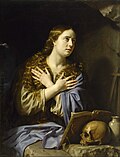 Mary MagdaleneEqual-to-the-Apostles · MyrrhbearerJul 22
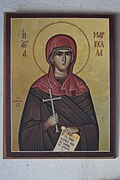 Markella of ChiosMartyr · Maiden of ChiosJul 22
- Cyril of AntiochSaint · Bishop of AntiochJul 22
- Cyprian of SuzdalFool-for-ChristJul 22
- Ilie LăcătușuConfessorJul 22
- Alexis IlinskyHieromartyrJul 22
- CaemhogSaintJul 22
- Dabhaetog of Cluain da BhaetogSaintJul 22
- DabiusSaintJul 22
- Harduin of FontenelleVenerableJul 22
- JosephConfessor · Count of ScythopolisJul 22
- LuighbeSaintJul 22