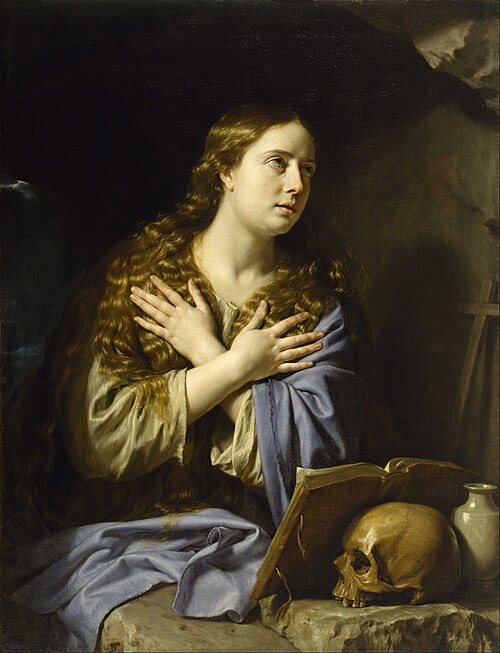
Equal-to-the-Apostles
Mary Magdalene
Myrrhbearer
A woman healed by Christ who followed Him and witnessed the Crucifixion and the Resurrection.
- Feast
- July 22old style August 4
- Era
- 1st century
- Place
- Ephesus
Life
Saint Mary Magdalene, myrrh-bearer and equal to the Apostles, was one of the women who followed Christ and served Him. She stood by the Cross, came first to the tomb on the morning of the Resurrection, and was the first to whom the risen Lord appeared. For this reason the Church honours her as the one who announced the Resurrection to the Apostles themselves.
Healing and discipleship
She came from Magdala, a town on the shore of the Sea of Galilee. The Gospel of Luke says that the Lord cast seven demons out of her, and from that moment she followed Him, together with Joanna the wife of Chuza, with Susanna and with other women, serving Him out of their own means. The Evangelists almost always name her first among the women who were with Christ, a sign that she stood out among them.
The Church of the East does not identify her with the sinful woman who anointed the Lord's feet in the house of Simon the Pharisee, nor with Mary of Bethany, the sister of Lazarus. The merging of these figures, and the picture of the Magdalene as a repentant sinner, arose later in the West. The Orthodox hymns call her a myrrh-bearer, not a penitent.
At the Cross and at the tomb
When the disciples fled, Mary Magdalene remained by the Cross with the Mother of God and John. She saw how Joseph and Nicodemus laid the Lord's body in the tomb. After the rest of the Sabbath she went in the dawn, while it was still dark, to anoint the body with spices. Finding the stone rolled away, she ran to tell Peter and John.
Left alone by the tomb, she wept and saw two angels in white. Turning, she saw someone whom she took for the gardener. When the Lord called her by name she knew Him and cried "Rabboni", that is, Teacher. Christ told her to go to His brethren and say that He was ascending to His Father and their Father. She went and announced, "I have seen the Lord". This is the first preaching of the Resurrection, and it was made to the Apostles themselves.
After the Resurrection, according to Tradition
Scripture says no more of her, but the Acts of the Apostles shows the women praying with the Apostles and the Mother of God. According to Tradition, Mary Magdalene went as far as Rome to proclaim the Gospel. The synaxarion tells that she came before the Emperor Tiberius, brought him a red egg as a sign of new life, said "Christ is risen", and spoke to him of the unjust condemnation of the Lord. From this account the custom of Paschal eggs is traditionally derived. The synaxarion adds that Paul names a Mary who laboured much for the Christians of Rome (Romans 16:6), and that she stayed in Rome until Paul came.
The same Tradition says that, in old age, she went to Ephesus, to the Apostle John, where she reposed in the Lord. She was buried at the entrance of the cave in which the Seven Youths of Ephesus later fell asleep. Bishop Gregory of Tours, in the sixth century, also records her burial at Ephesus.
Relics and veneration
According to the synaxarion, her relics were moved in the ninth century to Constantinople and placed in the monastery church of Saint Lazarus. In the time of the Crusades a part reached Italy and Rome, under the altar of the Lateran church. The West also keeps another tradition, which takes her to southern France, where part of her relics is said to rest, at Marseilles and Vézelay. The Greek synaxarion mentions these places only as holding fragments of relics.
Today her left hand is kept at the Simonopetra Monastery on Mount Athos, her right hand at Dionysiou, and part of her left foot at Esphigmenou, according to the Greek synaxarion. She is commemorated on 22 July, and on the Sunday of the Myrrh-bearers, the third Sunday after Pascha, the Church remembers her with the other myrrh-bearing women. The troparion of the day praises her for following the commandments of Christ, born of the Virgin.
Commemorated the same day July 22
 Markella of ChiosMartyr · Maiden of ChiosJul 22
- Cyril of AntiochSaint · Bishop of AntiochJul 22
- Cornelius of PereslavlVenerable · the SilentJul 22
- Cyprian of SuzdalFool-for-ChristJul 22
- Ilie LăcătușuConfessorJul 22
- Alexis IlinskyHieromartyrJul 22
- CaemhogSaintJul 22
- Dabhaetog of Cluain da BhaetogSaintJul 22
- DabiusSaintJul 22
- Harduin of FontenelleVenerableJul 22
- JosephConfessor · Count of ScythopolisJul 22
- LuighbeSaintJul 22