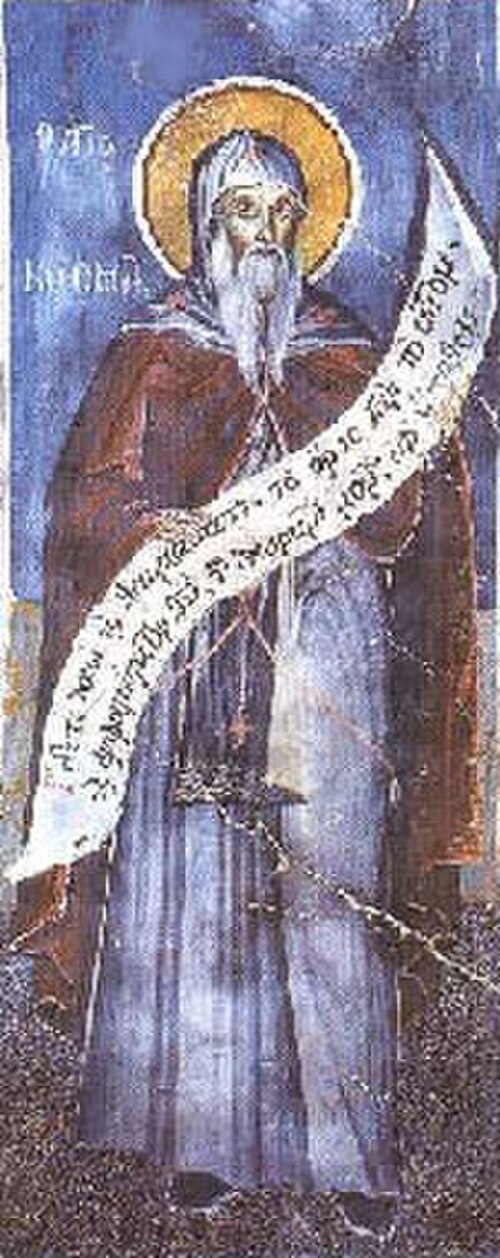
Saint
Cosmas the Melodist
Bishop of Maiuma
Bishop of Maiuma and hymnographer of the Eastern Church, who died in the eighth century.
- Feast
- October 12old style October 25
- Reposed
- 7608th century
- Place
- Maiuma
- Order
- Hierarchs
Life
Saint Cosmas the Melodist, bishop of Maiuma and hymnographer, lived in the eighth century. The Church honours him as one of the greatest poets of liturgical song, together with his adoptive brother, Saint John of Damascus. His canons, among them the canon of the Nativity and those of Holy Week, are sung at the services to this day. He is commemorated on 12 October, and in the Greek Church on 14 October.
Youth and monastic life
The sources do not agree on his birthplace: some say Jerusalem, others Damascus. Orphaned young, he was adopted by Sergius Mansur, the father of John of Damascus, a high official of the caliph, and grew up as John's brother. The two had the same teacher, a learned monk named Cosmas, from Calabria or Sicily, whom Sergius had ransomed from slavery. Together they studied theology, literature, mathematics, philosophy, astronomy, music and above all Holy Scripture.
Cosmas and John left Damascus for Jerusalem and entered the lavra of Saint Sabbas the Sanctified, where they lived as monks in the time of the iconoclast disputes. Together they defended the Church against the heresy of the image-breakers. In 743 Cosmas was elected bishop of Maiuma, the port of Gaza, in 735 or 745 according to some sources. He outlived John by many years and his end came in great old age. The year of his repose is not known with certainty; 740 or 750, 760, 773 and 794 are given.
Works
Cosmas wrote commentaries on the poems of Saint Gregory of Nazianzus. He became better known as a poet, however, he and John of Damascus being considered the greatest representatives of the later Greek hymnography, whose artistic liturgical chants are called canons. They worked together on the compilation of the Octoechos.
To him are attributed the canons of Matins for Lazarus Saturday and Palm Sunday, the three-ode canons of Holy Week, the first canon of the Nativity (Christ is born, glorify Him), and canons for Theophany, the Transfiguration, the Meeting of the Lord, the Dormition of the Mother of God, the Exaltation of the Holy Cross, the Entry into Jerusalem and other feasts. The liturgical books ascribe fourteen canons to him in all, and tradition also ascribes to him More honourable than the cherubim, sung at Matins, at the Liturgy and at other services. His hymns were first written for the services of the Church of Jerusalem, but through the influence of Constantinople they came into universal use. It is not certain that all the hymns put under his name are his, especially since his teacher of the same name was also a hymn writer.
The Church calls him a vessel of divine grace and the glory of the Church.
Commemorated the same day October 12
 Edwin of NorthumbriaRight-Believing · King of NorthumbriaOct 12
 Maximilian of LorchHieromartyr · Bishop of CeleiaOct 12
 Domnina of AnazarbusMartyrOct 12
 Michael KrasnotsvetovHieromartyr · PriestOct 12
 EdistusMartyrOct 12
 Tarasius of GlushitsaVenerable · Abbot in the Vologda regionOct 12
- Theodosius of GlushitsaVenerableOct 12
 Nicholas MogilevskyConfessor · Metropolitan of Alma-AtaOct 12
- 4966 Martyrs of AfricaHoly MartyrsOct 12
- 70 MartyrsHoly MartyrsOct 12
- AedhanSaintOct 12
- Alexander PozdeevskyHieromartyrOct 12