Martyr
Crescentian of Rome
A martyr of Rome, who died around the year 310.
Life
Holy Martyr Crescentian of Rome was one of the martyrs who suffered at Rome in the persecution of Diocletian and Maximian (284-305) and of their successors Galerius (305-311) and Maxentius (305-312), together with the holy hieromartyr Marcellus, pope of Rome. The Azbyka page honours them all together and speaks of Crescentian only as a prisoner who died under torture with Cyriacus, Smaragdus and Largus.
The emperor Maximian, who ruled the western part of the empire, stripped Christians of their military ranks and sent them to forced labour. A rich Christian, Thrason, began to send food and clothing to the prisoners through the Christians Sisinnius, Cyriacus, Smaragdus and Largus. Pope Marcellus thanked him for his good deeds, and ordained Sisinnius and Cyriacus deacons. Soon, while helping the prisoners, Sisinnius and Cyriacus were seized and sent to labour. They did not only their own quota but also worked in place of the elderly prisoner Saturninus, and for this Maximian gave Sisinnius over to torture by the governor of the region, Laodicius. The saint was imprisoned. The prison's chief, Apronian, summoned Sisinnius for interrogation but, seeing his face shine with heavenly light, believed in Christ and was baptized, then received with Sisinnius chrismation from Pope Marcellus, who gave them communion after the Liturgy. On the same day, 7 June, Sisinnius and Saturninus, accompanied by Apronian, stood before Laodicius. Apronian confessed himself a Christian and was beheaded, and Sisinnius and Saturninus were thrown into prison. Laodicius then ordered them taken to a pagan temple to sacrifice. Saturninus said: "May the Lord turn the pagan idols to dust", and at once the tripods on which incense burned before the idols melted. Seeing the miracle, the soldiers Papias and Maurus confessed Christ. After long torments Sisinnius and Saturninus were beheaded, and Papias and Maurus were shut in prison, praying to be enlightened by holy Baptism, which the Lord allowed them; leaving the prison unnoticed, they received Baptism from Pope Marcellus and returned to the prison. At the trial they again confessed themselves Christians and died in terrible torments. Their bodies were buried by the presbyter John and Thrason.
Cyriacus, Smaragdus, Largus and the other Christian prisoners were worn out further by labour. The youngest daughter of Diocletian, Artemia, was tormented by an unclean spirit. Learning that the prisoner Cyriacus healed diseases and cast out demons, the emperor summoned him to the sick girl. Casting out the demon, Cyriacus baptized Artemia. As a reward, the emperor freed Cyriacus, Smaragdus and Largus. Soon he sent Cyriacus to Persia to heal the daughter of the Persian king. On his return to Rome the saint was seized by command of the emperor Galerius, son-in-law of Diocletian, who was angry with his predecessor over Artemia's turning to Christianity. He ordered Cyriacus, naked and in chains, to be led behind his chariot for the shame and laughter of the crowd. Pope Marcellus publicly rebuked the emperor for his cruelty to innocent Christians, and the emperor ordered him beaten with rods and made a cattle-keeper. The saints Cyriacus, Smaragdus, Largus and one more prisoner, Crescentian, died of the tortures. At that time Artemia and twenty-one other prisoners in the prison of Cyriacus were also put to death.
Pope Marcellus was secretly freed by the Roman clergy. He dug up the bodies of the martyrs Cyriacus, Smaragdus and Largus and buried them on the estate of two Christian women, Priscilla and Lucina, near Rome, turning Lucina's house into a church. Maxentius, who took the throne, ordered the church destroyed and turned into a cattle yard, and sentenced the holy pope to follow cattle for life. Worn out by hunger, cold and stench, Pope Marcellus fell ill and died in 310. The holy women Priscilla and Lucina were driven out of Rome in disgrace, and their estates plundered.
Saint Crescentian is commemorated on 20 June, in the new style. Their passion is also found in the Lives of the Saints by Saint Dimitry of Rostov.
Commemorated the same day June 7
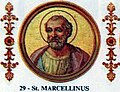 Marcellinus of RomeSaint · Bishop of RomeJun 7
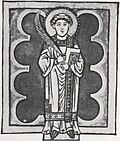 Cyriacus of RomeHieromartyr · Deacon of RomeJun 7
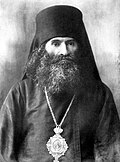 Andronik of PermHieromartyr · Archbishop of PermJun 7
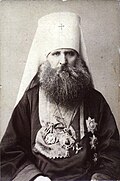 Joannicius RudnevSaint · Metropolitan of Kiev and GaliciaJun 7
 Daniel of ScetisVenerableJun 7
 Paisios BasiasVenerableJun 7
- Benjamin LukaninHieromartyr · PriestJun 7
- Abramius of KozheozeroVenerableJun 7
- Alexander MakhetovHieromartyrJun 7
- Alexander OsetrovHieromartyrJun 7
- Alexander PreobrazhenskyHieromartyrJun 7
- Alexander ZuevMartyrJun 7